The Ultimate Guide to Drupal on AWS: Architecture, Orchestration, and Scaling Strategies
The Ultimate Guide to Drupal on AWS
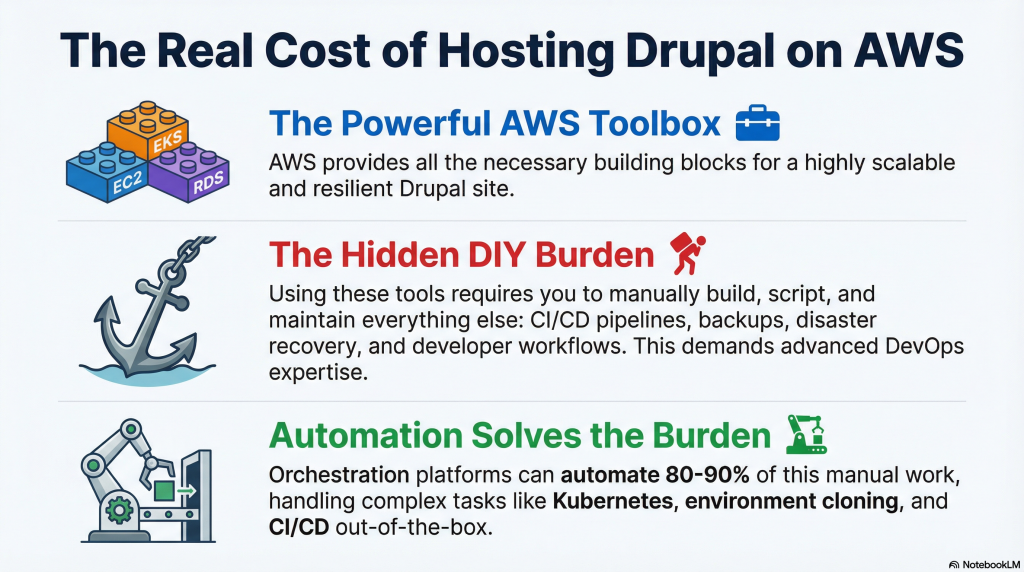
Launching and maintaining Drupal on AWS offers maximum flexibility and scalability, but most approaches require a heavy operational and DevOps burden1. While AWS provides the “infrastructure bricks,” wiring them together—from initial setup through ongoing SDLC management—is often a manual, high-friction process.
Why Architecture Choice Matters in 2025
In the modern web landscape, your choice of architecture dictates more than just uptime; it defines your team’s velocity, your security posture, and your total cost of ownership. As we look at the requirements for 2025, the gap between “running a site” and “managing a digital platform” has widened.
[VIDEO] Why Architecture Choice Matters: YouTube Explainer
Drupal on AWS: Pros, Cons & Trade-Offs Across Every Hosting Path
In this explainer, we visualize the flow of traffic across different AWS configurations and why the “hidden” costs of manual maintenance often outweigh the initial speed of setup.
Key Methods Compared: Finding Your Best Fit
Every major method to run Drupal on AWS comes with distinct operational realities. Below is the breakdown of the most common paths:
- Manual / Self-Managed EC2: Deploying virtual machines and installing the LAMP/LNMP stack manually. This offers maximum flexibility but carries the highest maintenance overhead, as you must handle all OS patches, PHP updates, and security configurations yourself.
- AWS Marketplace Images: Using pre-built AMIs from vendors like Bitnami. These are incredibly fast for evaluation but are typically limited to single-server setups, making them unsuitable for high-traffic production environments.
- AWS Lightsail: A one-click VPS for simplified hosting. While easy and predictable in cost, it is not appropriate for enterprise workflows or multi-user CI/CD pipelines.
- AWS Reference Architecture: The gold standard for high availability, utilizing Multi-AZ RDS, Auto Scaling Groups, and EFS. This provides best-in-class scale but requires advanced DevOps architects to wire and maintain all layers.
- Containerized Drupal (ECS/EKS): Using Docker on ECS (Fargate) or Kubernetes (EKS). EKS offers maximum flexibility and cloud portability but involves a massive maintenance burden, requiring expert-level Kubernetes skills.
- DevPanel Orchestration: A modern DevOps-driven platform that runs in your own AWS account. It automates the entire Drupal SDLC—including dev, stage, prod, and preview environments—reducing manual work by 80–90%.
Deep Dive: Operational Realities and the “Hidden” Work
The real challenge of Drupal on AWS isn’t the initial deployment; it’s the ongoing management18. Traditional AWS-native approaches require you to build and script your own solutions for every step of the development lifecycle19.
[PODCAST] The Truth About Operating Drupal on AWS
How DevPanel Automates the Drupal SDLC Inside Your AWS Account
Listen to our experts discuss the “day-two” operations that catch many teams off guard, from EFS performance tuning to managing cross-region disaster recovery.
Operational Responsibility Matrix
To understand what you are signing up for, consider who handles the following:
- Patches & Updates: On EC2 or EKS, this is your responsibility. On DevPanel, this is automated or opt-in.
- Scaling & Uptime: Manual methods require you to script Auto Scaling Groups; DevPanel abstracts this complexity.
- CI/CD Pipelines: With AWS alone, you must build your own pipelines (via CodePipeline or GitHub Actions). DevPanel provides these out-of-the-box.
Strategic Recommendations: Scaling Your Success
Choosing the right path depends on your team’s size and technical maturity:
- Agencies & High-Growth Teams: DevPanel is recommended for its ability to automate multi-site orchestration and preview environments at scale.
- Enterprise-Level Projects: For projects requiring 24/7 support and high-traffic resilience, the AWS Reference Architecture or DevPanel-managed EKS provides the necessary audit trails and disaster recovery.
- Prototyping: Lightsail or Marketplace AMIs remain the best fit for quick proof-of-concepts.
[SLIDES] Strategy Cheat Sheet: PDF Slide Deck
Drupal_on_AWS_Automation_The_Control_You_Need.pdf
Download our comparison slides to help your team visualize the pros, cons, and skill requirements for each AWS deployment method.