
The Future of Managed Hosting Is Customer-Owned Cloud
Managed hosting became popular for a good reason: it made infrastructure easier.
Organizations could launch websites and applications without hiring a full cloud team. The hosting provider handled servers, databases, SSL, backups, patches, scaling, and support. For many teams, that convenience was exactly what they needed.
But the market has changed.
Strategic buyers now want more than convenience. They want control. They want infrastructure ownership. They want data sovereignty. They want direct cloud access. They want the ability to customize, scale, secure, and integrate without waiting on a hosting provider’s roadmap.
At the same time, they do not want to go backward into raw cloud complexity.
That is why the future of managed hosting is customer-owned cloud.
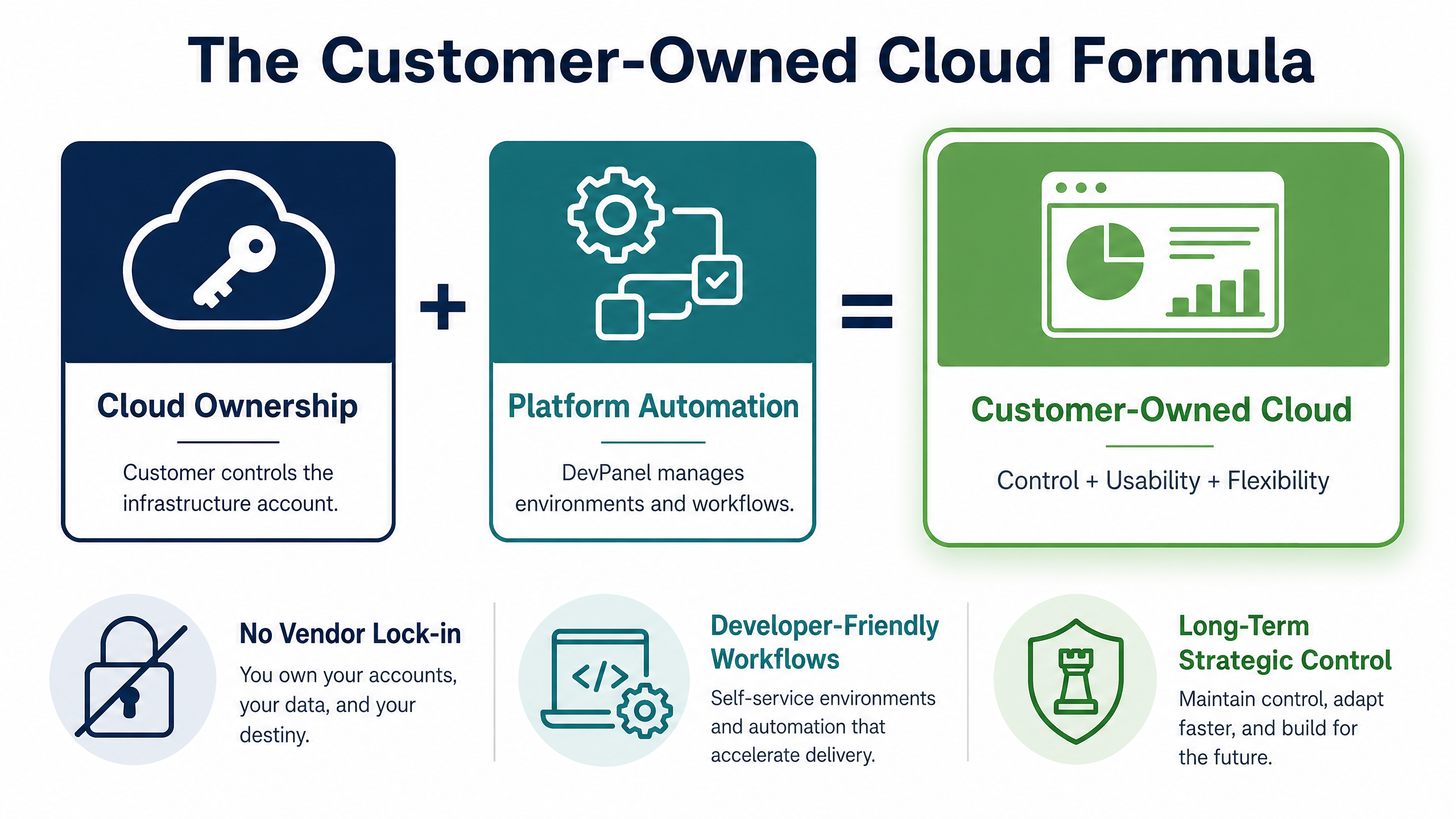
Customer-owned cloud gives organizations the best parts of public cloud ownership while keeping the automation and usability that made managed hosting valuable in the first place. Instead of choosing between vendor-controlled hosting and unmanaged AWS or Azure, organizations can own their infrastructure and use DevPanel as the control layer that makes it usable.
The next phase of managed hosting is not just managed convenience.
It is ownership plus automation.
What Is Customer-Owned Cloud?
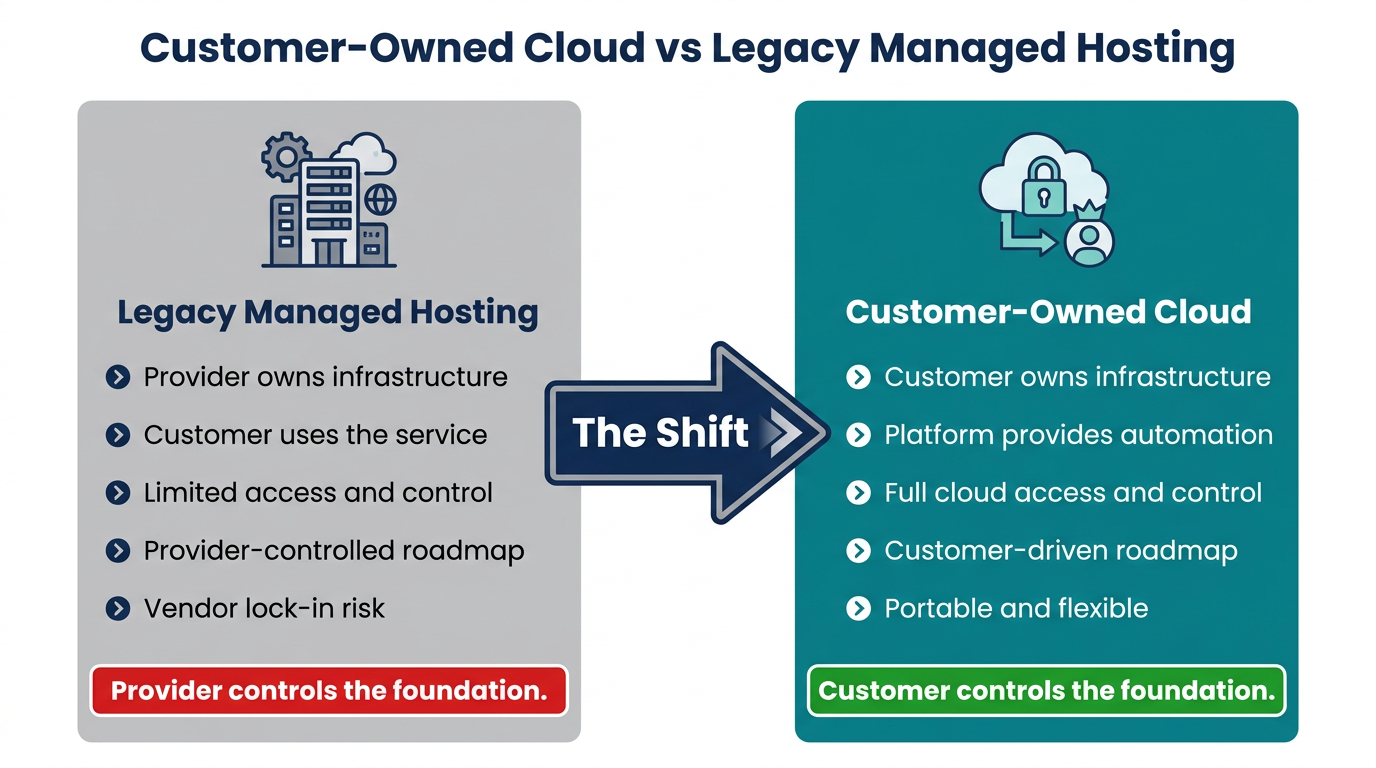
Customer-owned cloud means the customer owns the cloud infrastructure where the applications run.
The infrastructure may live in the customer’s AWS, Azure, DigitalOcean, or other cloud account. The customer controls the account, the data, the architecture, the access model, and the long-term infrastructure strategy.
But the customer does not have to manage every technical detail manually.
A platform like DevPanel sits on top as the control layer. DevPanel helps teams create environments, manage applications, automate workflows, support developers, deploy changes, handle infrastructure operations, and make the cloud usable without requiring every team member to become a cloud expert.
That is the key difference.
In legacy managed hosting, the provider owns and controls the hosting environment.
In customer-owned cloud, the customer owns the infrastructure, and the platform provides the automation.
This model matters because serious organizations increasingly need both control and convenience.
They want to own the foundation, but they also want a platform that removes the day-to-day operational burden.
Why Legacy Managed Hosting Worked
Legacy managed hosting solved real problems.
Most organizations did not want to manage Linux servers, database tuning, container orchestration, security patches, load balancers, backups, and DNS workflows. They wanted a reliable place to run their websites and applications.
Managed hosting gave them that.
It simplified deployment. It reduced operational responsibility. It gave teams a support channel. It made web operations more predictable.
For many companies, nonprofits, agencies, and institutions, managed hosting was a major improvement over unmanaged servers.
The problem is not that managed hosting was bad.
The problem is that many managed hosting models were built around provider-owned infrastructure.
That model works when the customer’s needs fit neatly inside the provider’s system. It becomes limiting when the customer needs more control, more flexibility, more scale, or more cloud-native integration.
Where Traditional Managed Hosting Starts to Break
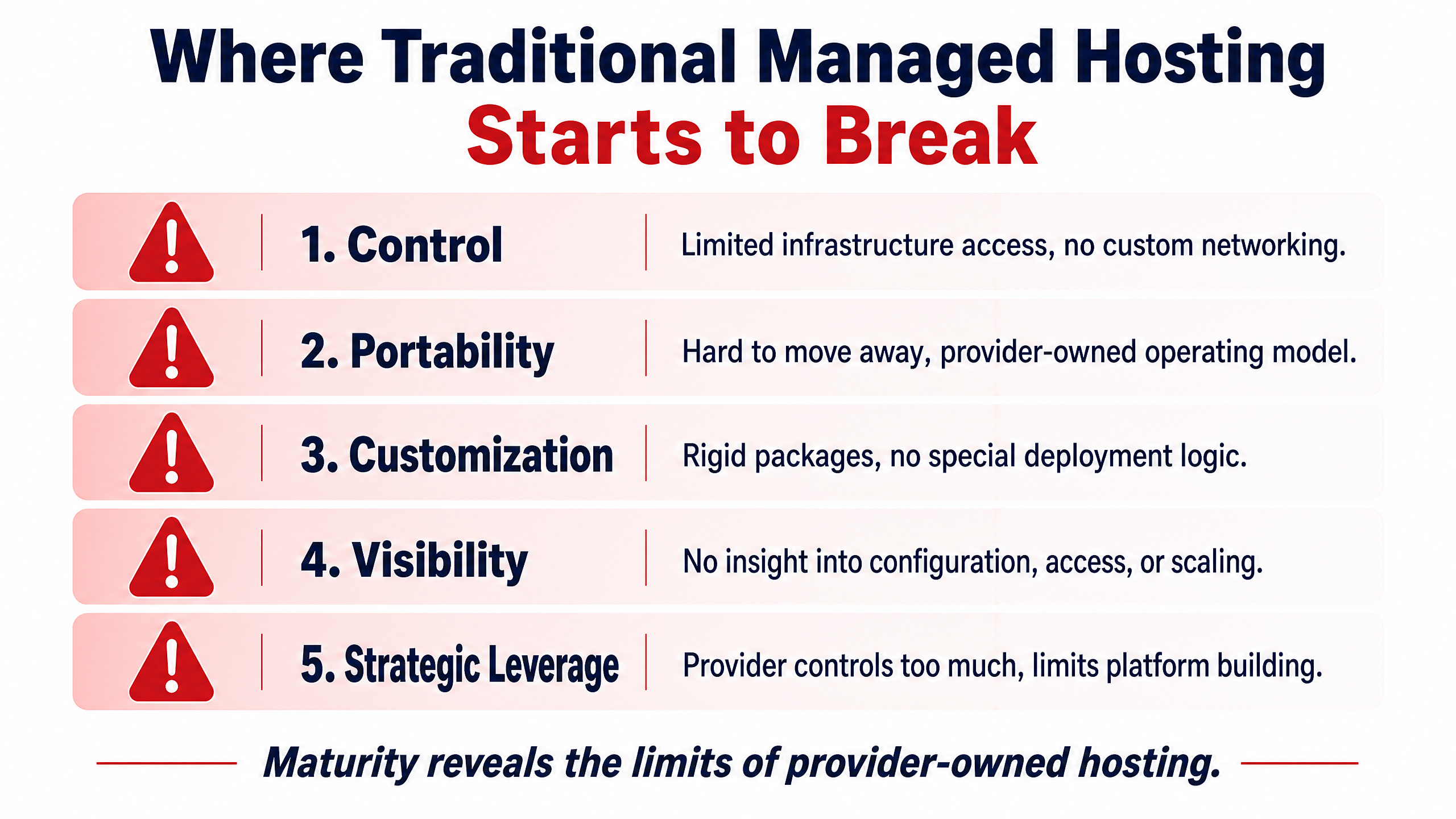
Traditional managed hosting often starts to feel restrictive when organizations mature.
The first issue is control. Many managed hosting platforms limit infrastructure access. That may be acceptable for a simple site, but it can become a problem when an organization needs custom networking, special security controls, direct cloud service integrations, or deeper performance tuning.
The second issue is portability. If the infrastructure, tooling, and environment are tightly controlled by the hosting provider, moving away can become painful. The customer may own the code and data, but not the operating model.
The third issue is customization. Every serious organization eventually has needs that do not fit the default hosting package. They may need a different caching architecture, a private network connection, special deployment logic, compliance-specific logging, or integration with existing cloud systems.
The fourth issue is visibility. Strategic buyers want to know how their infrastructure is configured, who can access it, how it scales, how it is secured, and how it can recover.
The fifth issue is strategic leverage. If the hosting provider controls too much of the environment, the customer has less ability to build new digital products on top of the infrastructure.
This is where customer-owned cloud becomes a better model.
It preserves the value of managed operations while giving the customer more ownership over the foundation.
Cloud Sovereignty Is Becoming a Business Issue
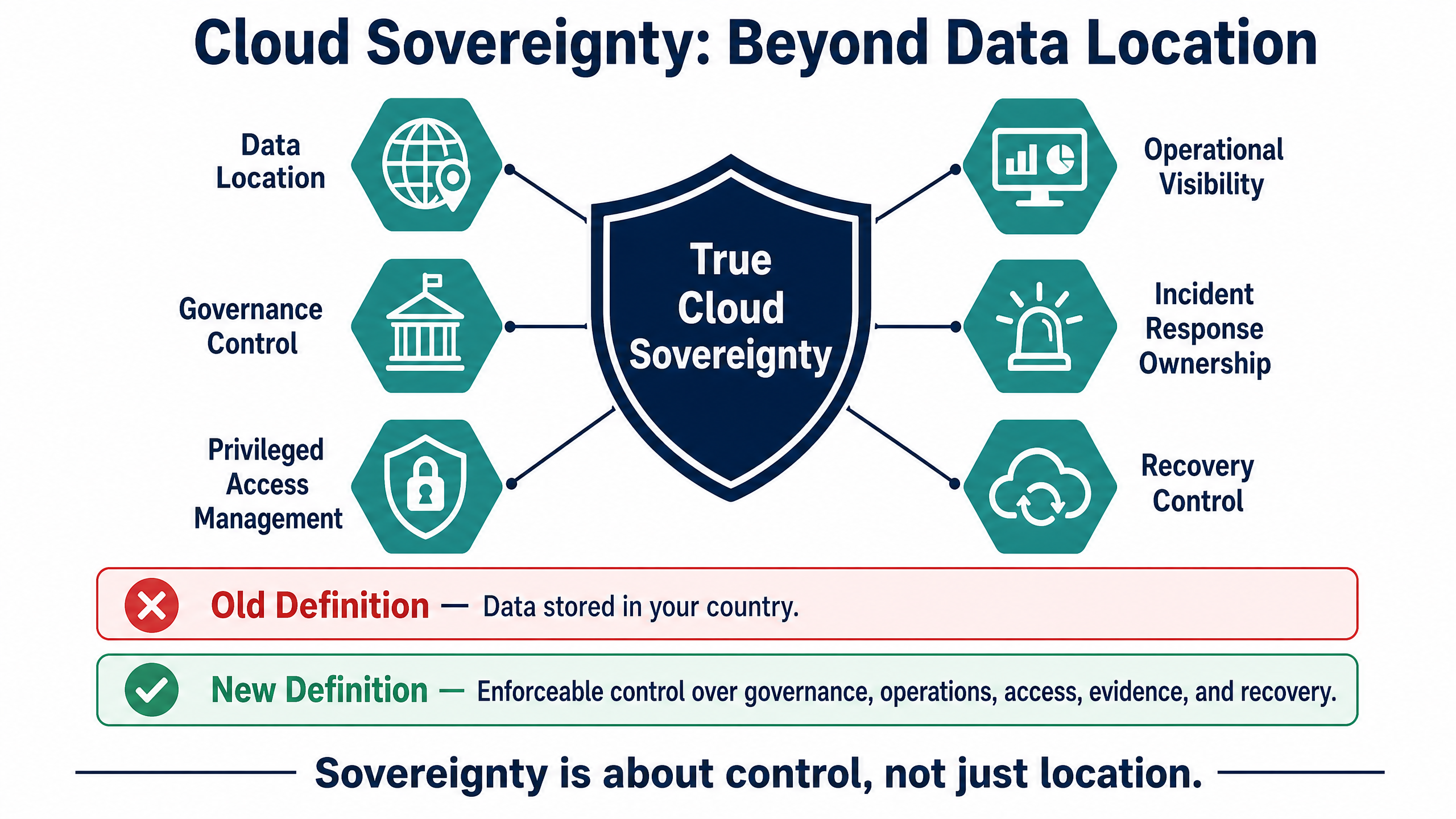
Cloud sovereignty is no longer only a government issue.
It is increasingly relevant to enterprises, universities, healthcare organizations, nonprofits, media companies, and agencies serving regulated clients.
A 2026 paper on cloud sovereignty argues that sovereignty cannot be defined only by where data is stored. It also needs to include enforceable control over governance, operations, privileged access, evidence, recovery, observability, and incident response across cloud systems.
That shift is important.
A customer may technically have access to data, but still lack meaningful control over the infrastructure model, security operations, recovery process, or architectural choices.
Customer-owned cloud gives organizations a stronger answer.
The infrastructure belongs to the customer. The cloud account is under the customer’s control. The platform layer helps operate it, but the customer is not trapped inside a black-box hosting environment.
For strategic buyers, that difference matters.
Ownership Alone Is Not Enough
Customer-owned cloud does not mean “just move everything into AWS and figure it out.”
That would create a different problem.
AWS, Azure, and other clouds are powerful, but they are also complex. Teams need to think about networking, Kubernetes, databases, object storage, secrets, access control, load balancing, backups, monitoring, logging, scaling, CI/CD, and security.
Owning the cloud account is useful, but without automation, it can become a burden.
This is why platform engineering has become important. Modern platform engineering focuses on reusable workflows, internal platforms, automation, policy enforcement, and self-service delivery for developers. Recent platform engineering guides describe internal developer platforms as more than portals; they include orchestration, infrastructure-as-code execution, pipeline automation, policy enforcement, and cost controls.
That is the missing layer between raw cloud and managed hosting.
Strategic teams do not want unmanaged cloud. They want cloud ownership with a platform that makes it usable.
That is where DevPanel fits.
DevPanel as the Control Layer
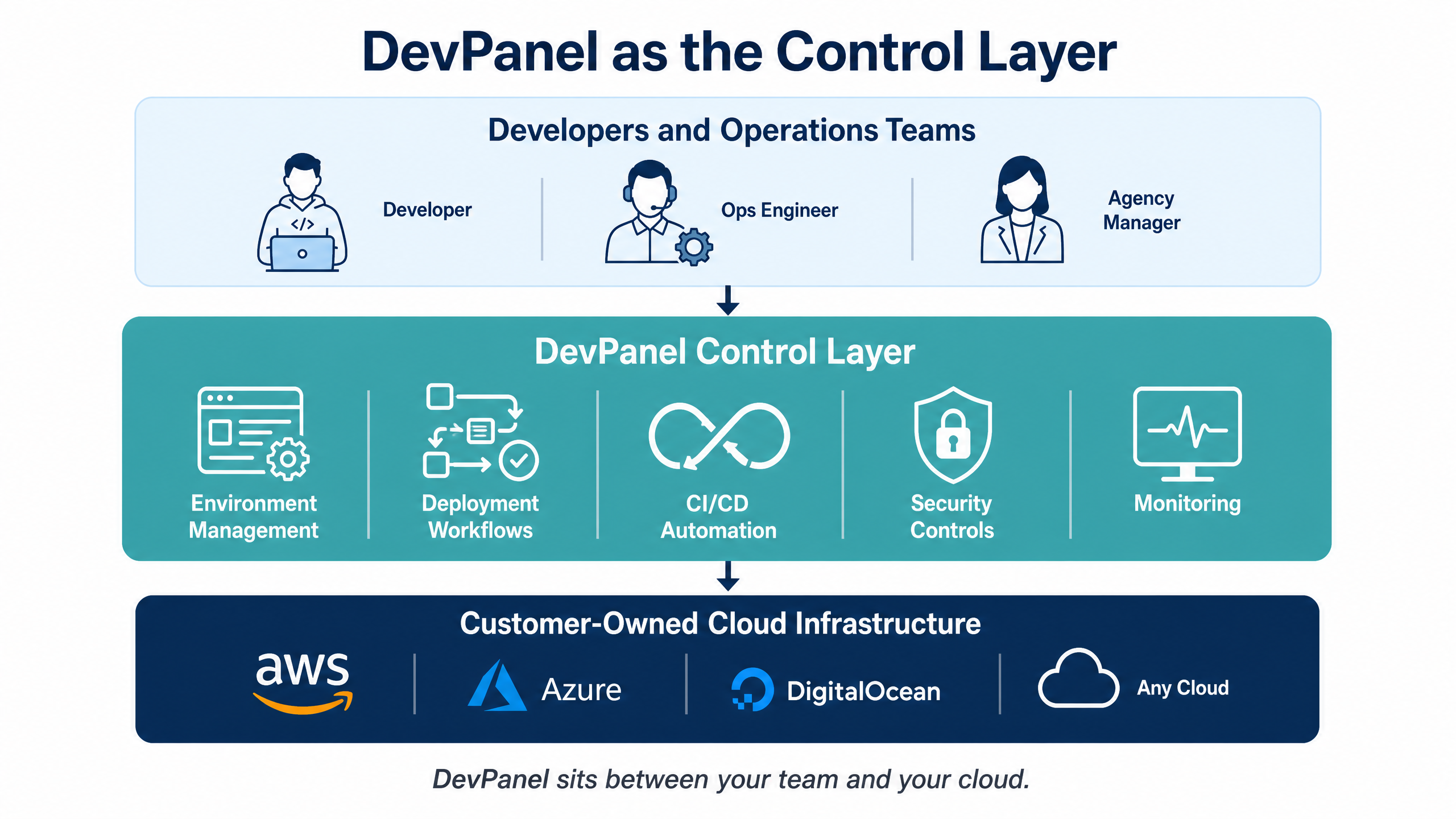
DevPanel is the control layer for customer-owned cloud.
It gives organizations a way to manage applications, environments, development workflows, and cloud operations on infrastructure they control.
Instead of forcing the customer into a provider-owned hosting environment, DevPanel can help teams run on their own AWS, Azure, DigitalOcean, or cloud infrastructure. That gives customers more control while still giving developers and operations teams a simpler interface.
DevPanel helps bridge the gap between two extremes.
On one side is legacy managed hosting, where the provider controls the environment.
On the other side is raw cloud, where the customer controls everything but must manage every detail.
DevPanel creates a third path: customer-owned cloud with automation.
The customer owns the infrastructure. DevPanel makes it manageable.
Why Strategic Buyers Want Customer-Owned Infrastructure
Strategic buyers think beyond the first launch.
They ask questions like:
What happens if traffic doubles?
What happens if compliance requirements change?
What happens if we need a custom integration?
What happens if we need direct access to logs or infrastructure?
What happens if we need to move providers?
What happens if we want to build a platform, not just host a website?
Customer-owned cloud gives better answers to those questions.
The organization can design around its long-term needs. It can integrate with its existing cloud systems. It can apply its own security policies. It can decide how infrastructure should scale. It can use cloud-native services directly when needed.
That does not mean every organization wants to manage infrastructure manually.
It means the organization wants the option to control its infrastructure when it matters.
DevPanel provides the operating layer that makes that control practical.
The VOA Example: Customer-Owned Cloud at Serious Scale
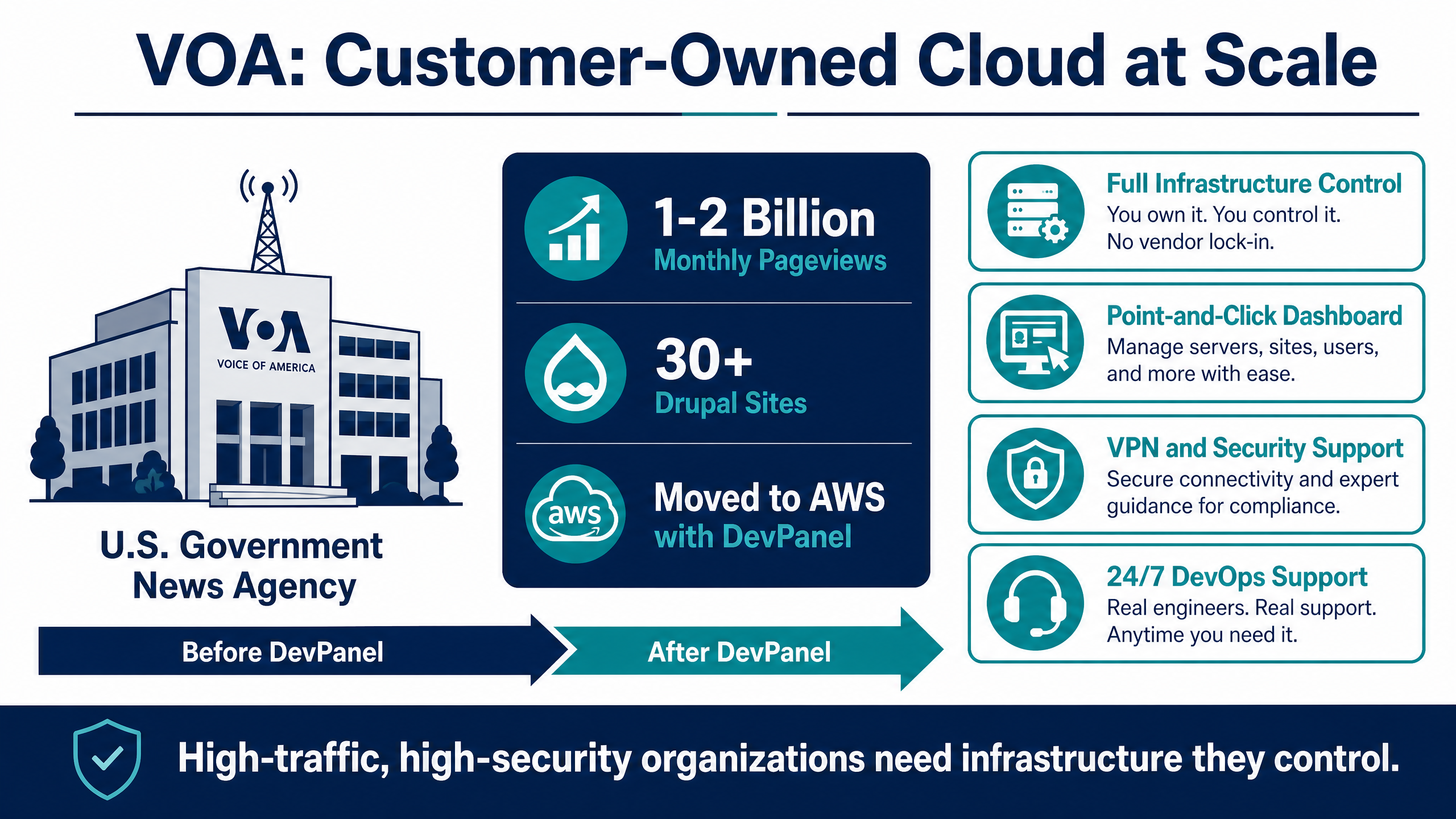
A U.S. government news agency provides a clear example of why customer-owned cloud matters.
The agency delivered 1 to 2 billion monthly pageviews across dozens of Drupal sites and was facing high hosting costs, limited technical flexibility, slow support, and development friction on its existing platform. It evaluated DevPanel as a way to move to AWS while keeping an easier management experience.
The critical point is not only cost.
The critical point is infrastructure control.
DevPanel could be deployed inside the agency’s own AWS account, giving the agency sovereignty over its infrastructure and data while still providing a point-and-click dashboard, browser-based development tools, AWS-native integration, VPN support, and hands-on DevOps support.
That is the customer-owned cloud model in practice.
The customer keeps control of the cloud account.
DevPanel provides the control layer.
For high-traffic, high-security, or high-visibility organizations, that model is more strategic than simply renting space inside someone else’s managed hosting environment.
The AMA Example: Ownership Without AWS Complexity

Customer-owned cloud is not only for huge enterprise teams.
The Academy of Model Aeronautics managed more than 30 websites across Drupal, Backdrop, and WordPress. The organization wanted the benefits of AWS, but did not have deep internal AWS expertise. Before DevPanel, even tasks like creating development or staging environments required coordination with external vendors.
With DevPanel, AMA migrated 30+ sites to AWS without needing to understand EKS, RDS, S3, networking, or load balancing. One person could manage what previously required multiple team members and outside help.
This is the practical value of customer-owned cloud.
The customer gains the benefits of cloud ownership, but DevPanel removes much of the operational complexity.
For smaller teams, that can be transformative.
They do not need to choose between vendor dependency and hiring a full cloud operations team.
They can own the infrastructure and use DevPanel to operate it.
The Kaplan Example: Customer-Owned Cloud for Regulated Workloads

Regulated workloads make the case even stronger.
Kaplan Early Learning Company needed to migrate a student portal to Microsoft Azure while maintaining HIPAA compliance. The project required development, testing, staging, and production environments; secure API endpoints; scalable architecture; backup and disaster recovery; and limited internal DevOps resources.
DevPanel provided automated Azure provisioning, HIPAA-compliant architecture, multi-environment management, security integration, and developer collaboration tools that allowed contractors to work without direct Azure access.
That is exactly the kind of situation where customer-owned cloud is valuable.
The customer can run in its own Azure environment while using DevPanel to simplify operations, standardize environments, and reduce cloud infrastructure burden.
For healthcare, education, government, and other regulated sectors, this combination of control and automation is often more valuable than traditional managed hosting.
The Future Is Ownership Plus Automation
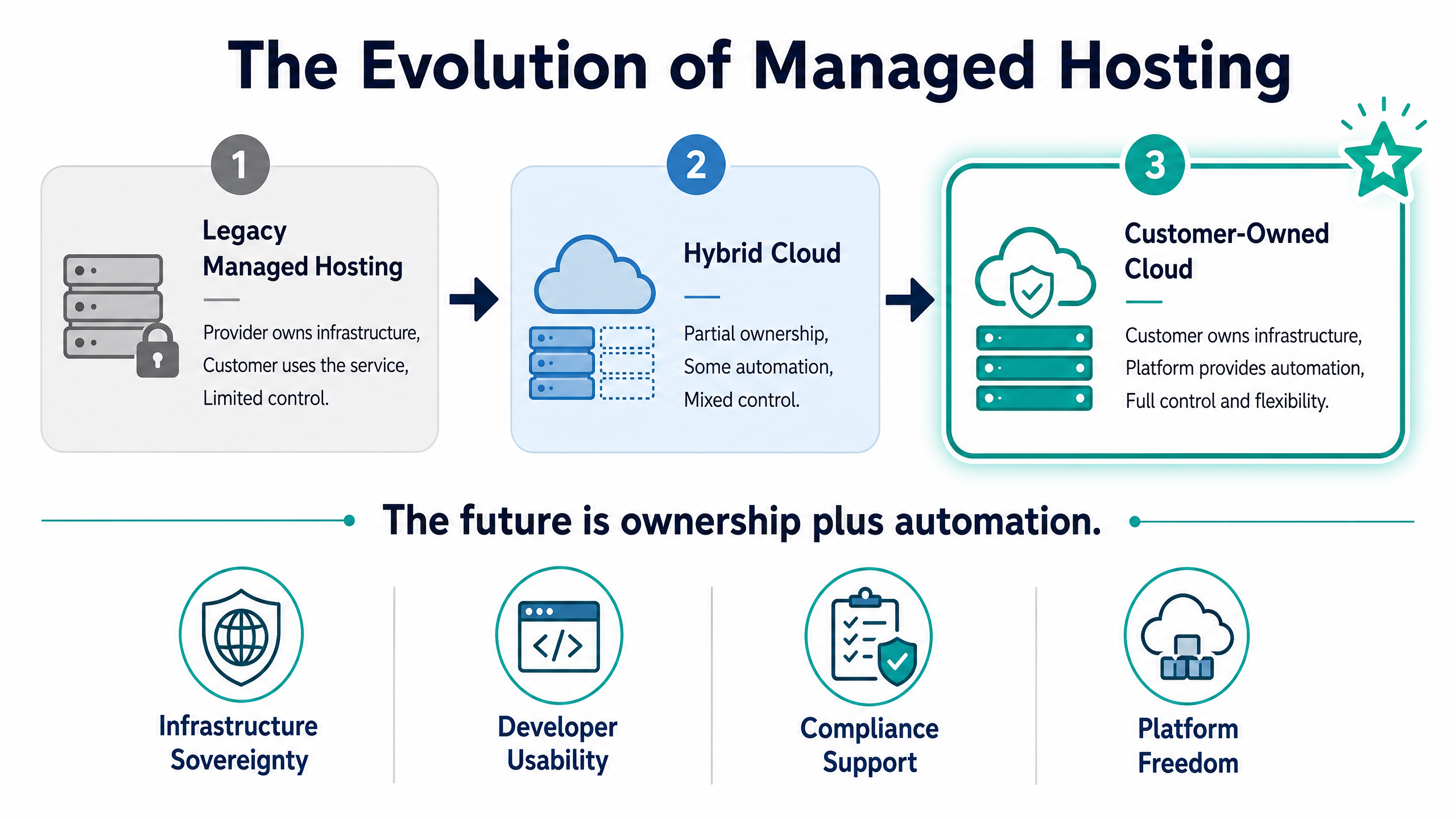
The future of managed hosting is not unmanaged cloud.
It is ownership plus automation.
Ownership gives the customer control.
Automation gives the team usability.
Together, they create a stronger model.
Legacy managed hosting says: “We own the infrastructure. You use the service.”
Customer-owned cloud says: “You own the infrastructure. We help you operate it.”
That difference changes the relationship between customer and provider.
The customer is no longer locked into a hidden infrastructure model. The provider becomes a platform partner, helping the customer use its own cloud more effectively.
This is better for strategic buyers because it supports long-term flexibility.
It is better for developers because they get repeatable environments and workflows.
It is better for operations teams because cloud complexity is standardized through a platform.
It is better for leadership because ownership, risk, and control are clearer.
Why Customer-Owned Cloud Supports Platform Building
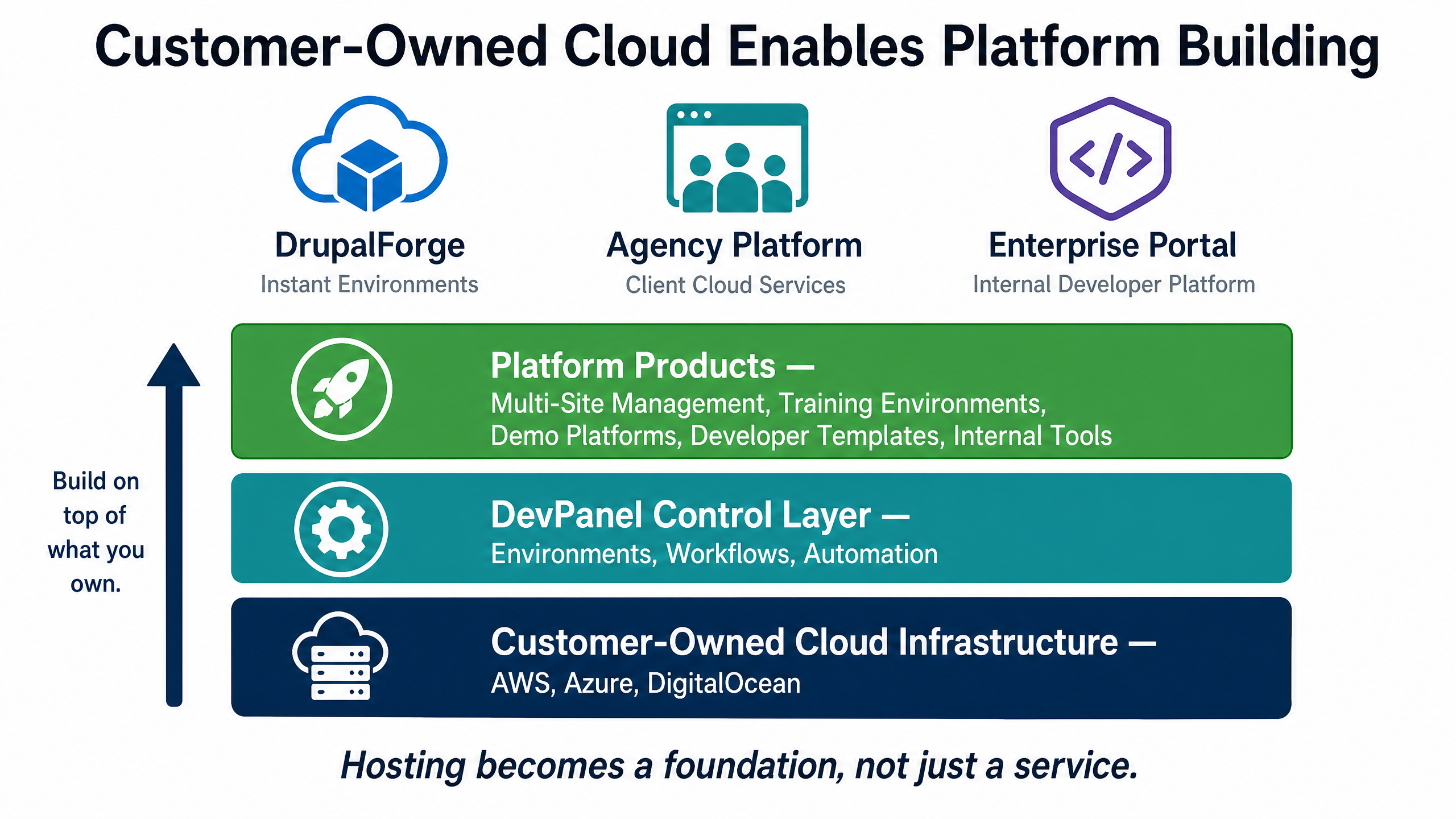
The strongest reason to care about customer-owned cloud is that it gives organizations a foundation they can build on.
A traditional hosting account may be enough for one site. But if the organization wants to manage many sites, launch templates, support training environments, build demos, create an internal developer platform, or productize cloud services, it needs more than hosting.
It needs a platform foundation.
DrupalForge is a useful example. DrupalForge was built on DevPanel as an auto-scaling, developer-friendly Drupal platform. It was designed to support instant, disposable development environments, training sessions, demos, development workflows, and site templates.
The case study notes that DrupalForge was built in four weeks, could scale from one to 1,000 sites in under 10 minutes, and could launch new Drupal development environments in about five seconds.
That is not just hosting.
That is platform building.
Customer-owned cloud makes this kind of platform strategy easier because the infrastructure can be treated as a foundation for new products and workflows, not just a place where one site happens to run.
Who Benefits From Customer-Owned Cloud?
Why Agencies Should Care
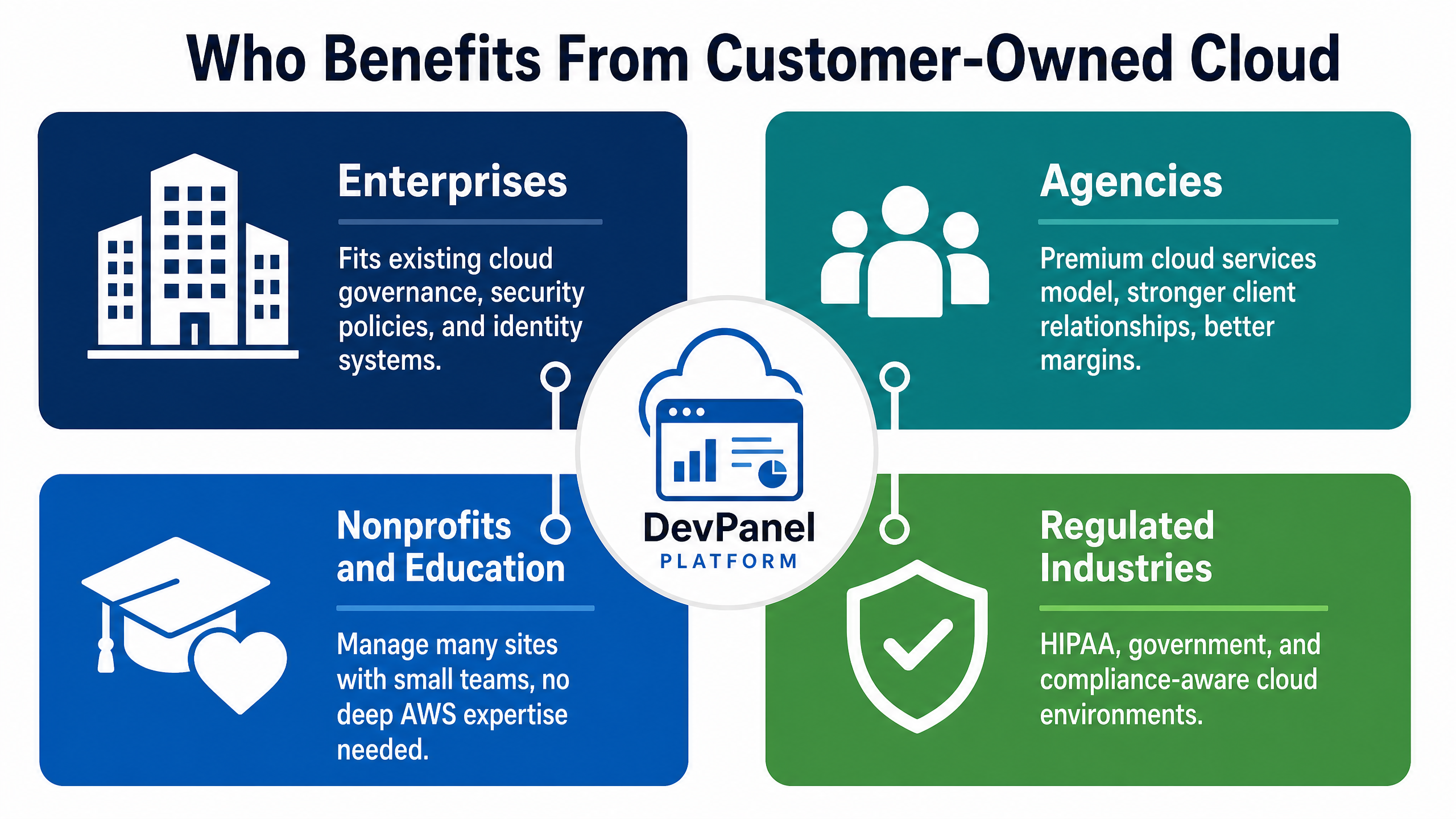
Agencies should care about customer-owned cloud because it gives them a more premium services model.
Many agencies currently resell hosting or manage client sites on third-party platforms. That can create recurring revenue, but it can also limit control and compress margins.
With customer-owned cloud, an agency can help clients run in their own AWS, Azure, or cloud account while using DevPanel to manage the operational layer.
This creates a stronger offer.
The agency can provide cloud strategy, governance, optimization, and platform operations, rather than just reselling a server.
This is much stronger than simply saying, “We host websites.”
The better message is: “We help you operate your own cloud with automation, governance, and expert support.”
Why Enterprises Should Care
Enterprises often already have cloud governance requirements.
They may already use AWS or Azure. They may already have procurement standards, security policies, identity systems, compliance expectations, and internal architecture rules.
Traditional managed hosting can conflict with those structures because the environment is controlled by the provider.
Customer-owned cloud fits enterprise governance better.
Applications can run inside approved cloud accounts. Security teams can maintain visibility. Developers can still get simplified workflows. Operations teams can standardize how environments are created and managed.
This is the model many strategic buyers are moving toward.
They do not want to abandon managed convenience.
They want managed convenience inside infrastructure they control.
Why Nonprofits and Education Teams Should Care
Customer-owned cloud is also important for nonprofits and education organizations.
These teams often have limited staff, sensitive data, multiple websites, and tight budgets. They need strong infrastructure, but they cannot always justify a large DevOps team.
DevPanel can make customer-owned cloud practical for these organizations.
AMA is the clearest example. With DevPanel, one person could manage more than 30 websites on AWS without needing deep AWS expertise.
For education and nonprofit teams, that kind of leverage matters.
It means they can modernize without becoming cloud infrastructure companies.
They can keep the benefits of ownership while relying on automation to reduce operational burden.
What to Look for in a Customer-Owned Cloud Platform
Strategic buyers evaluating customer-owned cloud should look for several capabilities.
They should look for multi-environment management, including dev, test, staging, and production.
They should look for cloud development tools, so developers can work without complex local setup.
They should look for deployment workflows, including CI/CD support and rollback options.
They should look for cloud provider flexibility, including support for AWS, Azure, DigitalOcean, or other infrastructure models.
They should look for security controls, access management, backups, monitoring, and support.
They should look for the ability to standardize templates and workflows.
Most importantly, they should look for a platform that gives the customer ownership without pushing all operational complexity back onto the customer.
That is the balance DevPanel is designed to provide.
Managed Hosting Is Evolving
Managed hosting is not disappearing.
It is evolving.
The old version of managed hosting was provider-owned infrastructure with a simplified customer interface.
The new version is customer-owned infrastructure with a powerful automation layer.
That is a better model for strategic buyers because it aligns with where cloud, compliance, developer experience, and platform engineering are going.
Sovereign cloud and platform engineering are growing because organizations want more control and more automation at the same time. The sovereign cloud market is projected to grow significantly through 2035 as organizations respond to data localization rules and demand more jurisdiction-controlled cloud infrastructure.
But sovereignty alone is not enough.
The winning model will be practical sovereignty: infrastructure ownership, platform automation, developer usability, and operational support.
That is customer-owned cloud.
Conclusion: The Future Belongs to Customer-Owned Cloud
Managed hosting became valuable because it made infrastructure easier.
But strategic buyers now need more than ease.
They need ownership.
They need control.
They need cloud flexibility.
They need compliance support.
They need developer workflows.
They need automation.
They need the ability to build on top of their infrastructure.
That is why the future of managed hosting is customer-owned cloud.
DevPanel makes that future practical.
It gives organizations a control layer for the cloud they own. It helps teams use AWS, Azure, DigitalOcean, and other infrastructure without manually managing every detail. It supports developers, agencies, nonprofits, enterprises, government teams, education organizations, and regulated industries that need more than commodity hosting.
The old model said:
“We own the infrastructure. You use the hosting.”
The new model says:
“You own the infrastructure. DevPanel helps you operate it.”