Featured image for blog post titled "11 Best Browser-Based Cloud IDE Features Teams Actually Need In 2026," showing a laptop with a collaborative cloud code editor.

11 Best Browser-Based Cloud IDE Features Teams Actually Need In 2026

Local dev environments used to be the only option, but they are now holding teams back. Shares.io reports saving 0.5 days per engineer per week after moving to standardized cloud development environments, which shows how much time traditional setups waste on configuration and troubleshooting. In this article, we explain what makes the best browser-based cloud…

Split screen illustration comparing two hosting methods. Left side: A stressed developer dealing with tangled wires and a chaotic whiteboard labeled "Manual DevOps (DIY)". Right side: A calm developer using a clean DevPanel dashboard labeled "Automation (DevPanel)". Main text reads: "Drupal on DigitalOcean: The Hidden Cost of Manual DevOps vs. The Power of DevPanel Automation

Drupal on DigitalOcean: The Hidden Cost of Manual DevOps vs. The Power of DevPanel Automation

Introduction: The Infrastructure Paradox For organizations deploying Drupal today, the challenge is rarely about code—it is about the infrastructure that supports it. DigitalOcean has democratized access to cloud computing, offering raw power like Droplets and Kubernetes at accessible price points. However, for Drupal teams, this accessibility creates a paradox: low infrastructure costs often mask high…

Here is the alt text for the image, optimized for both accessibility and SEO: ``` Infographic titled "DRUPAL ON AWS: ARCHITECTURE PITFALLS & BEST PRACTICES (2026 GUIDE)". The left side, colored red and labeled "PITFALLS", shows chaotic, tangled server wires and a broken rack next to a sad Drupal logo and AWS logo. The right side, colored blue and labeled "BEST PRACTICES", shows a clean, organized, and secure cloud server setup next to a happy Drupal logo and AWS logo. ```

Drupal on AWS: Architecture Pitfalls & Best Practices (2026 Guide)

🎧 Listen, Watch, & Learn Before diving into the architecture breakdown, explore the deep-dive research and multimedia discussions behind this guide. Key Takeaways (TL;DR) Why Your Drupal on AWS Architecture is Probably Wrong Hosting Drupal on Amazon Web Services (AWS) is far more complex than deploying a simple static application. A proper, production-grade setup is…

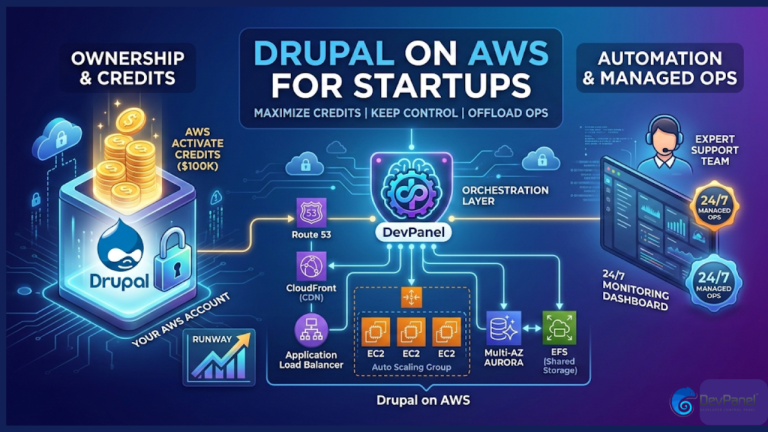
Diagram titled "The Ultimate Guide to Drupal on AWS" featuring the Drupal and AWS logos.

The Ultimate Guide to Drupal on AWS: Architecture, Orchestration, and Scaling Strategies

The Ultimate Guide to Drupal on AWS Launching and maintaining Drupal on AWS offers maximum flexibility and scalability, but most approaches require a heavy operational and DevOps burden1. While AWS provides the “infrastructure bricks,” wiring them together—from initial setup through ongoing SDLC management—is often a manual, high-friction process. Why Architecture Choice Matters in 2025 In…

Comparison of WordPress and AWS logos for cloud hosting deployment.

WordPress Deployment on AWS: The 2026 Comprehensive Expert Guide

Selecting the right architecture for WordPress deployment on Amazon Web Services (AWS) is a high-stakes decision that dictates your team’s operational velocity and your site’s reliability. While AWS offers unrivaled power, its complexity can lead to significant technical debt if not managed correctly. This guide provides an expert-level analysis of every major deployment method—from manual…

Uncover the dangers of DIY Cloud Infrastructure. Move beyond basic Bash scripts and learn the hidden security and scalability risks of manual server management.

Beyond the Bash Script: The 5 Hidden Risks of DIY Cloud Infrastructure

1. Introduction: The Precarious Reality of Script-Based Infrastructure If you’re a technical leader who just inherited a critical AWS environment held together by a fragile collection of custom bash scripts, you are not alone. Somewhere between “we should probably fix this” and “if it breaks, we’re in serious trouble” lies a precarious technical reality for…

Nonprofit hosting cost comparison graphic showing a reduction from $3,900 to $95 using a new cloud hosting setup, with a before/after design and the DevPanel logo.

The Nonprofit Hosting Hack Every Organization Should Know: AWS + Cloudflare + DevPanel

For most nonprofits, hosting is just another unavoidable line item in the budget. But what if that $3,900 annual expense could be reduced to just $95 per year—without giving up performance, security, or reliability? That’s exactly what happened for Parents Helping Parents (PHP), a 501(c)(3) organization that runs a high-traffic WordPress website serving families of…