
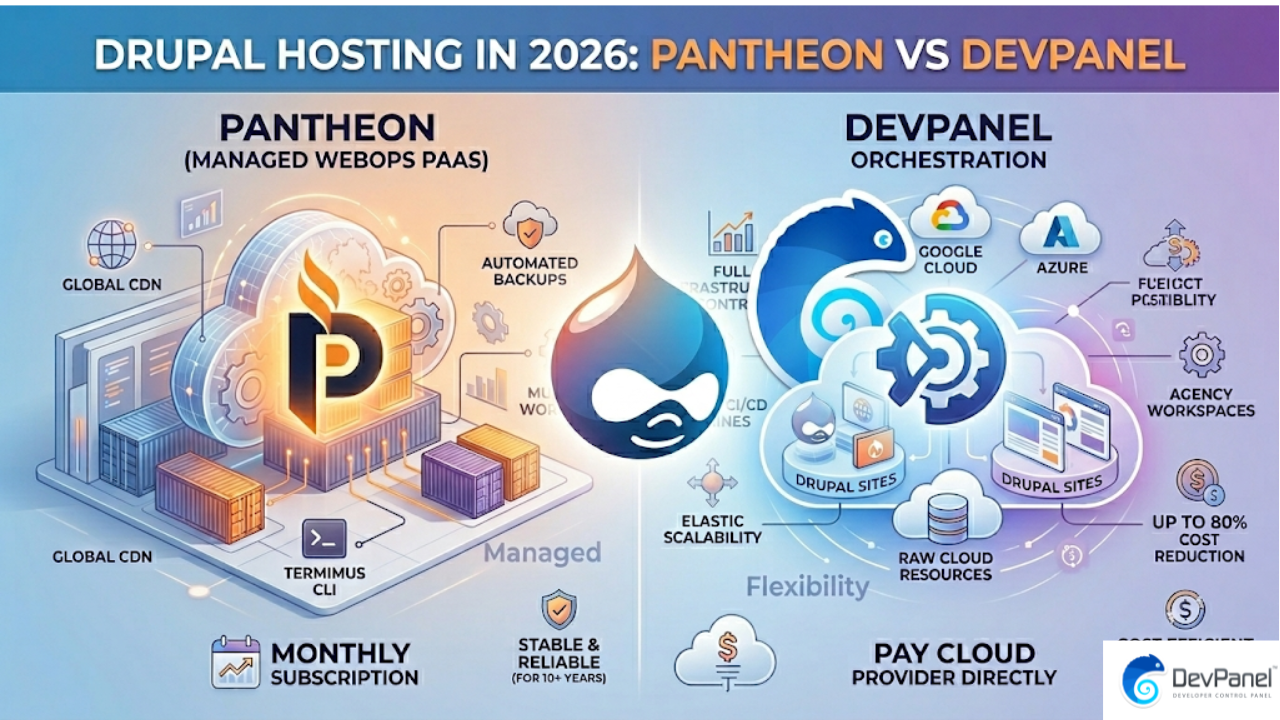
Drupal Hosting in 2026: Pantheon vs DevPanel – Which Platform Is Actually Best for You?
When comparing Drupal hosting in 2026, Pantheon vs DevPanel is the decision that keeps Drupal developers and IT directors up at night, and for good reason: organizations switching to DevPanel’s hybrid cloud orchestration model are reporting hosting bill reductions of up to 80% compared to traditional managed PaaS platforms. With the Drupal ecosystem going through one of its most active migration periods in recent history, choosing the right hosting platform has never carried more financial and operational weight.
Key Takeaways
| Question | Answer |
|---|---|
| What is the main difference between Pantheon and DevPanel for Drupal? | Pantheon is a managed WebOps PaaS with opinionated infrastructure; DevPanel is a hybrid orchestration platform giving teams full control over their cloud environment at raw compute costs. |
| Which platform is cheaper for Drupal hosting in 2026? | DevPanel typically delivers dramatically lower costs because clients pay cloud providers (like AWS) directly, eliminating platform markup. Pantheon’s managed pricing is predictable but carries a significant cost premium. |
| Is Pantheon still a good choice for Drupal in 2026? | Yes, especially for teams that want an all-in-one WebOps solution without managing cloud infrastructure. Pantheon’s usability scores remain exceptionally high among small and mid-sized teams. |
| Who should use DevPanel for Drupal hosting? | Digital agencies, enterprises, non-profits, and higher education organizations that manage multiple Drupal sites and want cost efficiency, flexible environments, and deep CI/CD customization. See DevPanel’s agency-focused solutions. |
| Does DevPanel support Drupal specifically? | Yes. DevPanel supports Drupal deployment with pre-built templates, automated pipelines, and cloud environment management designed for web applications including Drupal. |
| What is the biggest risk of choosing Pantheon over DevPanel? | The primary risk is the “platform markup trap” – paying significantly more per month for infrastructure than necessary, which compounds as your Drupal site portfolio grows. |
| Can DevPanel handle enterprise Drupal projects? | Yes. DevPanel’s enterprise tier is built for business-scale deployments with robust security, team workspaces, and scalable cloud resource management. |
What Has Changed in Drupal Hosting in 2026
The landscape for Drupal hosting in 2026 looks dramatically different from even two years ago. Over 200,000 Drupal sites were still running version 7 as of late 2025, triggering a massive migration wave that is reshaping which platforms teams are evaluating.
This migration surge has pushed the Pantheon vs DevPanel conversation to the forefront of nearly every Drupal agency’s roadmap. Teams are not just asking “where do I host?” – they are asking “how do I host smarter, faster, and cheaper across multiple environments?”
The rise of modern cloud-native platforms has given Drupal teams genuine alternatives to the traditional managed PaaS model. In 2026, the choice between a tightly managed platform and a flexible orchestration layer is one of the most consequential infrastructure decisions any Drupal team will make.
Pantheon for Drupal Hosting: What You Get in 2026
Pantheon has been in the Drupal and WordPress hosting space for over a decade, and in 2026 it continues to hold a significant market position. The platform serves over 285,000 websites across six continents, which speaks to its stability and reliability as a managed WebOps solution.
Pantheon’s core value proposition is simplicity at scale for WebOps teams. You get a fully managed stack – containerized environments, a global CDN, automated backups, a visual dashboard, and built-in dev/test/live workflow – without configuring any cloud infrastructure yourself.
For Drupal specifically, Pantheon provides one-click Drupal installations, integrated Terminus CLI, multidev environments for parallel feature work, and tight Git integration. The platform’s opinionated architecture means your Drupal site runs in a predictable, pre-configured container environment.
The trade-off is clear: you gain operational simplicity but sacrifice infrastructure control and cost efficiency. Pantheon’s pricing is transparent but carries a built-in premium for the managed layer on top of underlying cloud compute.
Did You Know?
In traditional Managed PaaS models like Pantheon, approximately 80% of a $1,000 hosting bill is platform markup – with only $200 actually going toward raw compute resources.
DevPanel for Drupal Hosting in 2026: A Different Model Entirely
DevPanel takes a fundamentally different architectural approach to Drupal hosting. Rather than running your site on a proprietary managed container, DevPanel acts as an orchestration and management layer that sits on top of your own cloud infrastructure (AWS, Google Cloud, Azure, etc.).
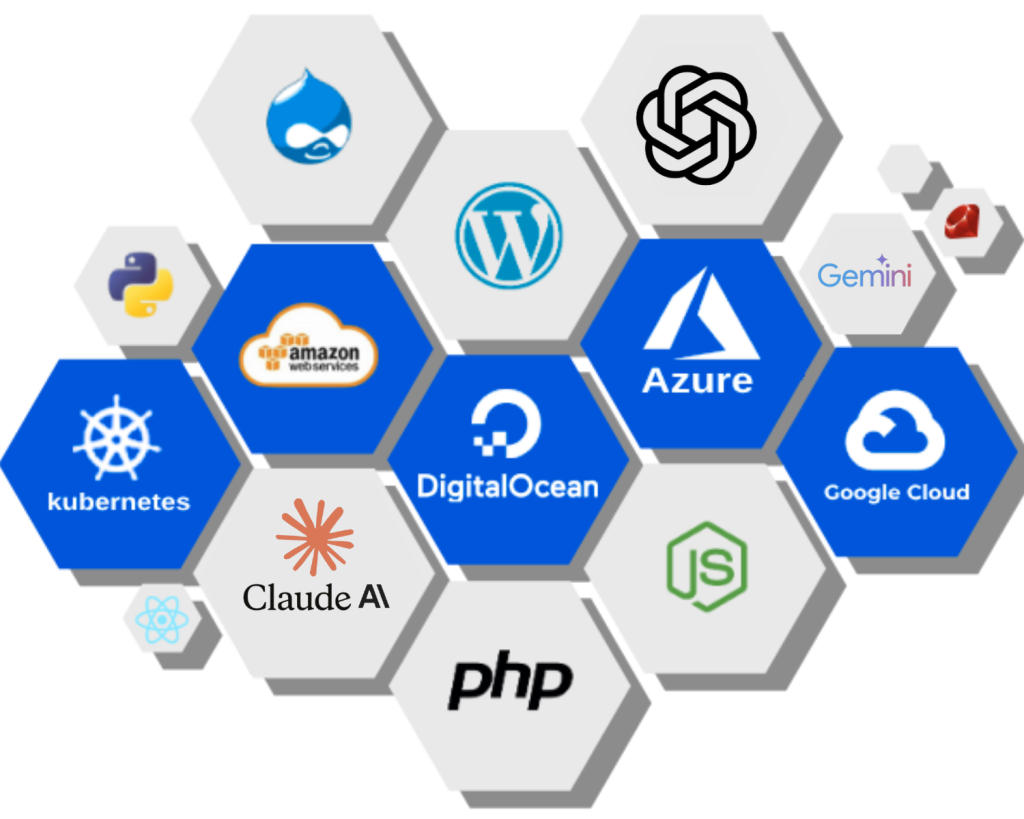
This means you pay your cloud provider directly for raw compute, storage, and bandwidth – and DevPanel provides the tooling, automation, and management interface on top. The result is a platform that gives you enterprise-grade Drupal hosting capabilities without the enterprise-grade markup.
DevPanel’s core platform features include cloud-based development environments with pre-installed tools, Git integration, pre-built CI/CD deployment pipelines, app and template building, and robust security and resource allocation controls. All of these capabilities are designed to accelerate Drupal development while keeping infrastructure costs in check.
The workspaces feature is particularly relevant for agencies and development teams managing multiple Drupal projects simultaneously – providing isolated, configurable environments for each client or project.
Drupal Hosting in 2026 Pantheon vs DevPanel: Pricing Breakdown
Pricing is where the Pantheon vs DevPanel comparison becomes most striking. Pantheon uses a tiered subscription model based on site traffic and features, with pricing that can scale quickly as your Drupal site grows or as you add more sites to your account.
DevPanel’s model is structurally different. You bring your own cloud account, DevPanel provides the management platform, and you pay cloud costs directly. This eliminates the platform markup layer entirely. DevPanel’s pricing page reflects this philosophy – you’re paying for the platform tooling, not for inflated compute resources.
For teams running multiple Drupal sites (common in digital agencies, higher education, and enterprise environments), the cost difference compounds significantly. A portfolio of 10+ Drupal sites on Pantheon at scale represents a very different monthly invoice compared to the same workload orchestrated through DevPanel on raw cloud infrastructure.
It is worth noting that Pantheon’s predictable flat-rate model does have value for finance teams and procurement departments that prefer simplicity over optimization. Not every organization wants to manage cloud billing directly, even if it costs more.
Performance and Speed: How Pantheon and DevPanel Compare for Drupal
Performance is non-negotiable for Drupal sites in 2026. With 47% of users expecting a site to load in 2 seconds or less – and 40% abandoning any site that takes longer than 3 seconds – both platforms have made performance a core part of their value proposition, but they achieve it in very different ways.
Pantheon delivers performance primarily through its Global CDN, edge caching architecture, and purpose-built Drupal containers with optimized PHP workers. For most standard Drupal use cases, Pantheon’s out-of-the-box performance is genuinely solid without any additional configuration.
DevPanel approaches performance through infrastructure flexibility. Because you can deploy your Drupal site on any cloud provider’s fastest available compute instances, in any geographic region, with any caching configuration you choose, the ceiling for performance optimization is significantly higher. You are not constrained by the container specs that Pantheon allocates to your tier.
For high-traffic enterprise Drupal sites with specific latency requirements – government portals, university platforms, or global e-commerce – the ability to tune infrastructure at the cloud level gives DevPanel a meaningful edge in maximum achievable performance.
Developer Workflow and CI/CD Pipelines for Drupal
Developer experience is a major factor in the Pantheon vs DevPanel for Drupal hosting decision, especially for agencies that bill by the hour and can’t afford workflow inefficiencies.
Pantheon’s developer workflow is well-established and genuinely loved by many Drupal teams. The Multidev environment system, Terminus CLI, and the visual Git-based deploy workflow (dev to test to live) match how most Drupal developers already work. The learning curve is low, and onboarding new team members is straightforward.
DevPanel’s deploy and clone capabilities offer a comparable workflow with added flexibility. Pre-built deployment pipelines handle CI/CD across environments, and the ability to build custom app templates means agencies can standardize their Drupal setup once and replicate it instantly across new client projects.
The development environment builder in DevPanel is particularly useful for Drupal teams working across multiple versions or configurations – you can spin up a Drupal 10 or Drupal 11 environment with all your standard tooling pre-installed in minutes, without relying on local environment setups like Lando or DDEV.
Drupal Hosting in 2026 Pantheon vs DevPanel: Scalability
Scalability means different things depending on whether you’re growing a single large Drupal site or expanding a portfolio of multiple sites. Both platforms handle scalability, but again through fundamentally different mechanisms.
Pantheon scales vertically within its container model – you move up to a higher plan tier to access more resources. This is predictable and simple but can become expensive quickly for sites with unpredictable or seasonal traffic spikes, since you’re essentially paying for peak capacity at all times.
DevPanel scales in the way cloud infrastructure naturally scales – horizontally, elastically, and on demand. Because you’re running on AWS or another major cloud provider directly, you can leverage auto-scaling groups, load balancers, and spot instances that would be unavailable or prohibitively expensive within a managed PaaS.
For organizations in higher education or government where traffic can spike dramatically around enrollment periods or public announcements, this elastic scalability at cloud cost is a significant operational and financial advantage.
Did You Know?
47% of users in 2026 expect a Drupal site to load in 2 seconds or less, while 40% will abandon a site taking longer than 3 seconds – making your hosting infrastructure a direct driver of user retention.
Best For: Who Should Choose Pantheon vs DevPanel for Drupal Hosting in 2026
After examining both platforms across pricing, performance, workflow, and scalability, here is our clear breakdown of which platform is best for each type of Drupal organization in 2026.
Choose Pantheon if you are:
- A small to mid-sized team that wants a fully managed solution with zero infrastructure overhead
- An organization that prioritizes a polished, user-friendly dashboard and standardized WebOps workflow
- A team with a single flagship Drupal site where predictable flat-rate billing matters more than cost optimization
- A developer or agency new to Drupal hosting who values Pantheon’s extensive documentation and community
- An organization where procurement simplicity and single-vendor accountability outweigh cost savings
Choose DevPanel if you are:
- A small or medium business managing cost efficiency as a core priority
- A digital agency managing 5+ Drupal sites that wants to standardize environments and reduce per-site hosting costs dramatically
- An enterprise IT team that needs full infrastructure control, custom cloud region selection, and direct cloud provider billing
- A non-profit organization running on constrained budgets where the 80% cost reduction is mission-critical
- A healthcare organization with specific compliance and data residency requirements that demand custom infrastructure configuration
- A team that wants elastic, cloud-native scalability without paying Pantheon’s managed tier premiums
Security, Support, and Compliance for Drupal Sites in 2026
Security requirements for Drupal hosting in 2026 have intensified, particularly for government, healthcare, and enterprise deployments. Both Pantheon and DevPanel take security seriously, but their approaches differ in ways that matter for compliance-sensitive organizations.
Pantheon provides a standardized security framework that covers the platform layer – managed updates, automated backups, SSL by default, and a web application firewall at the CDN level. For most Drupal teams, this coverage is sufficient and requires no additional configuration.
DevPanel advertises a robust security framework that operates at the cloud infrastructure level. Because organizations control their own cloud accounts, they can implement security policies, VPC configurations, IAM roles, and encryption standards that go well beyond what any managed PaaS will offer by default. This matters enormously for HIPAA-compliant healthcare Drupal deployments or FedRAMP-adjacent government portals.
On support, Pantheon’s structured support tiers are well-known and generally well-reviewed. DevPanel’s support model centers on platform guidance while relying on the broader cloud provider ecosystem for infrastructure-level support. Organizations choosing DevPanel should factor in whether their internal team has the cloud expertise to handle infrastructure-level issues, or whether they need a managed services partner alongside the platform.
Demos, Onboarding, and Getting Started with Each Platform
Getting started with either platform has become considerably smoother in 2026, reflecting the competitive pressure both face from the wider Drupal hosting market.
Pantheon’s onboarding for Drupal is genuinely excellent. You can have a Drupal site running in a development environment within minutes, and the structured dev/test/live workflow means new team members understand the deployment model immediately. The Terminus CLI documentation and Pantheon’s community resources are among the best in the managed hosting space.
DevPanel offers live demos that walk you through the platform’s capabilities before you commit. The onboarding process does require connecting your cloud provider account, which adds a few steps compared to Pantheon’s self-contained signup flow. However, this setup investment pays dividends immediately in the form of lower infrastructure costs and greater flexibility from day one.
For agencies considering DevPanel, the template and app-building system means you can create a standardized Drupal 11 deployment template once and reuse it across every new client project – a workflow efficiency that compounds significantly over time and directly improves project margins.
Conclusion: Drupal Hosting in 2026 Pantheon vs DevPanel – Our Final Verdict
The Drupal hosting in 2026 Pantheon vs DevPanel decision ultimately comes down to one core trade-off: operational simplicity vs. cost efficiency and infrastructure control.
Pantheon remains the best choice for teams that want a polished, fully managed WebOps experience where the infrastructure simply works without any cloud engineering overhead. Its usability, documentation, and Drupal-specific tooling are genuinely class-leading, and for smaller teams or single-site deployments, the premium is justifiable.
DevPanel is the stronger choice for any organization where the platform markup on a managed PaaS is a real financial concern, where multi-site portfolio management is central to the business, or where infrastructure flexibility and compliance control are non-negotiable. The potential to reduce hosting costs by up to 80% while retaining full CI/CD automation and development environment tooling makes DevPanel one of the most compelling options in the 2026 Drupal hosting landscape.
We recommend reaching out to the DevPanel team directly if you manage multiple Drupal sites and want to model the actual cost difference for your specific portfolio. For teams evaluating Pantheon, the free tier and demo environments make it easy to test the workflow before committing.
Whichever platform you choose, the most important thing is that your Drupal hosting in 2026 strategy is deliberate, cost-aware, and built to scale alongside your organization’s needs rather than against them.
Frequently Asked Questions
Is Pantheon worth it for Drupal hosting in 2026?
Pantheon is worth it for teams that prioritize ease of use, a managed WebOps workflow, and a single-vendor hosting solution for Drupal. However, for cost-conscious agencies or enterprises managing multiple Drupal sites in 2026, the platform markup may make alternatives like DevPanel significantly more attractive.
How much cheaper is DevPanel than Pantheon for Drupal hosting?
Organizations switching from Pantheon-style managed PaaS models to DevPanel’s hybrid orchestration approach have reported hosting cost reductions of up to 80% by paying raw cloud costs directly to providers. The actual savings depend on your site’s traffic, resource requirements, and the number of Drupal sites you manage.
Can DevPanel replace Pantheon for Drupal in 2026?
Yes, DevPanel can functionally replace Pantheon for most Drupal use cases in 2026, offering comparable CI/CD pipeline automation, development environments, and multi-site management. The key difference is that DevPanel requires connecting your own cloud account, giving you more control but also more responsibility over infrastructure setup.
Which Drupal hosting platform is better for digital agencies in 2026?
For digital agencies managing multiple Drupal client sites, DevPanel is generally the better choice in 2026 due to its dramatically lower per-site infrastructure costs, reusable app templates, and flexible workspace management. Pantheon is a strong choice for agencies that prefer a standardized workflow and are willing to pay a premium for zero infrastructure management overhead.
Does DevPanel support Drupal 10 and Drupal 11 hosting?
Yes, DevPanel supports modern Drupal deployments including Drupal 10 and Drupal 11 through its pre-built application templates and cloud-based development environments. Teams can build standardized Drupal templates once and deploy them consistently across multiple environments and projects.
What is the “platform markup trap” in Drupal hosting?
The platform markup trap refers to the phenomenon where managed PaaS hosting providers like Pantheon charge significantly above raw cloud compute costs – with estimates suggesting up to 80% of a typical hosting bill on a managed platform goes to platform markup rather than actual compute resources. In 2026, this is a central concern driving organizations to evaluate DevPanel and similar hybrid orchestration alternatives for their Drupal hosting.
Is DevPanel a good Pantheon alternative for Drupal non-profits and universities?
DevPanel is an excellent Pantheon alternative for non-profits, higher education institutions, and government organizations in 2026, primarily because the cost savings at scale are substantial – directly freeing budget for mission-critical work. DevPanel also offers infrastructure flexibility that allows these organizations to meet specific data residency, compliance, and security requirements that a standardized managed PaaS may not accommodate.