Drupal Hosting in 2026: The Complete Guide to Choosing the Right Platform
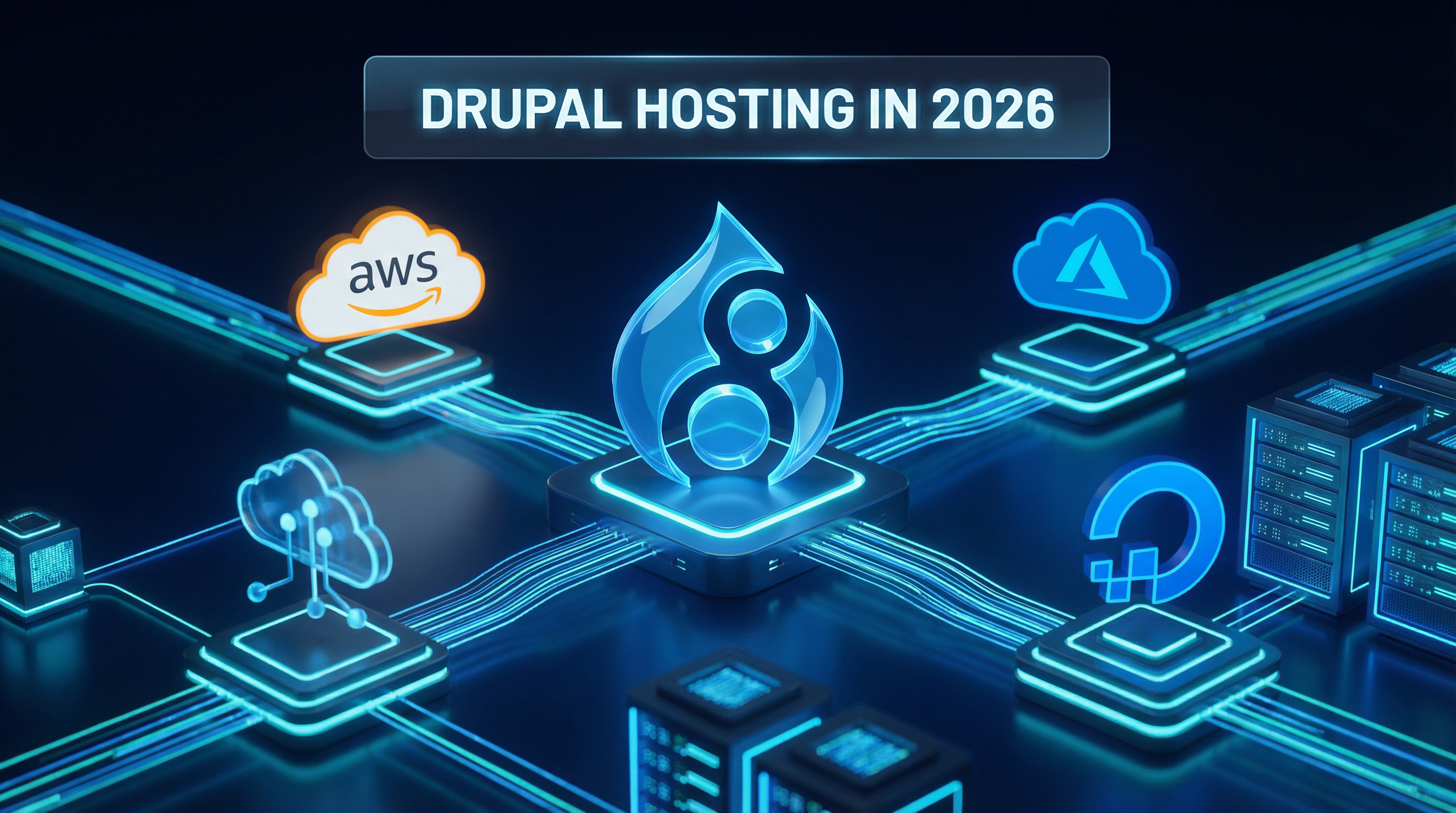
Choosing the right Drupal hosting platform is one of the most consequential infrastructure decisions your organization will make in 2026. The wrong choice locks you into a vendor’s ecosystem, inflates your monthly bill by up to 300%, and strips you of the data sovereignty that modern compliance frameworks demand. The right choice gives you enterprise-grade performance, full infrastructure ownership, and the freedom to grow without penalty.
This guide cuts through the noise. It examines what the top Drupal hosting providers actually offer, where they fall short, and why a growing number of government agencies, nonprofits, and high-growth startups are migrating to a new model — Hybrid Orchestration — that combines the automation of a managed PaaS with the economics and control of your own cloud account.
Key Takeaways
| Question | Short Answer |
|---|---|
| What is the best Drupal hosting in 2026? | Hybrid Orchestration (e.g., DevPanel on AWS) for most teams; Acquia for extreme compliance needs |
| How much can I save vs. Pantheon/Acquia? | Up to 75–80% lower hosting costs reported by DevPanel users |
| Do I need DevOps expertise? | No — DevPanel automates 99% of infrastructure tasks |
| Is my data safe in my own cloud? | Yes — full data sovereignty, no vendor lock-in |
| Can I use AWS credits? | Yes — because your infrastructure lives in your own AWS account |
1. Why Drupal Hosting Is Different in 2026
Drupal is not a simple CMS. It powers some of the world’s most demanding digital properties — the Voice of America (handling 1.2 billion hits per month), major government portals, and global nonprofit networks. Its architecture demands more from a hosting environment than a typical WordPress blog: robust PHP 8.3+ support, object caching via Redis or Memcached, database-level performance tuning, and the ability to handle sudden traffic spikes without manual intervention.
For over a decade, the market offered two options: pay a premium for a fully managed Platform-as-a-Service (PaaS) like Acquia or Pantheon, or build and maintain your own servers on a VPS. Both approaches carry significant trade-offs. The PaaS route delivers convenience but at a steep price — and with a walled garden that prevents you from using your own cloud credits or customizing your infrastructure. The DIY route preserves control but demands a full-time DevOps engineer to keep everything running.
In 2026, a third path has matured: Hybrid Orchestration. Platforms like DevPanel sit between your Drupal application and your own cloud provider account (AWS, Azure, or DigitalOcean), automating the complex infrastructure work while leaving ownership — and the bill — entirely in your hands. As DevPanel’s own research into the ultimate guide to Drupal hosting demonstrates, this shift is redefining what “best Drupal hosting” means.
2. The Four Dominant Drupal Hosting Models Compared
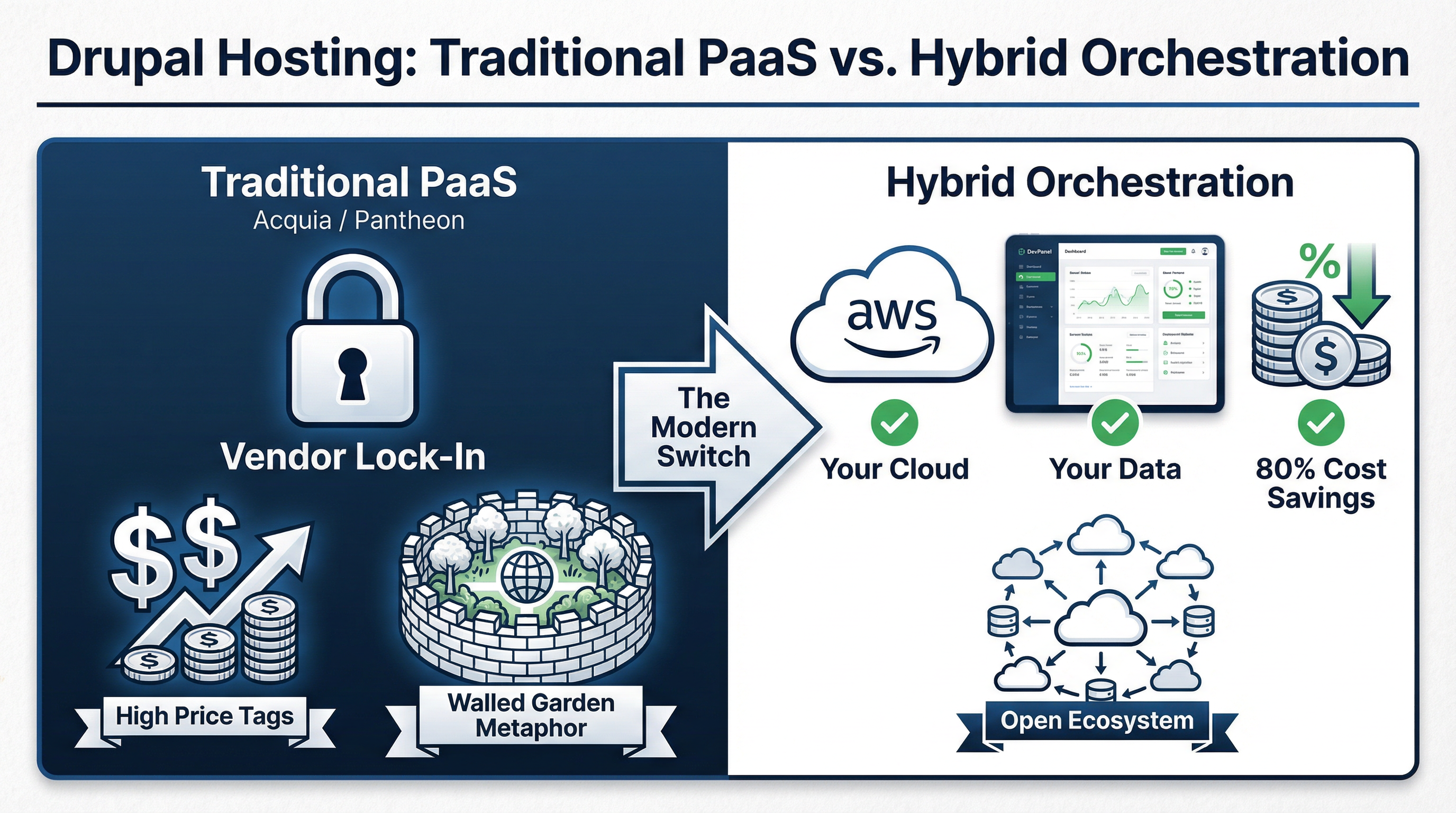
Understanding the landscape requires looking honestly at each model’s strengths and limitations.
A. Acquia: Enterprise Governance at Enterprise Prices

Acquia is the Drupal hosting provider most closely associated with the platform’s origins — its co-founder, Dries Buytaert, also created Drupal. This heritage gives Acquia deep credibility in regulated industries. Its compliance portfolio (FedRAMP, HIPAA, SOC 2, ISO 27001) is unmatched, and its Acquia Site Factory product can manage thousands of Drupal sites from a single dashboard.
The trade-off is cost and flexibility. Acquia’s pricing is typically negotiated on annual contracts, and organizations frequently report that the “platform markup” — the gap between what Acquia pays for raw AWS infrastructure and what they charge clients — can reach 200–300%. For organizations with strict compliance mandates and unlimited budgets, Acquia remains the default. For everyone else, it is difficult to justify.
B. Pantheon: The WebOps Standard with a Walled Garden

Pantheon pioneered the “Dev, Test, Live” workflow that has become the gold standard for Drupal development teams. Its container-based architecture delivers impressive performance, and features like Multidev (for feature-branch environments) and Autopilot (for automated updates) have earned genuine loyalty from agencies and development shops.
The limitation is structural. Pantheon’s platform is deliberately “opinionated” — it works brilliantly within its defined boundaries, but those boundaries are real. You cannot use a custom VPC configuration, integrate directly with AWS Lambda, or apply your AWS Activate credits to your hosting bill. As DevPanel’s detailed comparison of Drupal hosting options for 2026 shows, this lock-in becomes a strategic liability as organizations scale.
C. DigitalOcean: Developer-Friendly but DIY at Heart

DigitalOcean occupies the opposite end of the spectrum. Its Droplets offer excellent performance-to-price ratios, and its one-click Drupal installers lower the barrier to entry significantly. For small projects, personal sites, and development environments, DigitalOcean is a compelling choice.
For production workloads, however, DigitalOcean is fundamentally a DIY platform. Security hardening, multi-zone failover, automated backups, and scaling logic are all your responsibility. Without a dedicated DevOps engineer, a DigitalOcean-hosted Drupal site is one traffic spike away from an outage.
D. DevPanel: Hybrid Orchestration — The 2026 Standard

DevPanel represents a fundamentally different architecture. Rather than hosting your Drupal site in its own infrastructure, DevPanel connects to your own cloud provider account and builds a best-practice, production-ready environment inside it. You get the automation and developer experience of a managed PaaS — one-click deployments, Dev/Test/Live workflows, automated SSL, CI/CD pipelines — while paying raw cloud costs directly to AWS, Azure, or DigitalOcean.
The result is a platform that eliminates the “markup” entirely. DevPanel users consistently report 75–80% lower hosting costs compared to legacy managed platforms. Because the infrastructure lives in your account, you retain full data sovereignty, can apply AWS Activate credits, and face zero vendor lock-in.
3. The DevPanel Architecture: How Hybrid Orchestration Works
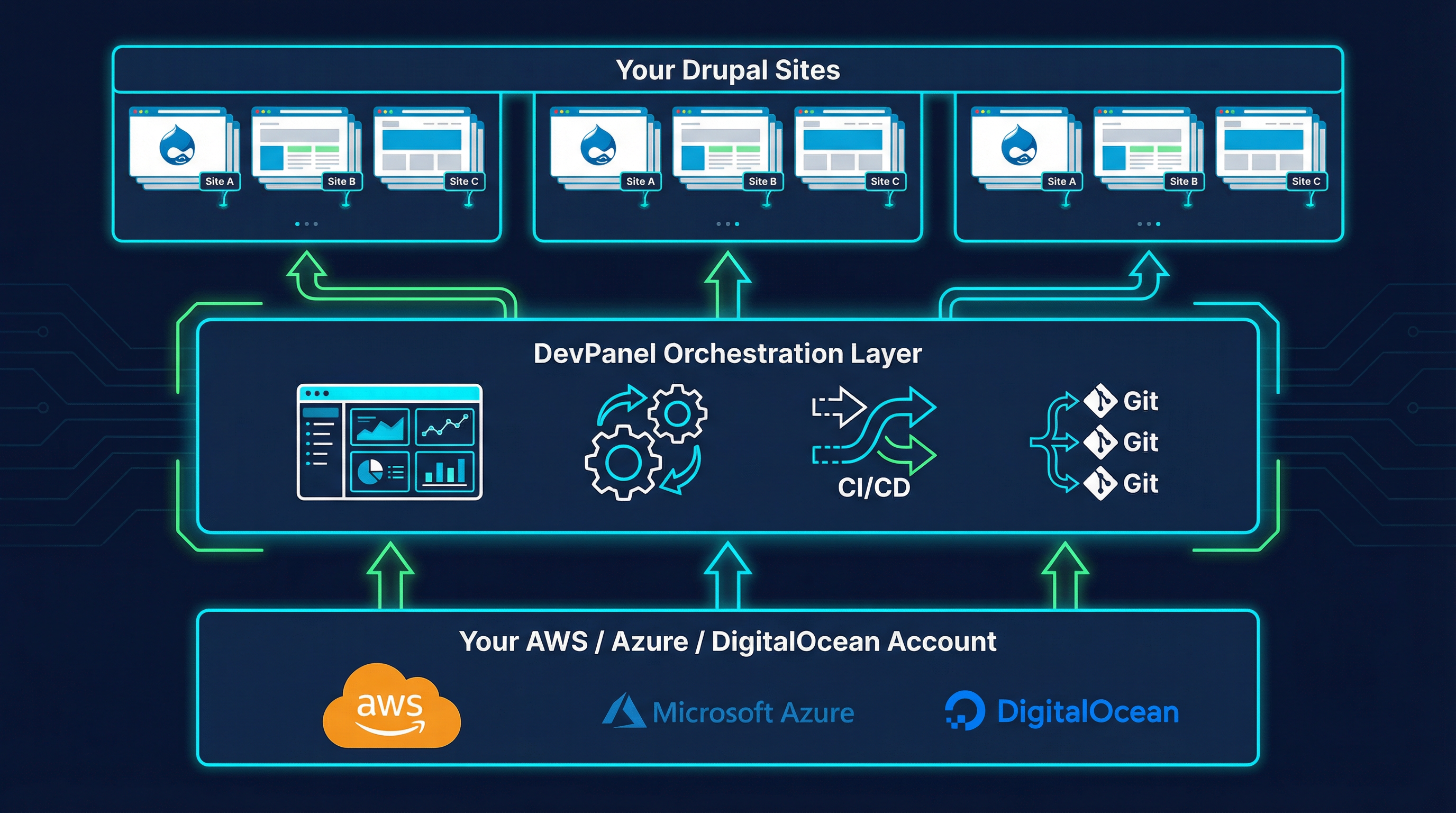
The DevPanel platform overview describes a three-layer model that is worth understanding in detail.
At the foundation sits your cloud provider account — AWS, Microsoft Azure, or DigitalOcean. This is infrastructure you own and pay for directly. DevPanel’s orchestration layer connects to this account and automates the configuration of every component a production Drupal site requires: load balancers, auto-scaling groups, managed databases (RDS/Aurora), shared file storage (EFS), CDN configuration (CloudFront), and security hardening (WAF, VPC, SSL).
Above the orchestration layer sit your Drupal applications. From a developer’s perspective, the experience is indistinguishable from a premium managed PaaS — you interact with a clean dashboard, deploy with Git, and spin up feature-branch environments with a single click. The difference is that every resource provisioned by that click lives in your account, not DevPanel’s.
This architecture directly addresses the noisy neighbor problem that plagues shared hosting environments. Because each client’s infrastructure is isolated within its own cloud account, one organization’s traffic spike cannot degrade another’s performance.
4. Performance: What Drupal 11 Actually Requires
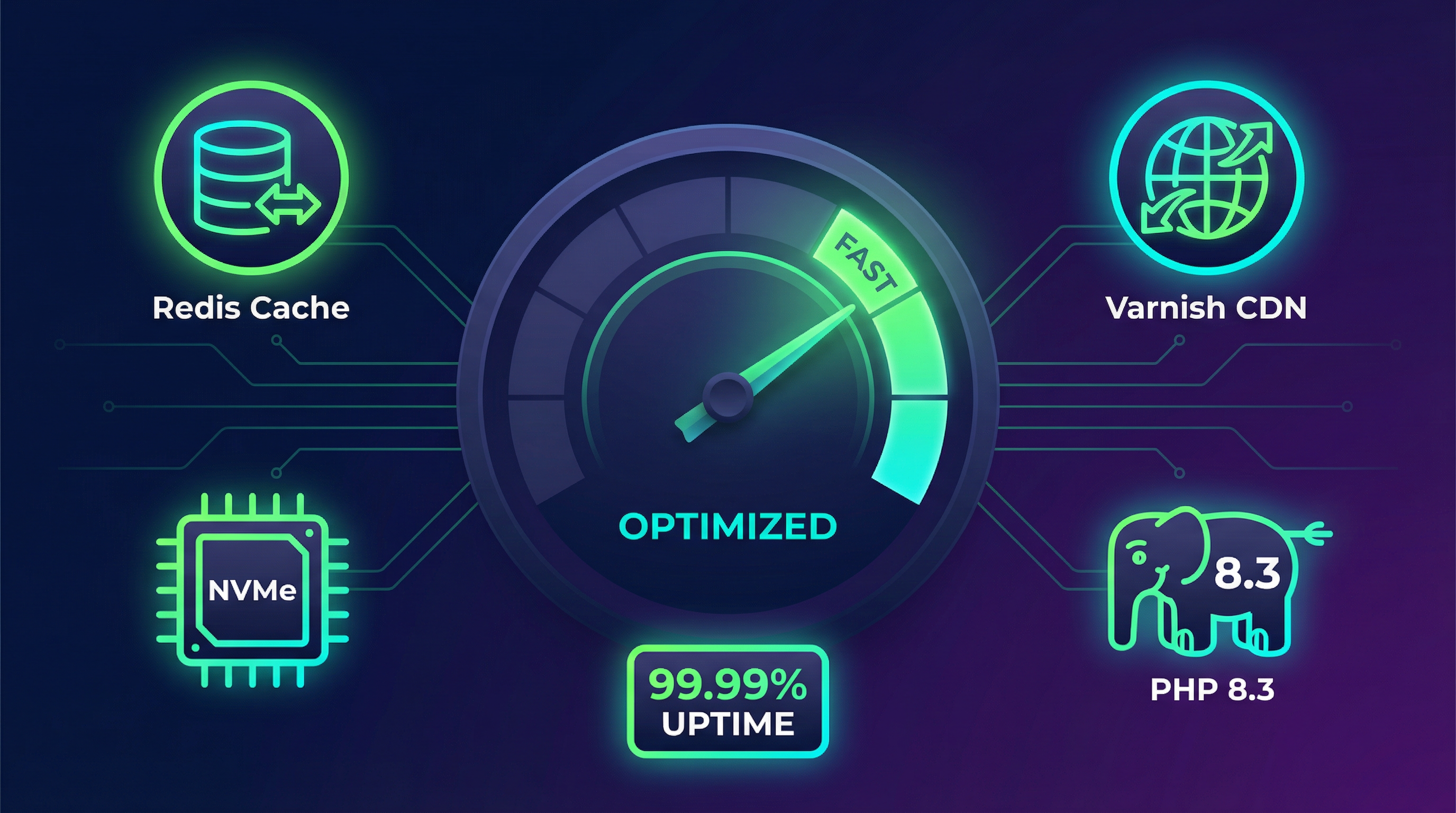
Drupal 11 raises the performance bar significantly. A hosting environment that was adequate for Drupal 9 may be a bottleneck for Drupal 11’s more demanding architecture. The following technical requirements are non-negotiable for any production deployment in 2026.
PHP 8.3+ with JIT Compilation. Drupal 11 requires PHP 8.3 at minimum. The Just-In-Time (JIT) compilation engine in PHP 8.x delivers measurable performance gains for compute-intensive operations, and the improved memory management reduces server resource consumption under load.
NVMe Storage. Standard SSDs are no longer sufficient for Drupal’s database-heavy read patterns. NVMe storage delivers approximately 20x the throughput of traditional SSDs, directly reducing Time to First Byte (TTFB) and improving Core Web Vitals scores.
Redis or Memcached for Object Caching. Without a dedicated object cache, Drupal rebuilds complex page components from the database on every request. Redis integration — available natively through DevPanel’s apps, frameworks, and templates library — can reduce database load by 60–80% on content-heavy sites.
Global CDN with Varnish. Edge caching is essential for sites serving international audiences. A properly configured Varnish layer, combined with a global CDN like CloudFront, ensures that cached pages are served from the node geographically closest to each visitor.
Automated Backups and Multi-AZ Failover. Production Drupal sites require point-in-time recovery capabilities and the ability to survive a data center failure without manual intervention. DevPanel automates both through its deploy and clone features, ensuring that your disaster recovery plan does not depend on a 3:00 AM phone call to your lead engineer.
5. Developer Experience: The Cloud IDE Revolution
One of the most significant shifts in Drupal development workflows over the past two years has been the adoption of browser-based development environments. DevPanel’s Cloud IDE — a fully configured VS Code instance running in the browser — eliminates the “it works on my machine” problem that has historically slowed Drupal teams.
A new developer can be writing code within five minutes of joining a project, without installing Docker, DDEV, or Lando locally. The development environment is a precise clone of the production environment, eliminating the class of bugs that arise from configuration drift between local and live systems. For distributed teams, the ability to share a URL and live-debug code collaboratively is a genuine productivity multiplier.
This capability is particularly valuable for agencies managing multiple client sites. Rather than maintaining a different local setup for each project, developers work from a consistent, cloud-hosted environment that travels with them across devices and locations. DevPanel’s dev environments documentation provides a detailed walkthrough of how this workflow is configured.
6. Security and Compliance in 2026
The threat landscape for Drupal sites has grown more sophisticated. Automated AI-driven attack tools can probe for vulnerabilities at a scale and speed that manual security practices cannot match. Modern Drupal hosting must provide security at the infrastructure level, not just the application level.
DevPanel’s security model is built on several principles that distinguish it from traditional managed hosting. Immutable infrastructure means that servers cannot be modified while running — a technique that prevents attackers from injecting persistent malware even if they briefly gain access. Automated Multi-AZ failover ensures that a compromised or failed data center does not take your site offline. Self-healing clusters detect and replace unhealthy containers in milliseconds, before most monitoring systems would even generate an alert.
For organizations in regulated industries, DevPanel’s enterprise plan supports HIPAA, FedRAMP, GDPR, SOC 2, and ISO 27001 compliance requirements. Critically, because your data lives in your own cloud account, you maintain full data sovereignty — a requirement that is increasingly written into government contracts and healthcare agreements.
For nonprofits in particular, the combination of compliance capability and cost efficiency is compelling. DevPanel’s dedicated guide on Drupal hosting for nonprofits using AWS grants explores how organizations can combine AWS Imagine Grant credits with DevPanel’s orchestration to achieve enterprise-grade hosting at near-zero cost.
7. The Economics: Understanding the 80% Cost Reduction
The cost difference between traditional managed Drupal hosting and Hybrid Orchestration is not marginal — it is structural. Understanding why requires looking at how managed PaaS providers price their services.
When you pay $1,000 per month to a managed Drupal host, approximately $150–$200 of that covers the actual AWS or GCP infrastructure your site consumes. The remaining $800–$850 is the platform’s margin — the “markup” for their dashboard, their support team, their proprietary tooling, and their profit. This markup is not disclosed; it is simply embedded in the price.
DevPanel’s model eliminates this markup entirely. You pay AWS (or Azure, or DigitalOcean) directly for the infrastructure your sites consume. You pay DevPanel a flat management fee for the orchestration platform. The total is consistently 75–80% lower than what legacy platforms charge for equivalent performance.
For organizations running multiple sites, the savings compound. DevPanel’s analysis of cheap ways to host multiple websites on AWS demonstrates how agencies and enterprises can consolidate dozens of Drupal sites onto a single AWS cluster managed by DevPanel, achieving economies of scale that are simply unavailable on per-site PaaS pricing models.
For startups with AWS Activate credits, the economics are even more favorable. As detailed in DevPanel’s guide on Drupal on AWS for startups, the “Private PaaS” model allows startups to apply their $25,000–$200,000 in AWS credits directly to their hosting costs — something impossible on Pantheon or Acquia, where the infrastructure lives in the vendor’s account.
8. Who Should Use DevPanel for Drupal Hosting?
DevPanel’s model is not the right fit for every organization. The following framework helps identify where it delivers the most value.
| Organization Type | Best Fit | Why |
|---|---|---|
| Government agencies | DevPanel (Enterprise) | FedRAMP/HIPAA compliance + data sovereignty + cost control |
| Nonprofits | DevPanel + AWS Grants | Combine AWS Imagine/TechSoup credits with zero-markup hosting |
| Agencies (5+ client sites) | DevPanel | Multi-site management, white-label options, margin improvement |
| Startups with AWS credits | DevPanel | Apply Activate credits directly; avoid PaaS credit trap |
| Enterprise (complex compliance) | Acquia or DevPanel Enterprise | Extreme governance requirements may justify Acquia’s premium |
| Small projects / hobbyists | DigitalOcean or shared hosting | Overhead of cloud account setup not justified at small scale |
DevPanel’s solutions pages cover specific configurations for agencies, businesses and enterprises, government, healthcare, higher education, and nonprofits — each with tailored guidance on cloud provider selection, compliance configuration, and cost optimization.
9. Getting Started with DevPanel for Drupal
DevPanel’s Community Edition is 100% free to use. There are no subscriptions, no hidden fees, and no lock-in. The platform connects to your existing AWS, Azure, or DigitalOcean account and provisions a production-ready Drupal environment in minutes.
The onboarding process follows four steps:
- Link your cloud account — DevPanel’s Cloud Link feature connects to your AWS, Azure, or DigitalOcean account with read/write permissions scoped to the resources it manages.
- Choose your Drupal template — Select from DevPanel’s library of pre-configured Drupal applications and templates, including Drupal 10, Drupal 11, and headless configurations.
- Configure your environments — DevPanel automatically provisions Dev, Test, and Live environments with separate databases, isolated file systems, and Git-based deployment pipelines.
- Deploy and scale — Use DevPanel’s deploy and clone tools to push code, clone environments for testing, and configure auto-scaling rules that respond to real traffic patterns.
For organizations that need hands-on assistance with migration, security hardening, or Kubernetes tuning, DevPanel offers optional managed services starting at $85/hour. Full details are available on the DevPanel pricing page.
10. Frequently Asked Questions
Is DevPanel really free?
Yes. DevPanel Community Edition is free because it runs inside your cloud account. You pay your cloud provider directly for the infrastructure; DevPanel charges nothing for the orchestration software itself.
Do I need AWS or Kubernetes expertise to use DevPanel?
No. DevPanel abstracts the complexity of cloud infrastructure behind a clean, intuitive dashboard. You do not need to understand VPC configuration, IAM policies, or Kubernetes cluster management to deploy and manage Drupal sites.
Can I migrate my existing Drupal site to DevPanel?
Yes. DevPanel supports migrations from Pantheon, Acquia, and traditional VPS environments. The platform’s clone and deploy tools make it straightforward to import an existing site, test it in a staging environment, and cut over with minimal downtime.
What happens if I want to stop using DevPanel?
Because your infrastructure lives in your own cloud account, you can disconnect DevPanel at any time and continue managing your servers directly. There is no data hostage situation, no export fee, and no migration penalty.
Does DevPanel support Drupal multisite configurations?
Yes. DevPanel’s centralized dashboard supports managing multiple Drupal sites across a single cluster, making it well-suited for agencies, universities, and government entities running large site portfolios.
Conclusion
The Drupal hosting market in 2026 is defined by a fundamental tension between convenience and control. Legacy managed platforms like Acquia and Pantheon offer genuine value — their tooling is mature, their support is responsive, and their developer experience is polished. But that value comes at a price that is increasingly difficult to justify when the alternative delivers equivalent automation, superior performance, and 75–80% lower costs.
DevPanel has emerged as the leading Hybrid Orchestration platform for Drupal because it resolves this tension without compromise. It gives development teams the PaaS experience they expect — Dev/Test/Live workflows, one-click deployments, Cloud IDEs, automated security — while giving IT directors and CFOs the infrastructure ownership, cost transparency, and compliance capability they require.
Whether you are a nonprofit maximizing AWS grant credits, a government agency navigating FedRAMP requirements, or an agency looking to improve margins across a portfolio of client sites, DevPanel’s model deserves serious evaluation. The platform overview and pricing page are the best places to start.