The European Commission Chooses DevPanel and DrupalForge for the 2026 Drupal AI Hackathon
Brussels, Belgium — January 2026
When the European Commission decides to host a hackathon, they don’t just need “hosting.” They need an infrastructure capable of powering the next generation of digital sovereignty.
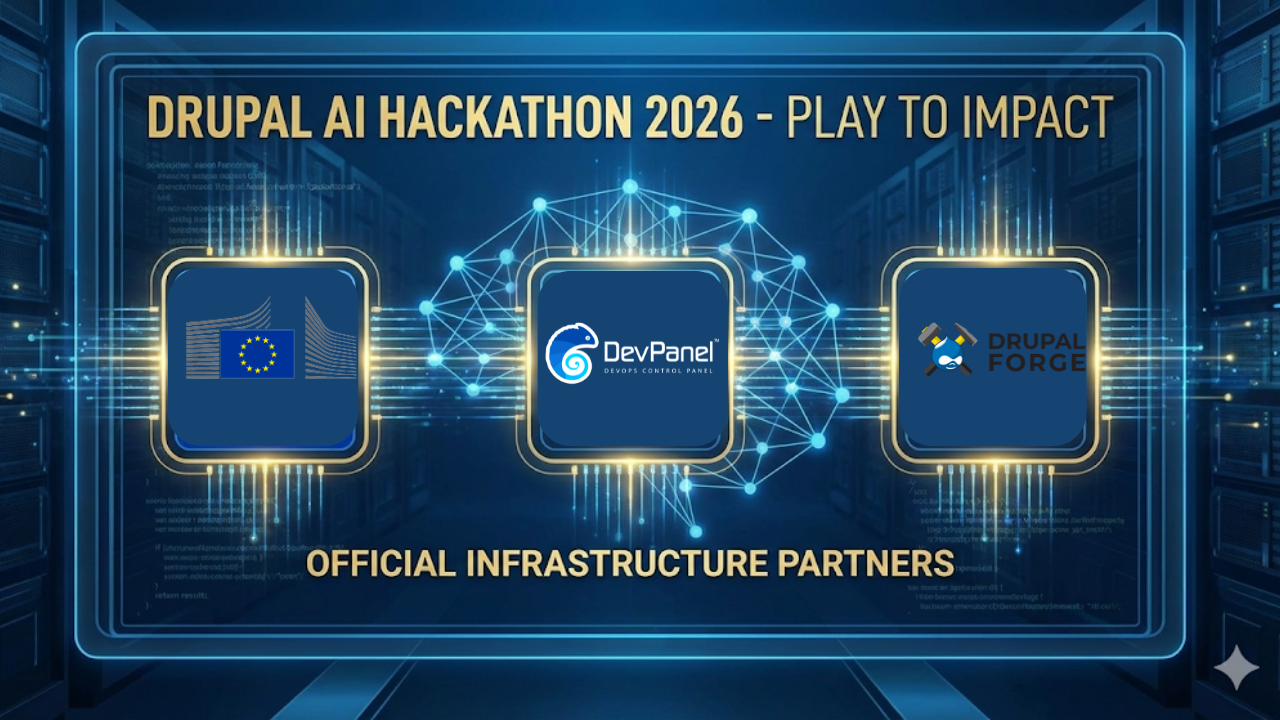
For the upcoming “Play to Impact” Drupal AI Hackathon 2026, the European Commission has made a definitive choice for their technical foundation. To enable 48 hours of uninterrupted innovation, they have selected DevPanel and DrupalForge as the official tools of choice to power the event.
This selection highlights a major shift in how government and enterprise organizations approach innovation. It isn’t just about writing code anymore; it’s about removing the barriers to entry so that innovation can happen instantly.
This blog post explores why the European Commission selected these platforms, the specific challenges participants will face, and what this means for the future of Open Source in the public sector.
The “Play to Impact” Mission: Innovation Without Friction
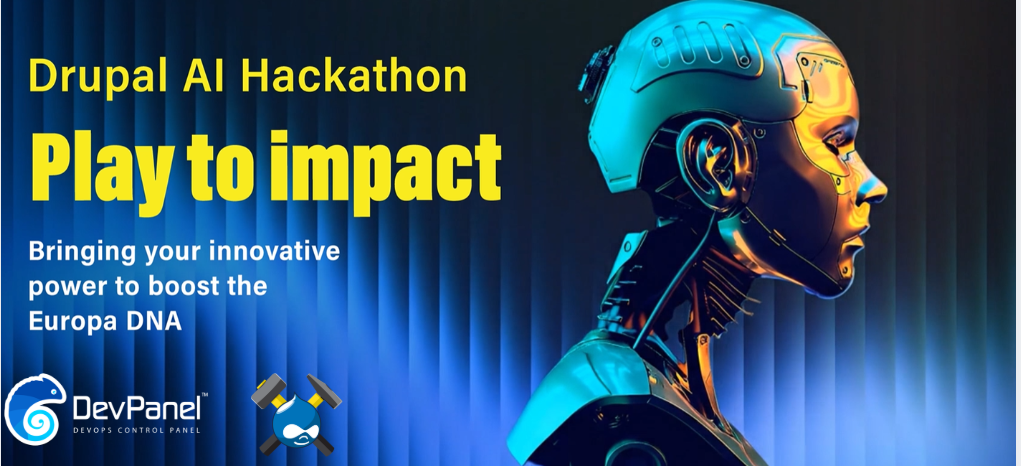
Scheduled for January 27–28, 2026, in Brussels, the Drupal AI Hackathon is not a standard coding competition. It is a strategic initiative by the Drupal Community of Practice @ EC to modernize how the European public sector builds digital experiences.
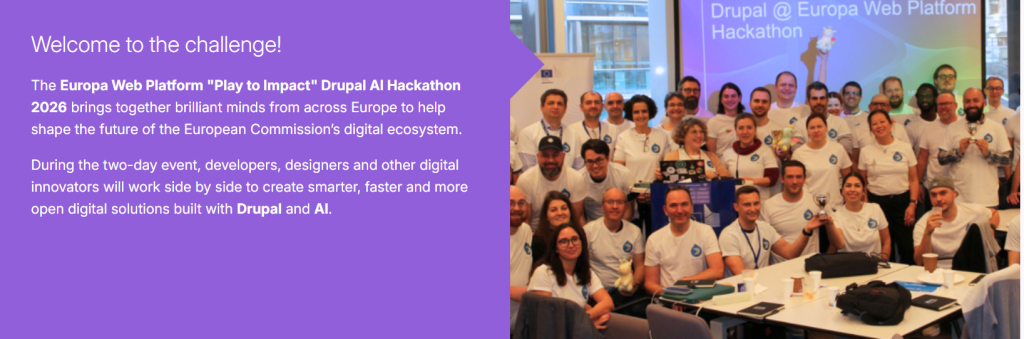
The goal is ambitious: to prototype “Sovereign AI” solutions and “No-Code” interfaces that can be deployed across the European Commission’s vast digital ecosystem.
However, traditional hackathons suffer from a notorious bottleneck: Infrastructure Fatigue. In a typical 48-hour event, participants often lose the first 4–6 hours just setting up their local environments. They struggle with Docker containers, fight with PHP version conflicts, debug Composer dependencies, and wrestle with API keys before they write a single line of feature code.
For the European Commission, this latency was unacceptable.
Why They Chose DevPanel and DrupalForge
To maximize impact, the EC needed a platform that provided Zero-Config Environments. They chose DevPanel and DrupalForge because they solve the “Day 0” problem entirely.
- Instant Onboarding: Instead of asking participants to “git clone” and configure localhost, the EC is using DrupalForge to provision fully functioning cloud development environments in seconds.
- Browser-Based VS Code: DevPanel provides a full Integrated Development Environment (IDE) directly in the browser. This democratizes the hackathon, allowing participants with lower-powered laptops (or even tablets) to contribute code without local limitations.
- Pre-Fabricated Stacks: The environments come pre-loaded with the exact tools needed for the hackathon challenges—Drupal AI modules, Ollama for local LLMs, and Drupal Canvas.
By selecting DevPanel, the European Commission effectively gave every participant a “DevOps Team in a Box,” ensuring that 100% of the hackathon time is spent on innovation, not installation.
The Challenges: Building the Future of GovTech
The hackathon focuses on two distinct tracks that represent the future of the web: Agentic AI and No-Code Visual Building. Both tracks heavily rely on the specific capabilities of the DevPanel platform.
Challenge #1: AI Agents for Content Editors

The first challenge asks participants to answer the question: Can AI make life easier for content editors?
Government websites are massive. The European Commission manages thousands of pages of complex policy documents, reports, and news. The goal here is to move beyond simple “text generation” and build AI Agents—autonomous tools that can audit content, schedule updates, and optimize workflows without human micromanagement.
How DevPanel Powers This:
- Sovereign AI Ready: The EC has a strict mandate for “Sovereign AI”—meaning data cannot just be piped into public models like ChatGPT without governance. DevPanel’s architecture allows teams to run RAG (Retrieval-Augmented Generation) systems and local models within their own secure, isolated cloud environments.
- Vector Database Integration: The DrupalForge templates provided to participants come pre-wired with the necessary vector database connections, allowing teams to build “Chat with your Data” prototypes immediately.
Challenge #2: Drupal Canvas (No-Code Site Building)
The second challenge focuses on Drupal Canvas, the new React-based visual page builder that allows marketers to design sites using drag-and-drop components.
The challenge is to “reimagine how websites are created” by integrating AI into the design process. Participants will build tools where a user can simply describe a page layout (“Create a landing page for a climate conference with a hero video and a 3-column news grid”), and Drupal Canvas will generate it instantly.
How DrupalForge Powers This:
- React/Preact Environment: Drupal Canvas relies on modern JavaScript (JSX/Preact) rendered in the browser. DrupalForge environments are optimized for this “Headless-adjacent” architecture, providing the Node.js and build tools required to compile these components on the fly.
- Component Libraries: Participants have access to a library of “Recipes” on DrupalForge, allowing them to pull in existing components and remix them rather than starting from a blank slate.
Strategic Alignment: Digital Sovereignty & Open Source
The selection of DevPanel is not just a technical convenience; it is a statement of intent regarding Digital Sovereignty.
The European Union has been a global leader in advocating for technology that adheres to privacy, governance, and transparency (e.g., GDPR, the AI Act). By utilizing Drupal (Open Source) hosted on DevPanel (which deploys into the user’s own cloud account), the EC is validating a stack that ensures Data Ownership.
Unlike proprietary SaaS platforms where the vendor holds the keys, DevPanel’s “Control Plane” model means the infrastructure belongs to the customer. For the hackathon, this means the innovative prototypes built by participants are not locked away in a black box—they are open, accessible, and ready to be deployed into the EC’s real-world infrastructure.
The “GovTech” Ripple Effect
This event serves as a blueprint for other government agencies. We are seeing a shift where public sector bodies are moving away from massive, multi-year “Waterfall” contracts and towards agile, hackathon-driven innovation cycles.
Tools like DrupalForge enable this shift. Agencies don’t have to start from scratch; they can instantly deploy specialized government distributions—such as the GovCMS Template—to spin up a secure “Sandbox” for a hackathon.
This capability allows them to invite external developers to collaborate safely (via DevPanel’s RBAC), and then tear down the environment or promote the winning ideas to production—all without risking the security of their main legacy systems.
What This Means for the Drupal Community
For the global Drupal community, the EC’s endorsement of these tools is a validation of the Starshot Initiative and the move towards a more accessible Drupal.
- Drupal is no longer “Hard to Start”: The perception of Drupal as having a steep learning curve is being dismantled by tools like DrupalForge. If the EU Commission can onboard hundreds of hackers in minutes, any agency can do the same.
- AI is Core, Not Contrib: By centering the hackathon on “Drupal AI,” the EC is signaling that AI is now a fundamental part of the CMS experience, not just a plugin.
Ready to Play?
The “Play to Impact” Hackathon kicks off on January 22, 2026 (online) followed by the in-person event in Brussels on January 27–28.
While registration is primarily for authorized staff and invited experts, the outcomes of this event will ripple through the community for years to come.
If you want to experience the same “Zero-Friction” environment that the European Commission is using to power their innovation:
- Visit DrupalForge: Browse the AI and Canvas templates used in the hackathon.
- Try DevPanel: See how you can deploy your own “Sovereign AI” infrastructure on AWS today.
The future of government technology is being built in Brussels this month—and it is running on DevPanel.