

Modernizing Higher Ed Web Agency Infrastructure: Overcoming Cost, Security, and Scalability Bottlenecks
Introduction: The Agency Dilemma in Higher Education
Partnering with higher education institutions is one of the most lucrative yet operationally complex domains for a digital agency. University websites are massive, multi-faceted ecosystems—ranging from central recruitment portals and academic department pages to student information portals, research lab microsites, and alumni hubs.
However, digital agencies building and managing these web properties face a recurring set of technical and operational hurdles:
•Tight Institutional Budgets: Colleges and universities face strict budget constraints, forcing them to demand maximum value from their agency partners without overspending on infrastructure.
•Resource-Intensive Multi-Site Management: Managing dozens or hundreds of departmental microsites drains agency developer bandwidth and creates massive administrative overhead.
•Extreme Traffic Volatility: Marketing campaigns, admissions releases, and course registration events trigger sudden, unpredictable traffic spikes that crash over-capacity servers.
•Strict Security & Compliance Standards: Protecting sensitive student and faculty data against rising cyber threats—while adhering to strict regulatory requirements—is non-negotiable.
•Slow Developer Onboarding: Onboarding new agency contractors or student developers to local development environments frequently takes days of manual sysadmin intervention.
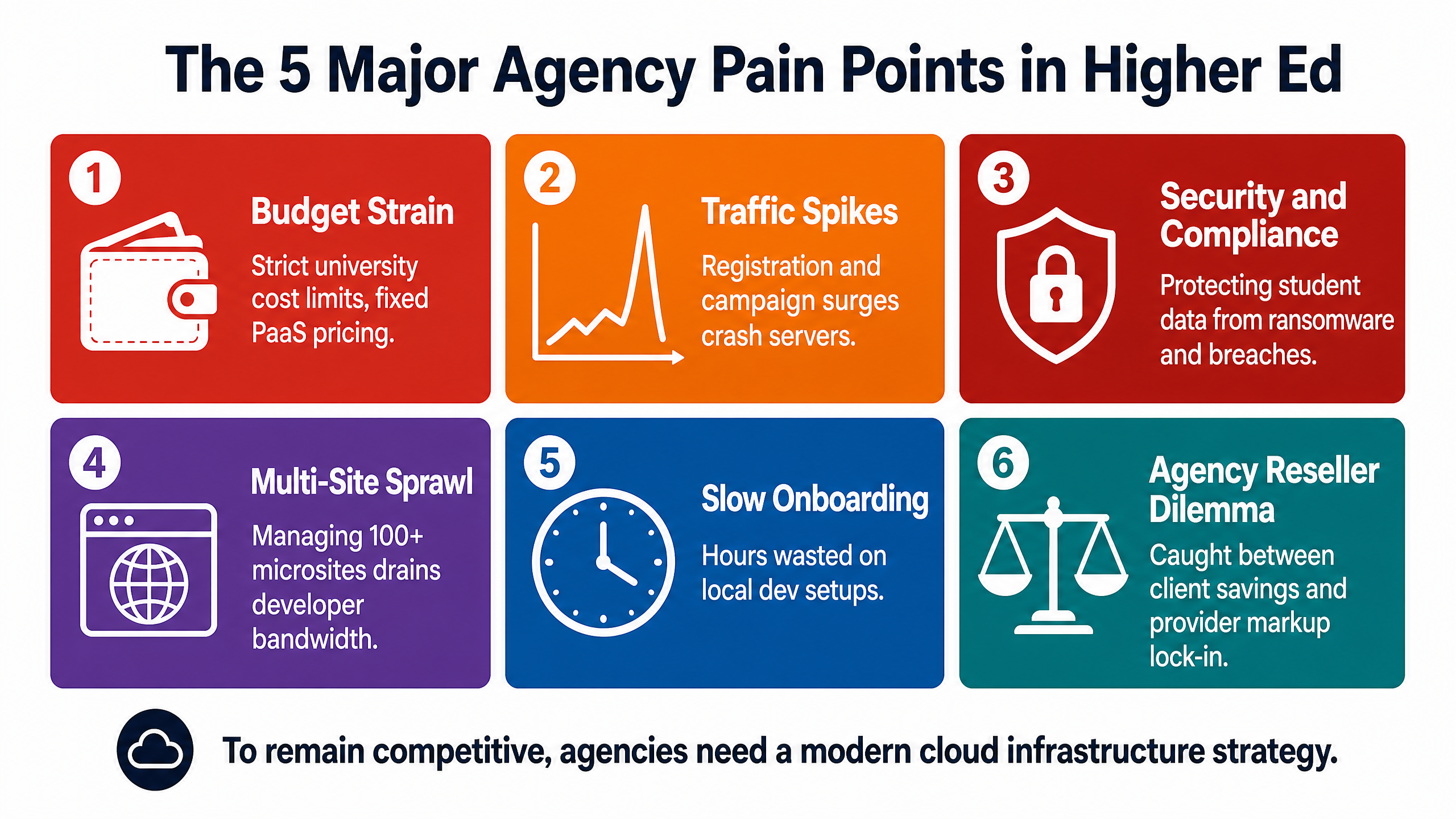
To remain competitive and protect client relationships, digital agencies need a modern cloud infrastructure strategy. By utilizing DevPanel as a centralized orchestration layer over native cloud infrastructure (AWS, Microsoft Azure, or DigitalOcean), agencies can eliminate technical complexity, protect university sites from cyber threats, and reduce client hosting fees by up to 80%.
Challenge 1: The Cost Efficiency Paradox & Vendor Alignment
As a digital agency, where do your loyalties lie? Are you committed to helping your university clients reduce their hosting overhead, or are your incentives tied to legacy PaaS providers that bill on expensive, flat per-site subscription tiers or restrictive “page view” limits?
Traditional hosting models lock higher ed institutions into expensive, fixed pricing brackets. Agencies often find themselves delivering bad news to university CIOs when site traffic overages trigger unexpected billing spikes.
How DevPanel Solves the Cost Equation
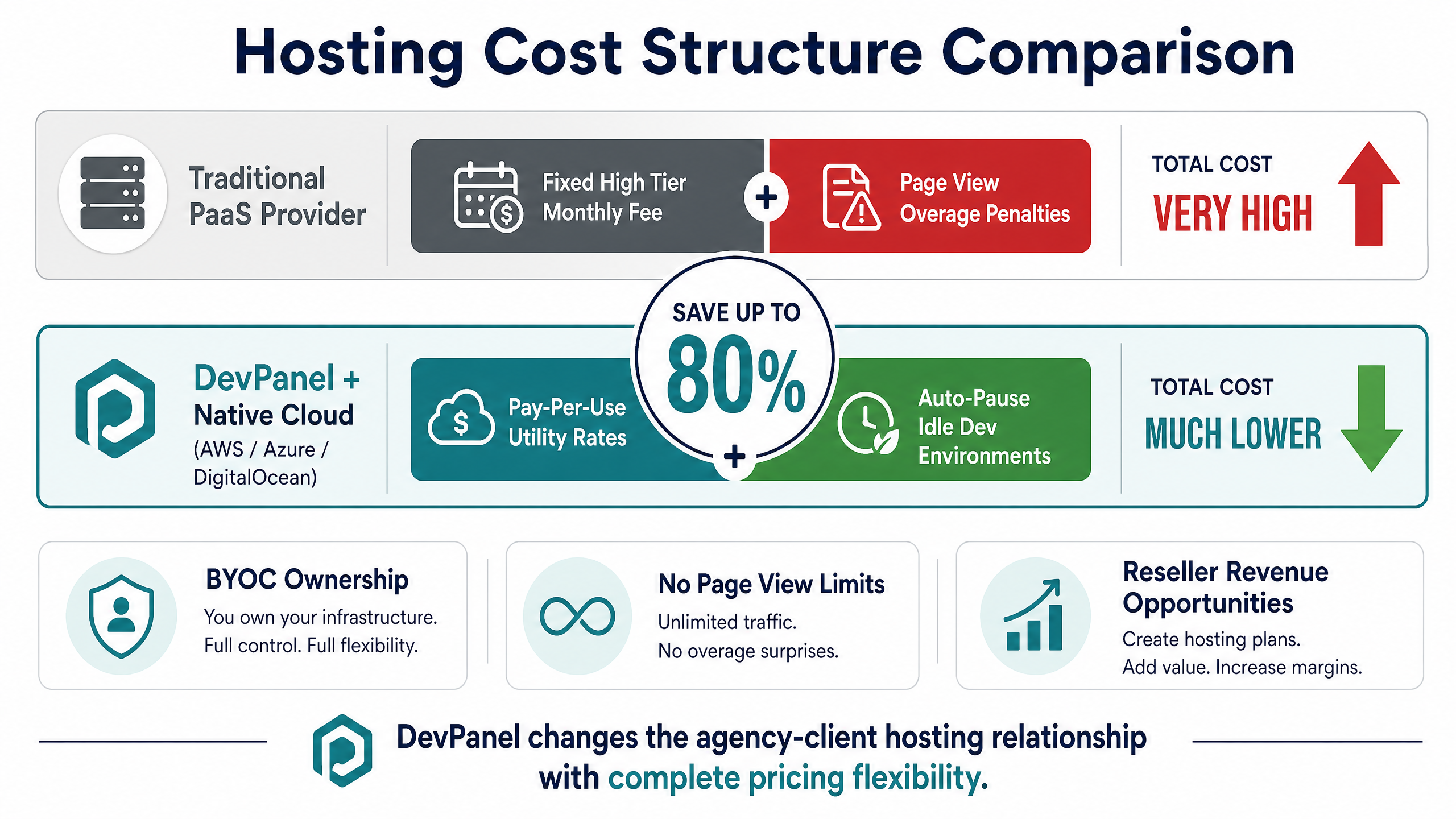
•Bring Your Own Cloud (BYOC): Agencies can deploy client sites directly within the university’s owned AWS, Azure, or DigitalOcean accounts—or host them within the agency’s own cloud accounts.
•Elimination of Page View Limits: Say goodbye to arbitrary traffic tier penalties.
•Pay-Per-Use & Serverless Computing: Take advantage of low-cost servers, reserved pricing models, and serverless compute. Infrastructure automatically scales up during heavy use and scales down when idle to cut costs.
•Reseller Revenue Opportunities: Agencies can become Value-Added Resellers (VARs), reselling managed cloud hosting powered by DevPanel to create a steady, recurring hosting revenue stream while still saving clients significant money compared to traditional PaaS vendors.
Challenge 2: Traffic Spikes, Reliability, and Serverless Auto-Scaling
Higher education websites experience intense traffic fluctuations. A university main domain or admissions portal may see steady baseline traffic for weeks, only to experience a 50x surge during:
•Open enrollment and course registration deadlines.
•Major institutional marketing campaigns or news announcements.
•Campus emergency alerts or athletics events.
If an agency hosts client sites on rigid, fixed-capacity servers, these spikes lead to site crashes, slow page loads, and damaged institutional reputations. Conversely, paying year-round for over-provisioned infrastructure to handle brief traffic spikes wastes institutional budget.
Auto-Scaling and Uninterrupted Uptime
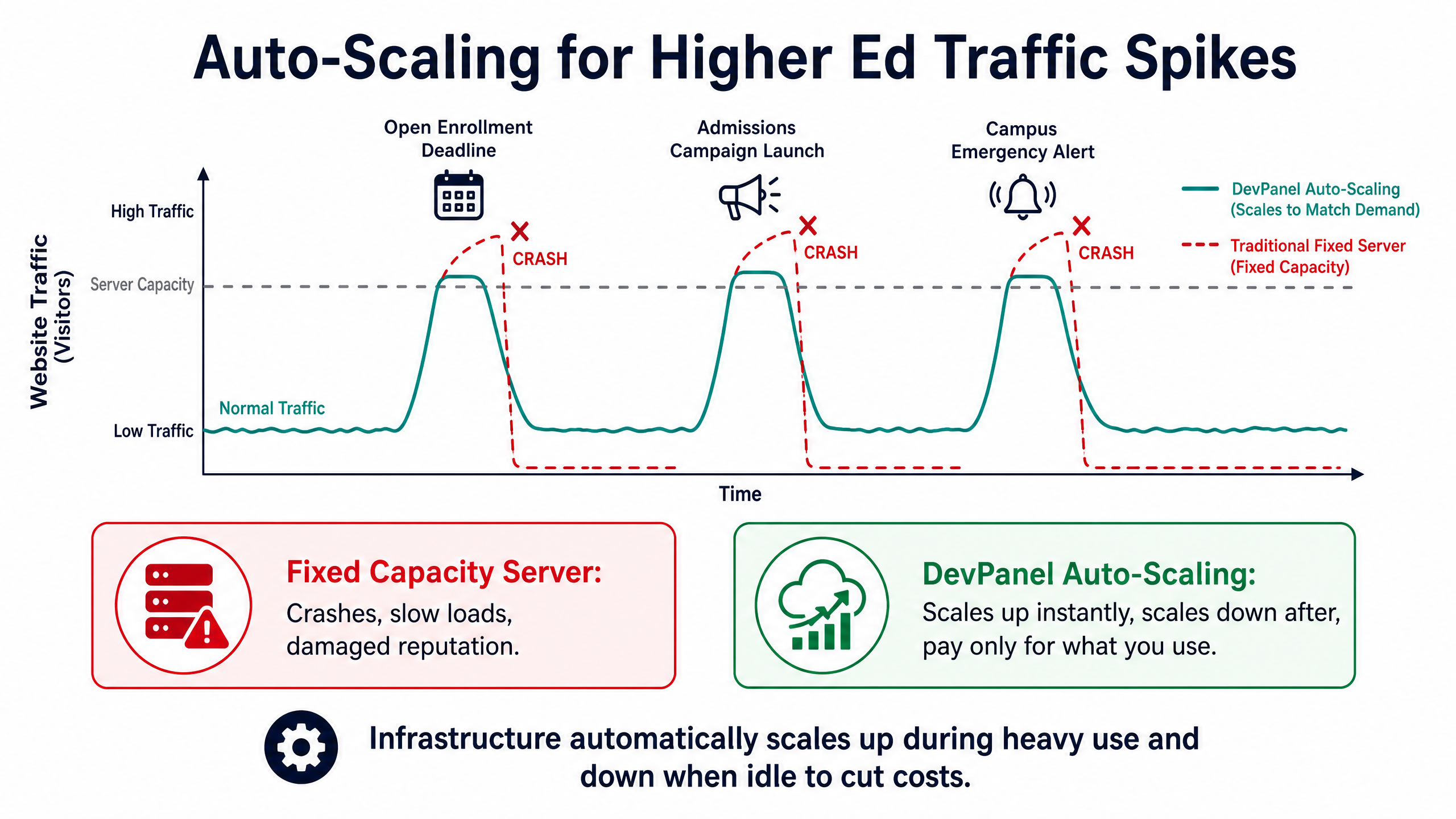
DevPanel handles traffic volatility through automated cloud scaling:
•Automatic Scaling Up: When a marketing campaign or registration push hits, DevPanel dynamically provisions additional compute resources behind the scenes to maintain low latency and high performance.
•Automatic Scaling Down: Once traffic normalizes, infrastructure automatically contracts, ensuring clients only pay for the exact compute power consumed during the spike.
•Reliability & Uptime SLAs: Backed by enterprise SLAs and managed 24/7/365 infrastructure monitoring, agencies can guarantee high availability for mission-critical campus portals.
Challenge 3: Built-In Security, Compliance, and Auditability
In higher education, data security is paramount. With approximately 66% of organizations hit by ransomware annually, higher ed IT directors are under intense pressure to secure sensitive student information, faculty research, and financial systems.
Agencies building higher ed sites must answer tough questions from university security officers:
•Are access controls and audit trails fully logged?
•How are backups managed, and what is the disaster recovery protocol?
•Are Web Application Firewalls (WAF) and DDoS protection active out-of-the-box?
Proactive Security by Default
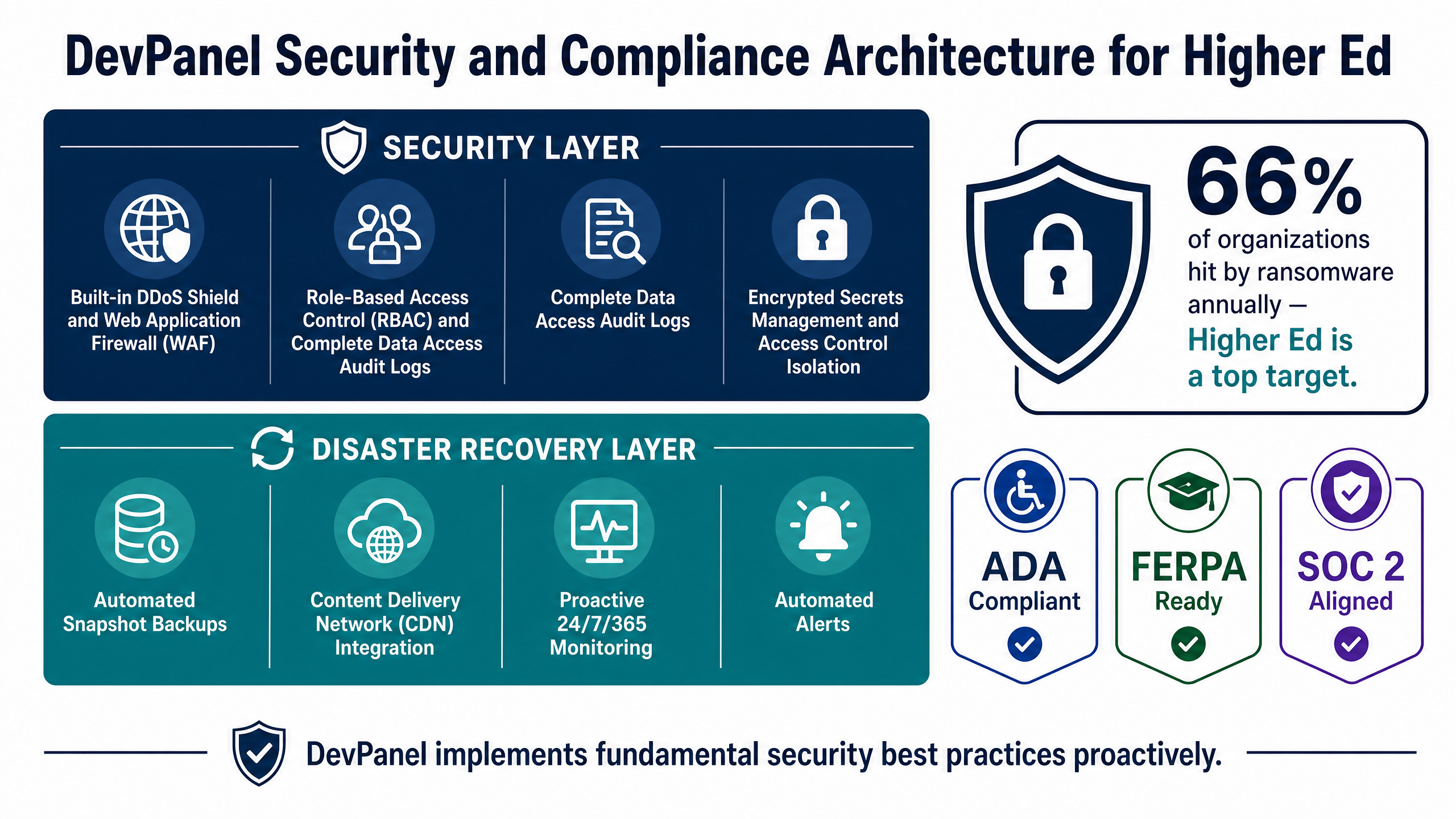
DevPanel implements fundamental security best practices proactively:
•DDoS Shield & WAF Integration: Protects campus sites against malicious traffic surges, brute-force attempts, and common web exploits.
•Access & Secrets Management: Provides strict role-based access control and encrypted secret management so developer keys are never exposed in code repositories.
•Automated Backups & Disaster Recovery: Offers customizable backup retention schedules and quick disaster recovery capabilities.
•Comprehensive Observability & Audit Trails: Keeps full logs of data access and system modifications to satisfy regulatory compliance reviews.
Challenge 4: Developer Onboarding & Cloud Dev Environments
A major internal bottleneck for digital agencies is developer environment setup. When an agency hires a new senior developer, onboarding a temporary student intern, or engaging an external sub-contractor, configuring local development environments (Docker, local PHP/Node runtimes, database syncs) can take days.
Furthermore, “it works on my local machine” bugs create friction between developers and quality assurance teams during client sign-offs.
Accelerated Development Cycles
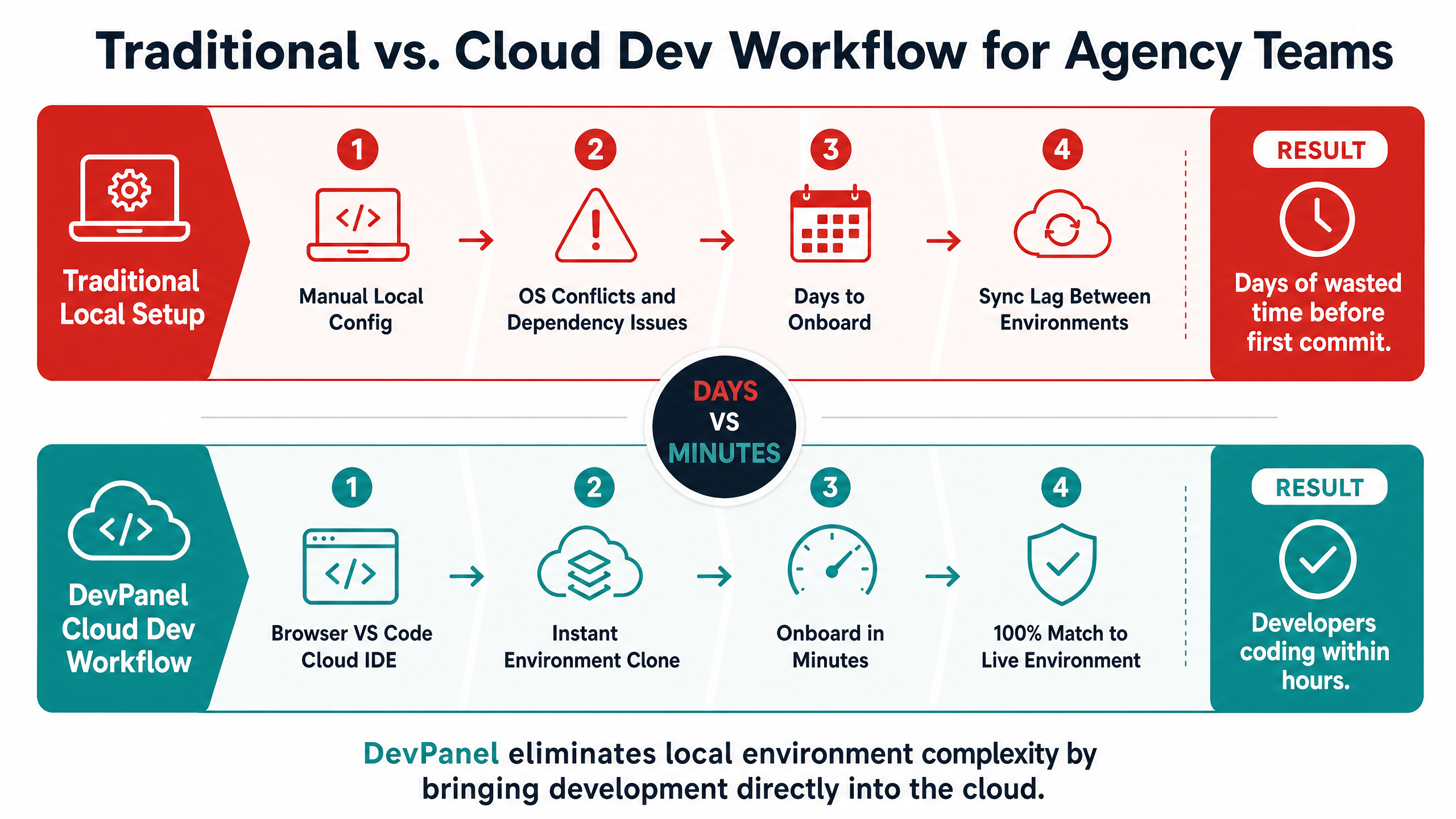
DevPanel eliminates local environment complexity by bringing development directly into the cloud:
•Onboard Developers in Minutes: As highlighted by agency developers, DevPanel provides a development space with fast setup, allowing new developers to get into the server and code within hours or less.
•Cloud IDE with VS Code: Developers can access their complete development workspace directly through a browser-based VS Code environment. Works on Mac, PC, Chromebooks, and tablets.
•Standardized Dev, Test, and Live Workflows: Agencies can spin up isolated Dev, Test, and Live environments with a single click.
•Eliminate Sysadmin Dependency: Developers get self-service environments without waiting for dedicated sysadmin or DevOps engineers to provision servers.
Challenge 5: Managing Multi-Site Sprawl and System Integrations
Higher education clients rarely run just one website. A typical agency project portfolio for a university client involves managing hundreds of departmental sites, faculty blogs, research portals, and campaign landing pages.
Additionally, higher ed sites must integrate seamlessly with third-party tools, such as:
•Student Information Systems (SIS)
•Learning Management Systems (LMS like Canvas or Blackboard)
•Enterprise CRMs (HubSpot, Salesforce/TargetX)
•Custom Webhooks and CI/CD pipelines
Centralized Control with Total Flexibility
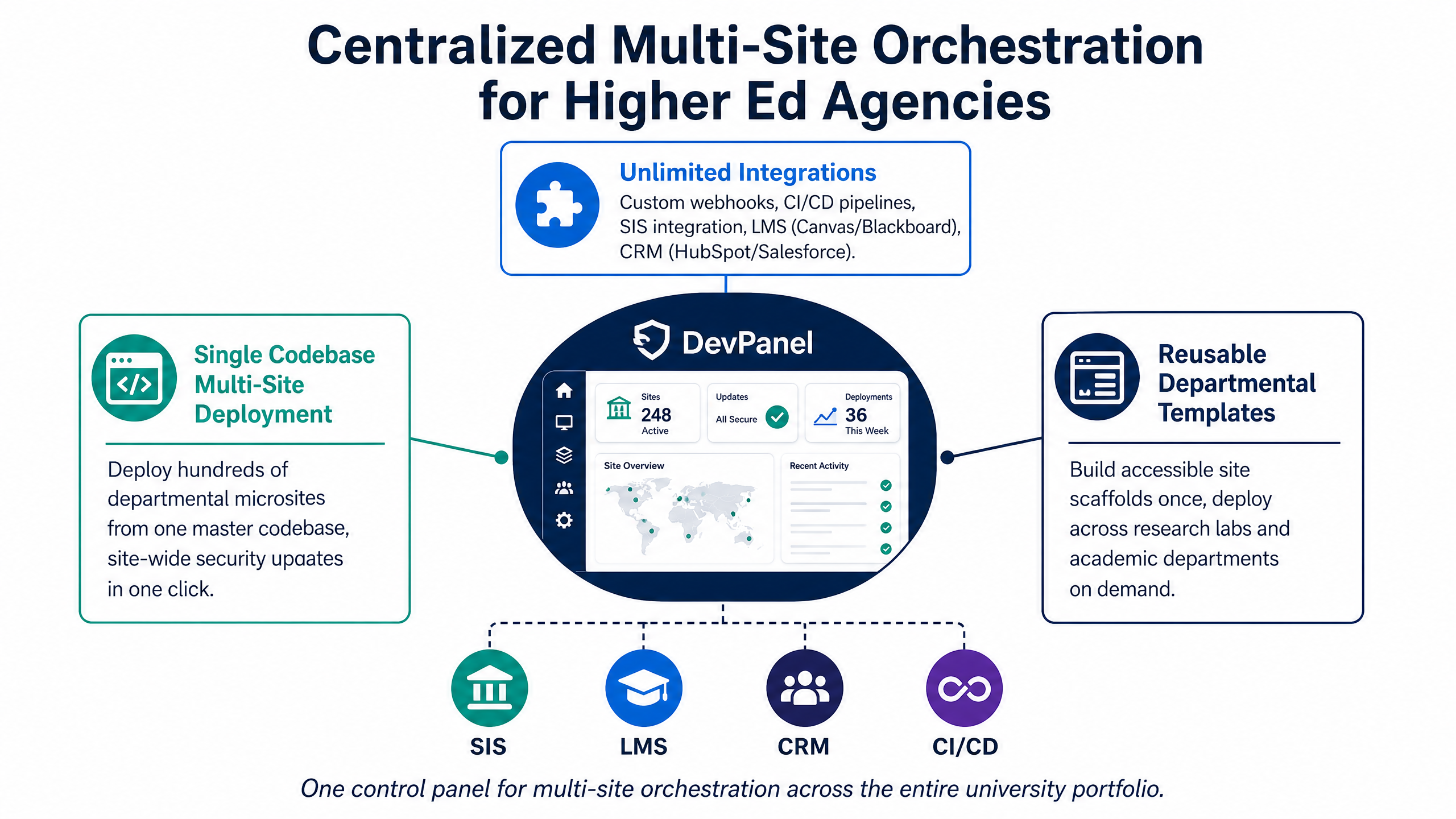
DevPanel provides an all-in-one control panel for multi-site orchestration:
•Single Codebase Multi-Site Deployment: Agencies can deploy hundreds of departmental microsites from a single master codebase, making site-wide security updates fast and painless.
•Unlimited Integrations & Customization: Unlike locked-down proprietary PaaS environments, DevPanel grants full access to tweak site performance, configure webhooks, and integrate any third-party API or CI/CD pipeline.
•Reusable Departmental Templates: Build standardized, accessible site scaffolds once, and deploy them across research labs and academic departments on demand.
Technical Feature Matrix: DevPanel vs. Legacy Higher Ed PaaS
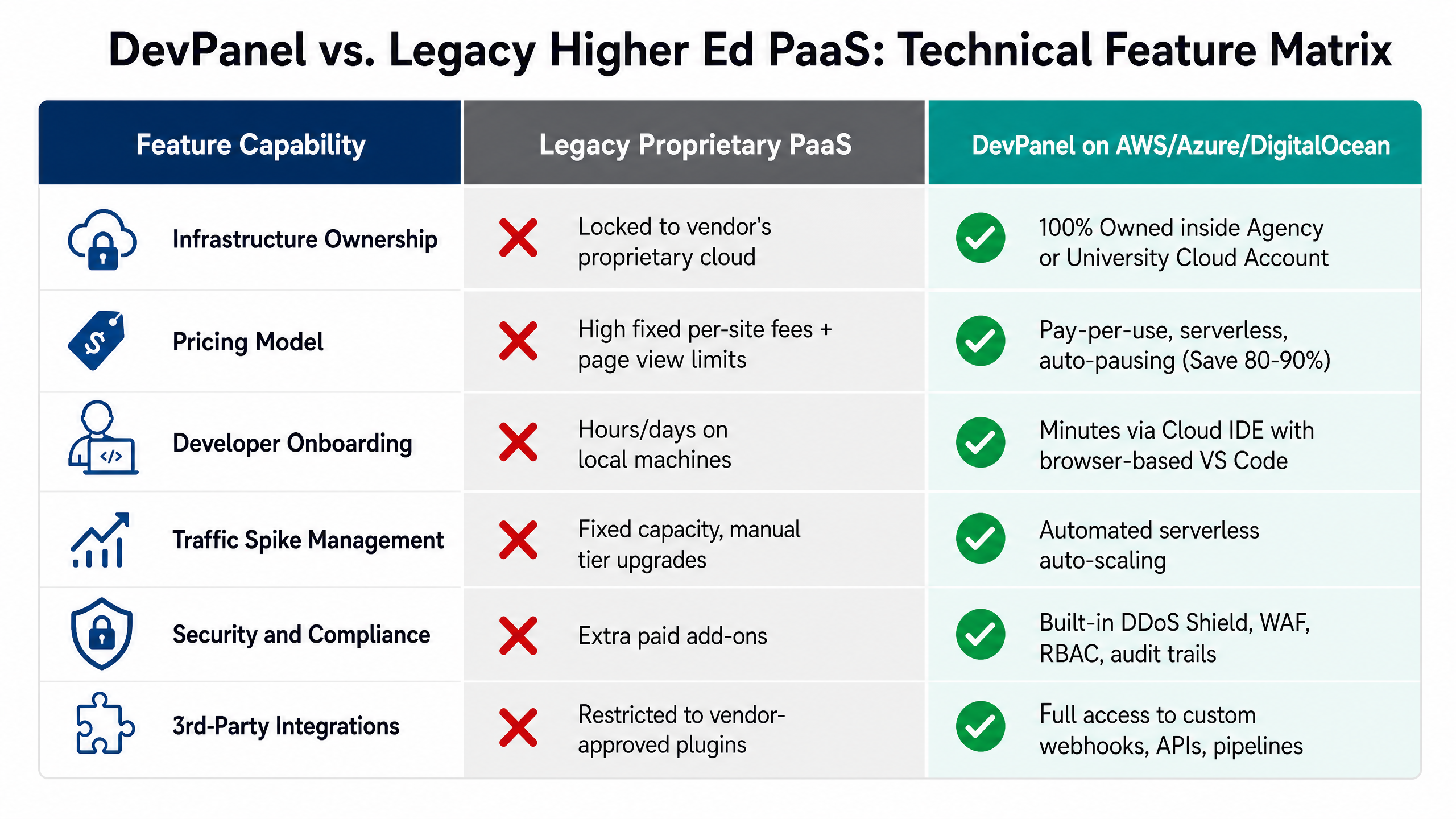
| Feature Capability | Legacy Proprietary PaaS | DevPanel on AWS / Azure / DigitalOcean | Agency Impact |
| Infrastructure Ownership | Locked to vendor’s proprietary cloud | 100% Owned inside Agency or University Cloud Account | Eliminates vendor lock-in; retains full data sovereignty. |
| Pricing Model | High fixed per-site fees + page view limits | Pay-per-use, serverless, and auto-pausing idle environments | Slashes client hosting costs by up to 80-90%. |
| Developer Onboarding | Hours/days spent configuring local machines | Minutes via Cloud IDE with browser-based VS Code | Accelerates project start times and developer output. |
| Traffic Spike Management | Fixed capacity; requires manual tier upgrades | Automated serverless auto-scaling up and down | Prevents registration crashes while saving off-peak costs. |
| Security & Compliance | Extra paid add-ons for advanced security | Built-in DDoS Shield, WAF, RBAC, and audit trails | Satisfies university IT security audits by default. |
| 3rd-Party Integrations | Restricted to vendor-approved plugins | Full access to custom webhooks, APIs, and pipelines | Connects easily with SIS, LMS, and higher ed CRMs. |
4-Step Action Plan for Agencies Servicing Higher Ed
If your digital agency is ready to elevate its technical operations, win more university RFPs, and protect client budgets, follow this implementation strategy:
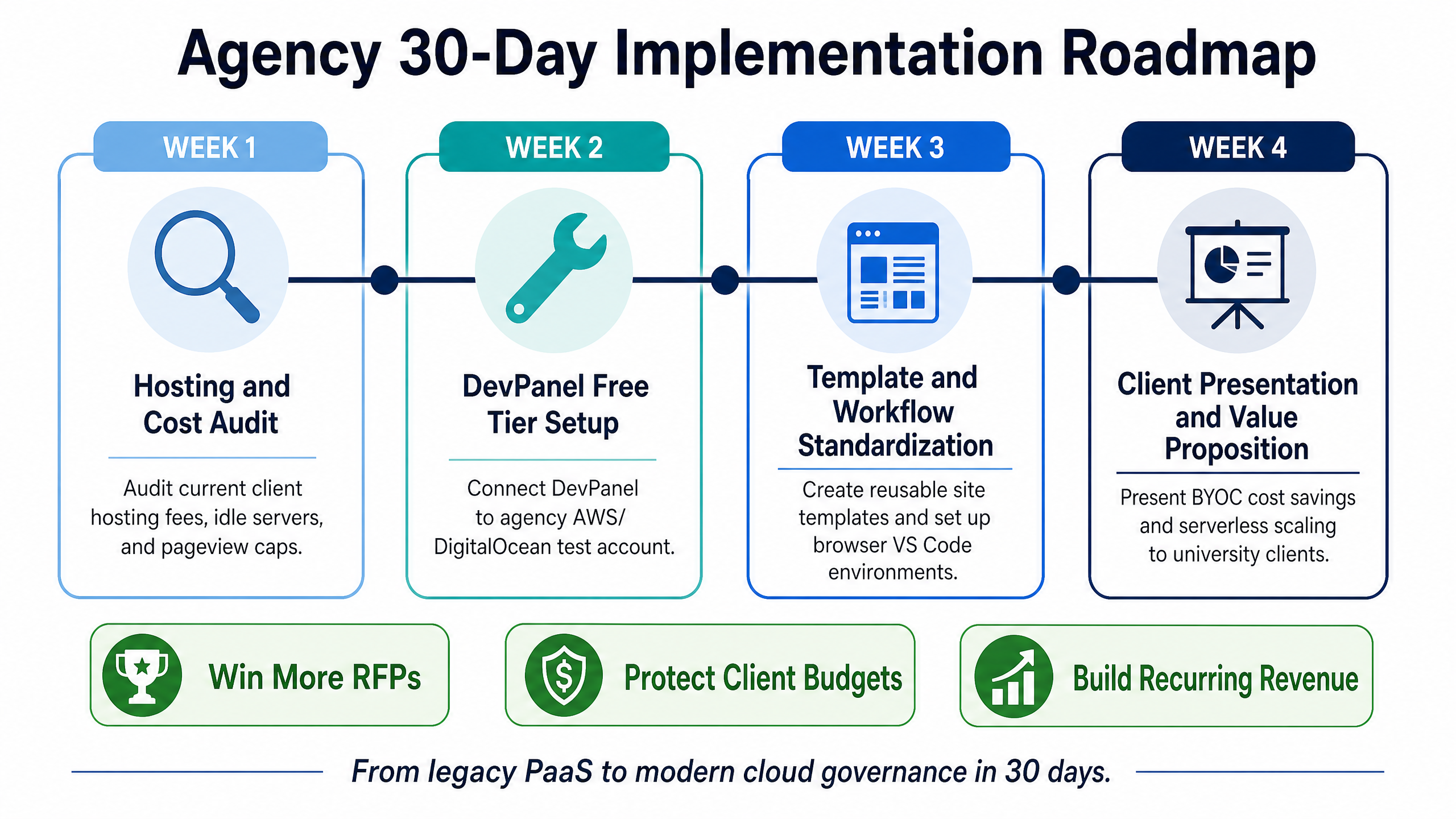
1.Audit Your Client Hosting Expenditures: Review your higher ed client portfolio. Identify how much they spend on legacy PaaS providers, how many non-production environments sit idle, and where traffic overage risks exist.
2.Start with DevPanel’s Free Developer Tier: Test DevPanel at no cost. Connect your agency’s AWS, Azure, or DigitalOcean account to build test sites and evaluate the cloud VS Code development environment.
3.Standardize Your Agency’s Site Scaffolds: Build master Drupal or WordPress templates complete with higher ed accessibility guardrails, pre-configured security modules, and standard CRM/LMS integrations.
4.Position Your Agency as a Value-Added Reseller (VAR): Pitch direct cloud hosting with DevPanel orchestration to your higher ed clients. Position your agency as a strategic partner focused on reducing client hosting costs while improving security, speed, and scalability.
Frequently Asked Questions (FAQ)
Q1: How does DevPanel help digital agencies win more higher ed client proposals?
A: DevPanel allows agencies to offer higher education institutions direct cloud ownership (AWS/Azure/DigitalOcean) with automated serverless scaling and built-in security—slashing their client’s hosting costs by up to 80% compared to traditional PaaS vendors. This positions the agency as a cost-conscious, highly technical partner.
Q2: Can digital agencies generate recurring hosting revenue using DevPanel?
A: Yes. Agencies can become Value-Added Resellers (VARs) by managing cloud infrastructure through DevPanel on behalf of their clients. Agencies can bundle 24/7 support, managed maintenance, and cloud orchestration into a recurring monthly package while still delivering significant savings to the client.
Q3: How fast can new developers be onboarded using DevPanel’s cloud environments?
A: Developers can be fully onboarded in minutes. By utilizing browser-based VS Code and automated environment cloning, agencies eliminate the need for manual local machine configuration (Docker, MAMP, etc.), drastically accelerating project start times.