
Case Study: Scaling to 11M Daily Hits: A Guide to High-Traffic Hosting on AWS
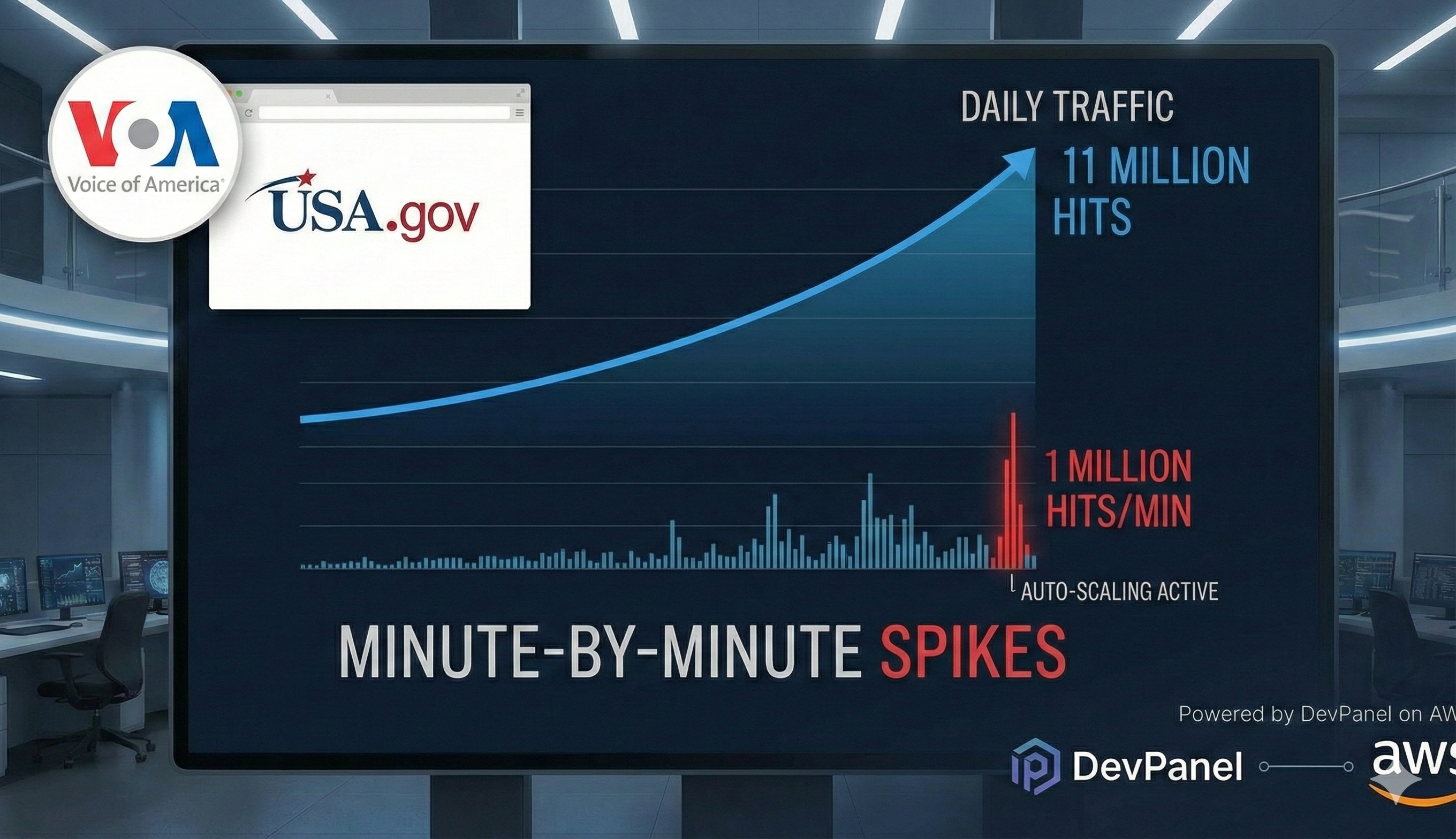
In the world of digital publishing, traffic is usually a metric of success. However, for enterprise-level organizations and government agencies, traffic can quickly become an infrastructure nightmare. What do you do when your website needs to handle 11 million hits per day—and instantly scale to absorb shocks of over 1 million hits per minute during breaking news events?
For most DevOps teams, achieving this level of resilience isn’t just a “stretch goal”—it is a full-blown crisis waiting to happen. Standard hosting solutions crumble under this pressure. Databases lock up, caching layers fail, and “loading” spinners replace headlines.
But for one prominent U.S. government news agency, operating one of the world’s most visited English-language news sites, this level of traffic was simply a daily reality. Their mandate required them to deliver critical information to a global audience without interruption, regardless of the load.
To solve this, they needed a paradigm shift in High-Traffic Hosting on AWS. They partnered with DevPanel to design, build, and implement an enterprise-grade architecture that could achieve what 99% of teams cannot.
This case study details how they moved from a fragile, expensive legacy system to a robust, auto-scaling AWS environment, achieving zero downtime deployments and 75% cost savings.
The Reality of High-Traffic Hosting on AWS
Managing a site with millions of daily visitors requires more than just “buying bigger servers.” It requires a sophisticated orchestration of compute power, database optimization, and content delivery networks (CDNs).
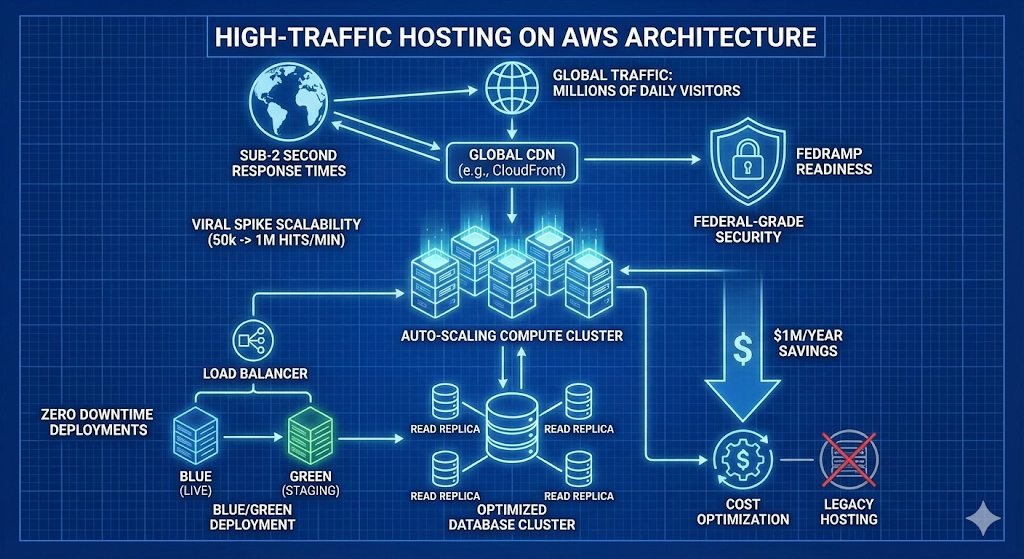
The agency’s requirements went far beyond the capabilities of traditional managed hosting platforms or standard cloud setups. They needed a solution that delivered:
- Zero Downtime Deployments: The ability to push code updates during peak traffic without dropping a single connection.
- Sub-2 Second Response Times: ensuring global accessibility even on slow connections.
- Viral Spike Scalability: The capacity to ramp up resources instantly when traffic surged from 50,000 to 1,000,000 hits per minute.
- Federal-Grade Security: Compliance with strict government standards (FedRAMP readiness).
- Massive Cost Reductions: Moving away from a bloated $1 million/year hosting contract.
This is the ultimate test for High-Traffic Hosting on AWS.
The Crisis: Why Traditional Architectures Failed
Before engaging DevPanel, the news agency was in a precarious position. Their existing hosting setup was buckling under the sheer weight of their audience. Despite paying nearly $1 million annually for a premium managed hosting service, the infrastructure was fragile.
The challenges were not theoretical; they were operational failures that occurred regularly:
1. The “Viral Traffic” Bottleneck
Breaking news does not announce itself. When a major story broke, traffic didn’t gradually increase; it exploded. The agency saw spikes reaching 1 million hits per minute. Their legacy infrastructure relied on reactive scaling that was too slow to catch up, leading to 503 errors exactly when the public needed the site most.
2. Database Connection Exhaustion
At this scale, the database is almost always the first point of failure. The agency’s previous setup struggled with connection limits. Thousands of concurrent users hitting the site simultaneously would max out the available database connections, causing the backend to seize up, even if the web servers had plenty of CPU capacity.
3. CDN Misconfigurations
A Content Delivery Network (CDN) is supposed to shield the origin server, but theirs was leaking. Misconfigurations meant that too many requests were bypassing the cache and hitting the origin directly. This “cache-busting” traffic overwhelmed the backend servers, defeating the purpose of the CDN.
4. High-Risk Deployments
Perhaps the most stressful aspect for the internal team was the deployment process. Pushing new code risked disrupting millions of active users. Because they lacked a true Blue/Green deployment mechanism, every release was a gamble. The fear of breaking the site meant that critical updates were often delayed, stalling innovation.
Internal teams lacked the deep, specialized DevOps expertise required to re-architect this monolithic system into a modern, microservices-based, auto-scaling solution. They didn’t need just a new host; they needed a fundamentally new strategy for High-Traffic Hosting on AWS.
Architecting for Resilience: The DevPanel Solution
DevPanel was brought in with a clear mission: Build what others couldn’t.
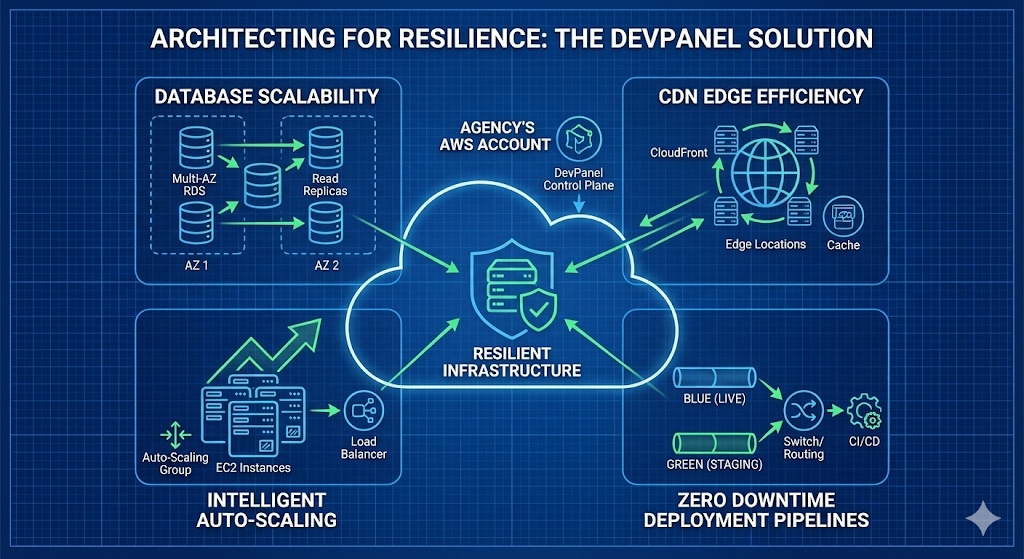
The goal was to architect a Multi-Availability Zone (Multi-AZ), auto-scaling AWS environment that could handle the agency’s massive baseline traffic and survive the most extreme viral spikes. DevPanel utilized its “Control Plane” approach—deploying the infrastructure directly into the agency’s own AWS account while providing a simplified management interface.
The solution focused on four critical pillars of High-Traffic Hosting on AWS:
- Database Scalability
- CDN Edge Efficiency
- Intelligent Auto-Scaling
- Zero Downtime Deployment Pipelines
The result was an infrastructure capable of scaling from thousands to millions of requests per minute—automatically, reliably, and securely.
1. Solving the Database Bottleneck in High-Traffic Hosting
When discussing High-Traffic Hosting on AWS, most people focus on EC2 instances (web servers). However, at 11 million hits per day, the database is your bottleneck.
Standard LAMP stack configurations cannot handle the concurrency required for this level of traffic. If 50,000 users try to read an article simultaneously, a standard database will crash under the connection load.
The DevPanel Approach:
To solve this, DevPanel implemented a highly distributed database architecture:
- Multi-AZ Distributed Databases: The database layer was spread across multiple AWS Availability Zones. If one data center experienced an outage, the system would automatically failover to a standby instance without service interruption.
- Aggressive Connection Pooling: DevPanel introduced an intermediate layer to manage database connections. Instead of opening a new connection for every user request (which is resource-intensive), connections were pooled and reused. This allowed the database to serve thousands of concurrent requests without maxing out connection limits.
- Read Replicas: Traffic was split between “Read” and “Write” operations. Since news sites are heavy on reads (millions of people reading stories) and light on writes (editors publishing stories), DevPanel offloaded the read traffic to multiple Read Replicas. This ensured that a viral story never blocked an editor from publishing breaking news.
2. CDN Configuration: A Business-Critical Decision
In High-Traffic Hosting on AWS, the CDN is your shield. The efficiency of your CDN determines whether your origin servers survive a viral spike.
The metric that matters here is the Edge-to-Origin Ratio. This measures how much traffic is served by the CDN (at the “edge” of the network) versus how much hits your actual servers (“origin”).
- 50% Efficiency: Half the traffic hits your servers. At 11 million hits, that’s 5.5 million requests hammering your database.
- 74% Efficiency: Only 26% of traffic hits your servers.
The DevPanel Optimization:
The agency was using Akamai, a top-tier CDN, but it wasn’t tuned for their specific traffic patterns. DevPanel reconfigured the Akamai implementation to achieve:
- 74% Edge-to-Origin Ratio: By fine-tuning cache-control headers and invalidation logic, DevPanel ensured that the vast majority of traffic was served from the cache.
- Intelligent Throttling: During extreme spikes, the CDN was configured to queue or throttle requests at the edge, preventing the backend from being totally overwhelmed.
- Dynamic Content Caching: DevPanel implemented strategies to cache semi-dynamic content safely, balancing the need for “fresh” news with the need for stability.
At this scale, even a 1% improvement in cache efficiency translates to hundreds of thousands of requests saved daily.
3. Auto-Scaling That Isn’t Just a Checkbox
Many cloud providers claim to offer “auto-scaling,” but standard auto-scaling is often too slow for news agencies. If traffic jumps from zero to 1 million in 60 seconds, standard AWS scaling policies (which might take 5 minutes to spin up new servers) will result in downtime.
To master High-Traffic Hosting on AWS, scaling must be proactive and rapid.
The DevPanel Strategy:
DevPanel moved beyond basic CPU-based scaling. They implemented:
- Predictive and Step Scaling: Instead of adding one server at a time, the system was configured to add servers in large “steps” (e.g., add 10 servers at once) when specific traffic thresholds were breached.
- Pre-Warming: Utilizing historical data to pre-scale infrastructure ahead of known high-traffic events (like elections or scheduled announcements).
- Cascade Failure Prevention: By simulating real-world viral spikes, DevPanel tuned the thresholds to ensure that the influx of new servers didn’t accidentally overwhelm the database during their boot-up sequences.
4. Zero Downtime Deployments: Blue/Green Architecture
For a news agency, downtime is not an option. You cannot take the site offline for maintenance when a global crisis is unfolding.
To achieve Zero Downtime Deployments, DevPanel implemented a robust Blue/Green Deployment strategy. This is the gold standard for High-Traffic Hosting on AWS, but it is notoriously difficult to implement manually.
How It Works:
- Blue Environment (Live): This is the current version of the site, serving all 11 million daily hits.
- Green Environment (Staging/Next): A complete, exact replica of the infrastructure is spun up with the new code.
- Testing Under Load: The Green environment is tested—not just for functionality, but under simulated heavy traffic to ensure performance.
- The Switch: Once validated, the load balancers instantly redirect traffic from Blue to Green.
The Result:
- Users experience no interruption.
- If the Green environment shows any errors, the load balancer instantly reverts traffic to Blue (One-Click Rollback).
- DevPanel validated this process under loads exceeding 1 million hits per minute, ensuring that deployments were safe even during viral events.
Performance Testing and Real-World Results
The transition to DevPanel wasn’t just a theoretical improvement; the data proved the success of the new High-Traffic Hosting on AWS architecture.
DevPanel conducted rigorous stress testing using real-world load simulation tools to verify the limits of the system. The results were definitive:
- 1.78 Million Hits Per Minute Sustained: The system handled sustained viral spikes without degradation.
- 10% Faster Response Times: Despite the higher traffic load, the optimized architecture delivered content faster than the previous legacy host.
- Zero Downtime: Simulated deployments during peak load resulted in zero dropped connections.
- Immediate Auto-Scaling: New resources were provisioned and active within seconds of traffic spikes detection.
Key Results (At a Glance)
| Requirement | Result Delivered |
| Daily Traffic | 11M+ hits/day |
| Viral Traffic Spikes | 1M+ hits/minute handled with auto-scaling |
| Deployment Downtime | Zero (via Blue/Green deployment) |
| CDN Edge Efficiency | 74% edge-to-origin ratio with Akamai |
| Performance | 10% faster vs. prior setup |
| Hosting Cost | Cut by more than 75% |
| Rollbacks | One-click, instant failback |
| Security | Government-grade with full auditability |
The Financial Impact: 75% Cost Savings
Perhaps the most shocking result of this migration was the cost efficiency. High-performance hosting usually commands a premium price. However, the agency’s previous $1 million/year bill was largely due to the inefficiencies of legacy managed hosting and “over-provisioning” (paying for massive servers all the time, just in case traffic spiked).
By moving to DevPanel on AWS, the agency shifted to a true utility model:
- Pay for What You Use: Auto-scaling meant they only paid for massive compute power during the minutes they actually needed it.
- No Vendor Markup: Because DevPanel runs inside the client’s own AWS account, the agency paid AWS directly. There was no “middleman markup” on the infrastructure costs.
- Reduced Operational Overhead: Automation reduced the need for a large army of manual sysadmins.
This efficiency allowed the agency to reduce their total hosting and operations costs by over 75%, freeing up hundreds of thousands of dollars to be reinvested into journalism and content creation.
Beyond Tech: Operational & Strategic Impact
The success of High-Traffic Hosting on AWS isn’t measured solely by server response times. It is also measured by the agility of the team managing it.
DevPanel’s platform provided a point-and-click “Control Plane” over this complex AWS setup. This had a profound impact on the agency’s internal culture:
- Democratized DevOps: Developers and content producers could manage environments, view logs, and trigger deployments without needing to be AWS certified architects.
- Reduced Stress: The fear of deploying code vanished. With automated testing and one-click rollbacks, the team became more confident and prolific.
- Focus on Mission: instead of firefighting infrastructure issues, the team could focus on their core mission: delivering news to the public.
DevPanel operated as an extension of their team, handling the deep architectural complexity while giving the agency full control over their application.
FAQs: Mastering High-Traffic Hosting on AWS
Q: Why is standard auto-scaling insufficient for news sites?
A: Standard auto-scaling is reactive. By the time metrics like CPU usage spike and trigger a new server launch, the existing servers may already be overwhelmed. High-traffic sites require predictive scaling and “step scaling” to provision resources before the crash occurs.
Q: How does Blue/Green deployment reduce risk?
A: Blue/Green deployment ensures that the new version of your site is fully running and tested in a production-like environment before any users see it. If an error is detected after the switch, traffic can be instantly routed back to the old version, eliminating prolonged downtime.
Q: Can I achieve these results without a dedicated DevOps team?
A: Yes. Platforms like DevPanel are designed to bridge the gap. They provide the “DevOps in a box” capability, automating the complex AWS configurations (like Kubernetes, Load Balancers, and Auto-Scaling Groups) so you can get enterprise performance without an enterprise-sized IT staff.
Q: What is the most critical component for 11M+ daily hits?
A: While all components matter, the database strategy is usually the linchpin. You can easily add more web servers, but scaling a database is difficult. Implementing Read Replicas and connection pooling is essential for survival at this scale.
Could Your Infrastructure Handle This?
The challenges faced by this U.S. government agency are not unique to the public sector. E-commerce platforms during Black Friday, media sites during breaking news, and apps launching viral features all face the same “11M Daily Hit” reality.
Ask yourself these questions to evaluate your readiness for High-Traffic Hosting on AWS:
- Can your setup withstand 1 million hits per minute—right now? Or would it crash?
- Do you have rollback strategies in place that take seconds, not hours?
- Can your team architect a Blue/Green deployment that works at enterprise scale?
- Are you relying on costly over-provisioning instead of smart auto-scaling?
- Could DevPanel save you 75% on hosting while improving performance?
If you aren’t sure of the answers—or if you are currently paying too much for hosting that delivers too little performance—this case study offers a roadmap to a better solution.
You don’t have to choose between bankruptcy-inducing hosting bills and website crashes. With the right architecture and the right automation partner, you can handle the world’s traffic.
👉 [Download the full “11M Daily Hits + 1M Spikes per Minute” case study PDF]
Let’s Talk
DevPanel isn’t for everyone. But if you are responsible for high-traffic, high-visibility, high-risk websites, and you need an AWS-native solution that works out of the box—this is what we do best.
Whether you are looking to replicate the success of this government agency or simply want to stabilize your current infrastructure, we are ready to help.
📬 Email us: contact@devpanel.com
🌐 Visit us: https://www.devpanel.com
📅 Request a 15-minute call to see if this architecture is right for your organization.