
Sovereign AI for WordPress: Why Regulated Teams Need Customer-Owned Cloud
AI is becoming part of the modern WordPress stack.
Healthcare organizations are exploring AI chatbots, patient education assistants, content workflows, search tools, and knowledge bases. Government agencies are evaluating AI for public information delivery. Universities are testing AI for student services, research communications, and content discovery. Nonprofits are looking for ways to use AI to scale support, outreach, and program delivery.
But for regulated organizations, adding AI to WordPress creates a new infrastructure question:
Where does the data go when AI is involved?
For a basic marketing site, that question may not seem urgent. For a hospital, public agency, university, financial institution, or nonprofit handling sensitive information, it becomes central to compliance, risk, and long-term cloud strategy.
Sovereign AI for WordPress is about keeping the WordPress site, the data it processes, the AI services it uses, and the infrastructure behind it inside a boundary the organization can understand, govern, and control.
That does not mean every organization needs to build AI infrastructure from scratch. It does mean regulated teams need more control than traditional managed hosting usually provides.
This is where DevPanel’s customer-owned cloud model becomes important.
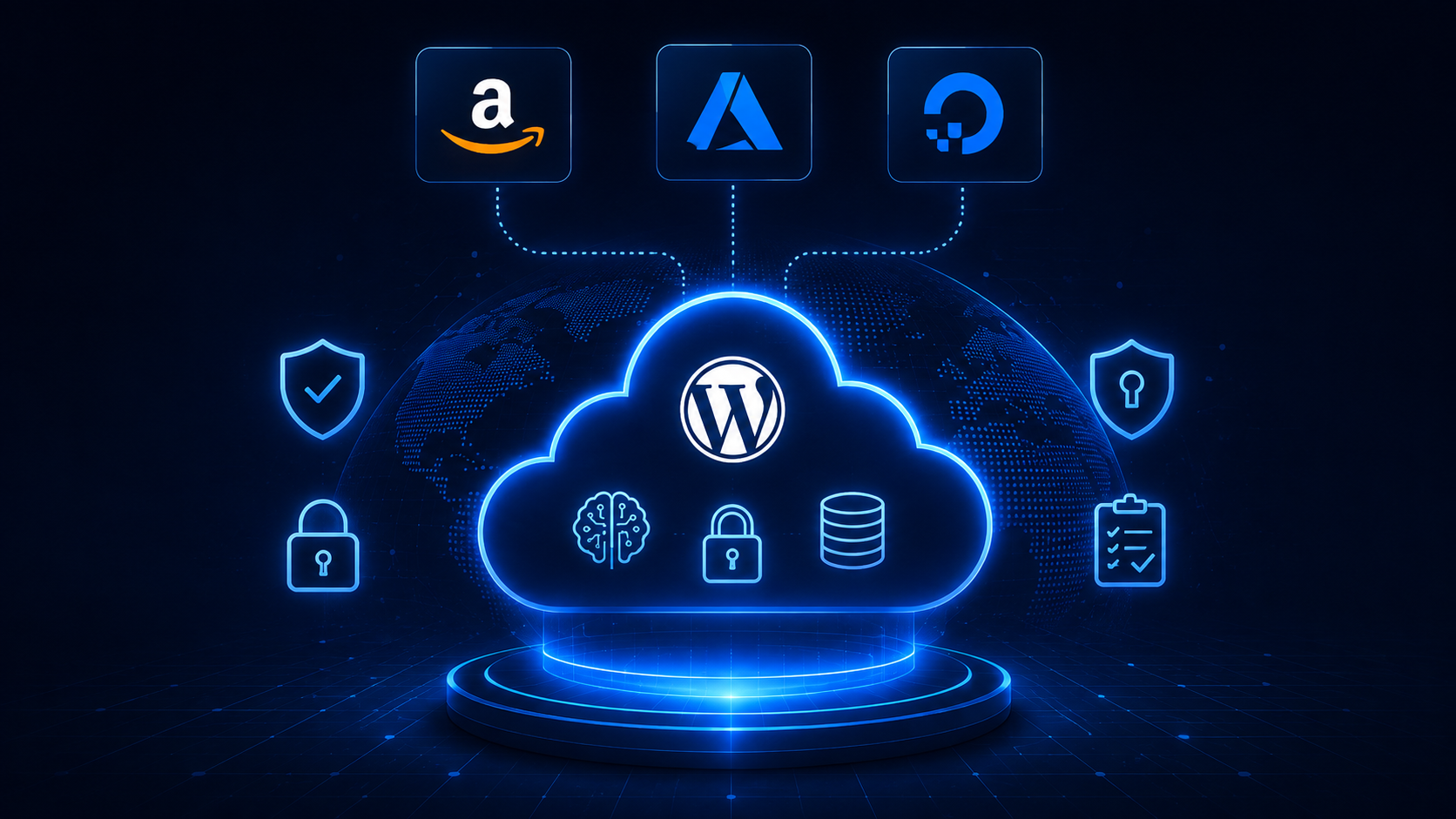
DevPanel is not a traditional hosting company that asks customers to move into a closed platform. DevPanel acts as a control layer on top of the customer’s own cloud infrastructure. That allows organizations to run WordPress in their own AWS, Azure, DigitalOcean, or other cloud account while still getting automation, environment management, DevOps workflows, and operational support.
For regulated WordPress teams exploring AI, that model offers a practical path forward: own the infrastructure, control the boundary, and automate the complexity.
What Sovereign AI Means for WordPress
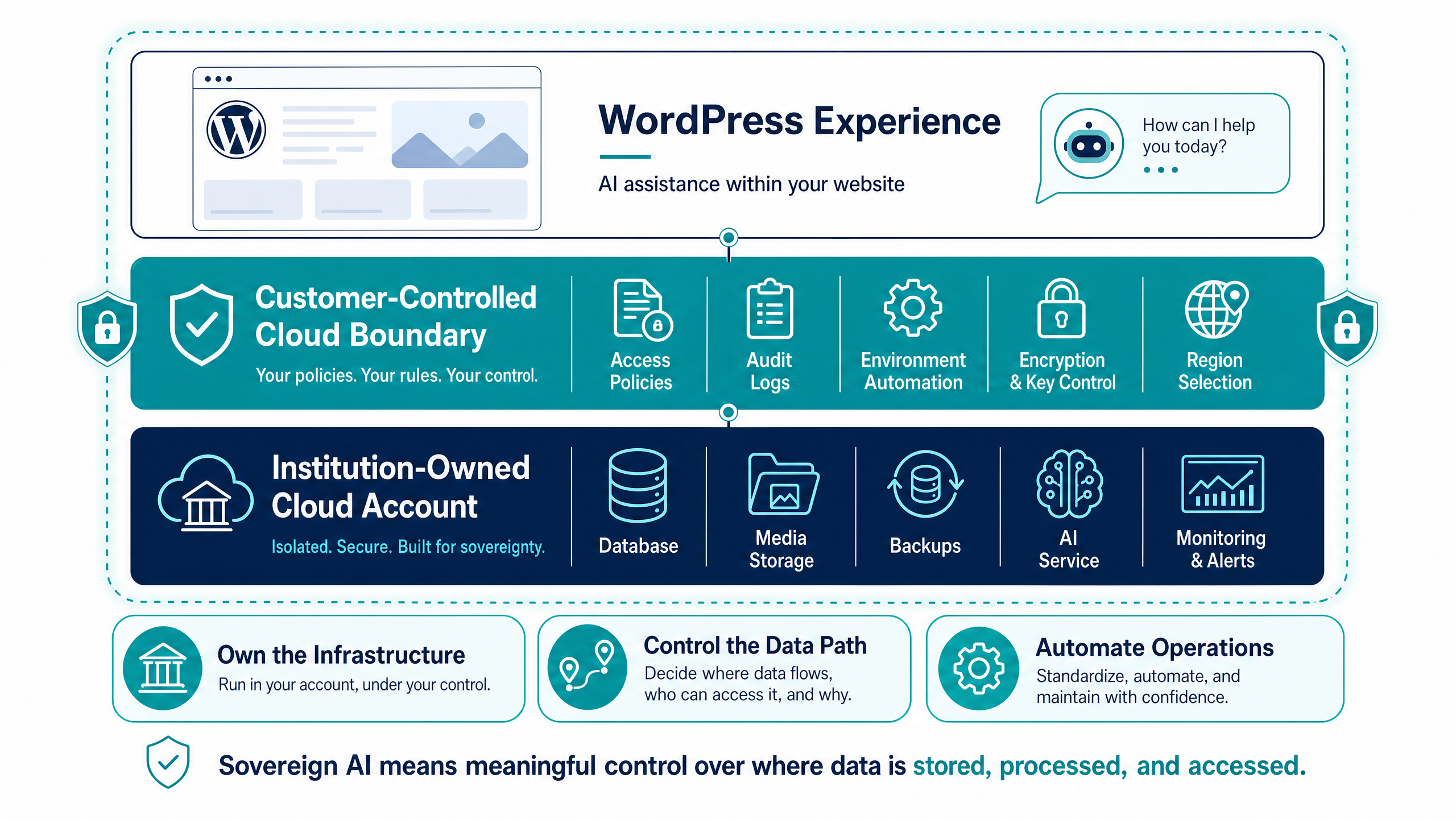
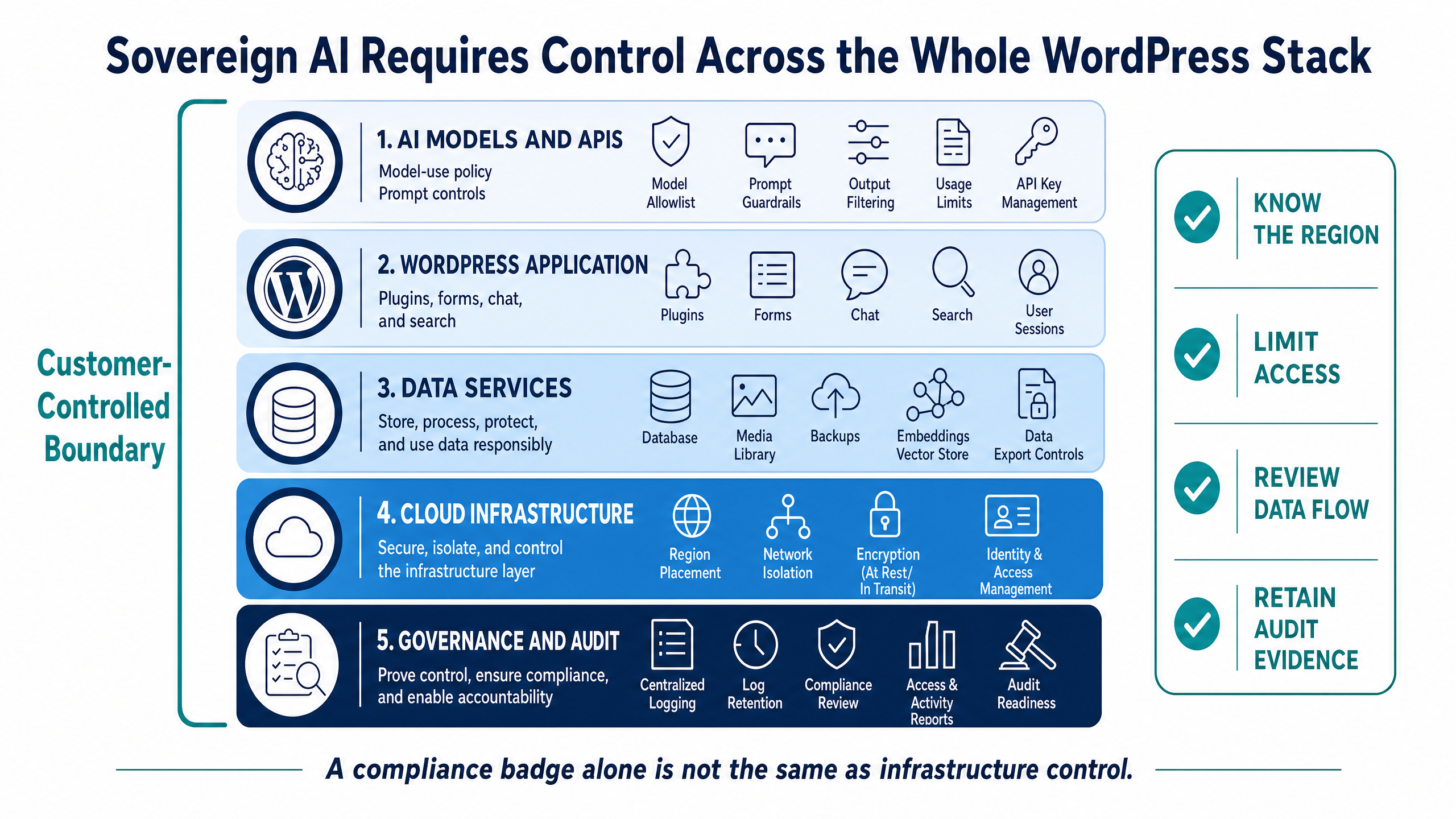
Sovereign AI means AI systems are designed so an organization has meaningful control over where data is stored, where it is processed, who can access it, and which legal or regulatory boundaries apply.
For WordPress, that usually means thinking through several layers:
Where the WordPress application runs
Where the database is hosted
Where files and media are stored
Where backups are kept
Which AI models or APIs are used
Whether prompts or user inputs are sent to third-party systems
Whether AI outputs are logged or retained
Which cloud region processes the data
Who controls the cloud account and access policies
This matters because WordPress is no longer just a publishing system for many organizations. It may power public information portals, membership systems, patient education sites, grant-funded programs, student-facing content, event registration, donation workflows, internal knowledge bases, or support experiences.
Once AI enters that stack, data flow becomes harder to ignore.
A chatbot may receive user questions. An AI search system may process content and user intent. A content assistant may summarize sensitive documents. A personalization system may use behavioral or account-level data.
For regulated teams, the question is not only “Does the AI work?”
The better question is:
Can we prove where AI processing happens and who controls the infrastructure around it?
Why Regulated Sectors Need More Than a Compliance Badge
A vendor’s compliance documentation can be useful, but it is not the same as infrastructure control.
Healthcare, government, higher education, financial services, and regulated nonprofits often need to answer detailed questions about data residency, access control, auditability, recovery, security operations, and vendor risk.
A managed platform may provide compliance documentation, but the customer still needs to understand how its own data moves through the system. That becomes more complicated when WordPress connects to AI services, external APIs, plugins, search tools, analytics platforms, or third-party integrations.
This is why customer-owned cloud matters.
When the infrastructure runs inside the customer’s own cloud account, the organization has more direct control over cloud region, network design, access policies, logging, security services, and integration patterns.
AWS describes Regions as separate geographic areas, and its data residency guidance explains how organizations can use AWS Regions and controls to meet location-specific requirements. AWS Control Tower also provides region-deny and residency-focused guardrails that can restrict where resources are created or used.
That level of control is difficult to match when all infrastructure is owned and operated inside a third-party managed hosting platform.
The point is not that every managed provider is wrong for regulated teams.
The point is that AI changes the hosting conversation. Regulated AI workloads often require more control than a standard managed hosting model was originally designed to provide.
Managed WordPress Convenience Has Limits
Managed WordPress and managed Drupal platforms became popular because they reduced operational burden.
They gave teams a simpler way to launch, update, and support websites without managing servers directly. For many organizations, that was a real improvement.
But managed hosting often trades control for convenience.
The provider controls the infrastructure. The provider defines the platform limits. The provider decides which regions, services, tools, and operational patterns are available. The customer gets a streamlined experience, but not full infrastructure ownership.
That model can work well for standard websites.
It becomes more limiting when an organization needs:
Customer-owned infrastructure
Specific cloud regions
AI processing inside a chosen cloud boundary
Direct access to logs and infrastructure settings
Private networking
Custom security architecture
Integration with AWS-native or Azure-native services
More control over backups and recovery
A clear path away from vendor lock-in
Pantheon, for example, offers site creation in multiple regions, including the United States, Australia, Canada, and the European Union. That may be enough for some organizations, but for teams that need deeper infrastructure ownership, region availability alone may not answer every sovereignty, AI, or compliance question.
With DevPanel, the model is different.
The infrastructure can run inside the customer’s own cloud account. DevPanel provides the control layer, automation, and workflows on top.
That gives regulated teams a better balance: managed convenience without giving up ownership of the underlying cloud.
AWS Bedrock and the Sovereign AI Opportunity
For organizations using AWS, Amazon Bedrock is one of the clearest ways to bring generative AI into a controlled cloud strategy.
Amazon Bedrock gives customers access to foundation models through AWS. AWS states that Amazon Bedrock does not share customer input or output data with model providers and does not use that data to train models. AWS also states that prompts and outputs are not used to train Amazon foundation models unless the customer chooses to use their data for customization.
For regulated organizations, those details matter.
A WordPress site can be integrated with AI in many ways. The risky path is installing plugins or external tools without understanding where user data, prompts, embeddings, or outputs are being sent.
The more controlled path is to connect WordPress to AI services that run within the organization’s chosen cloud architecture and compliance model.
Amazon Bedrock has also achieved FedRAMP High authorization in AWS GovCloud, and AWS has announced FedRAMP High and DoD IL4/IL5 approvals for certain Bedrock models in AWS GovCloud regions.
This does not automatically make every WordPress AI implementation compliant. Configuration, architecture, legal review, access controls, logging, and data handling still matter.
But it gives regulated teams a stronger foundation.
When WordPress, cloud infrastructure, and AI services can be managed inside the customer’s cloud strategy, the organization has more control over the full data path.
The Real Problem: AI Data Flow Is Often Invisible
Many organizations do not have a WordPress problem.
They have a visibility problem.
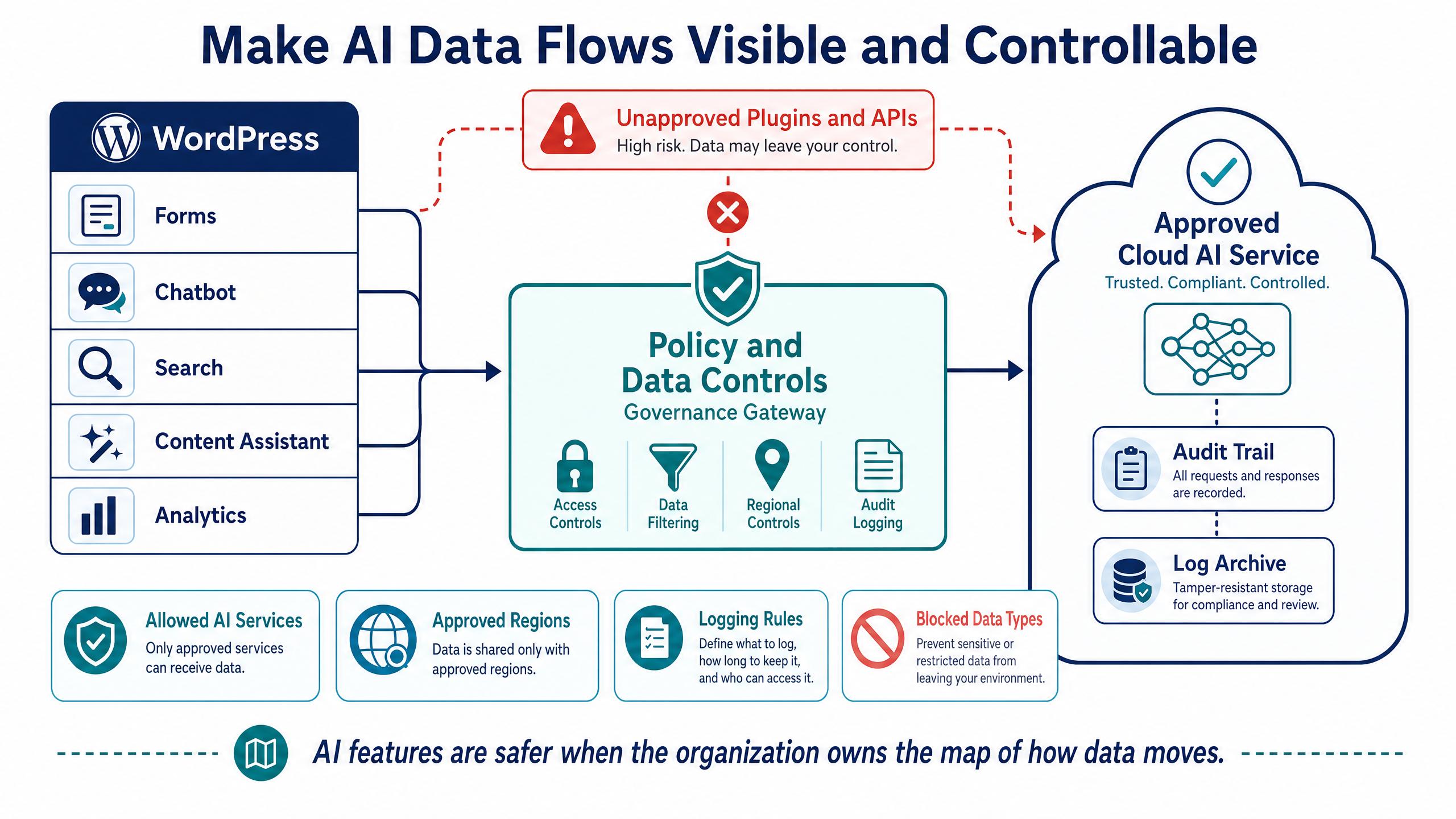
They do not always know which plugins are sending data to external APIs. They do not always know where analytics data goes. They may not know whether AI-powered search, chat, translation, moderation, or content generation tools retain prompts or use user input for training.
That is a serious problem for regulated sectors.
AI features can be added quickly, but compliance analysis usually moves more slowly. A marketing team may install an AI plugin. A developer may connect an external API. A content team may adopt an AI writing assistant. A chatbot may get embedded on a public website.
Each decision may seem small.
Together, they create a data flow map that nobody fully owns.
Sovereign AI for WordPress starts by making those flows visible and controllable.
That means choosing an infrastructure model that allows the organization to decide:
Which AI services are allowed
Which regions can process data
Which logs are retained
Which data is sent to AI models
Which data is blocked from AI processing
Which cloud services are used
Which vendors have access
Which compliance controls apply
DevPanel does not replace legal or compliance review. But by helping organizations run WordPress inside their own cloud account, it gives technical and compliance teams a stronger foundation for controlling these decisions.
Pantheon vs AWS vs AWS with DevPanel
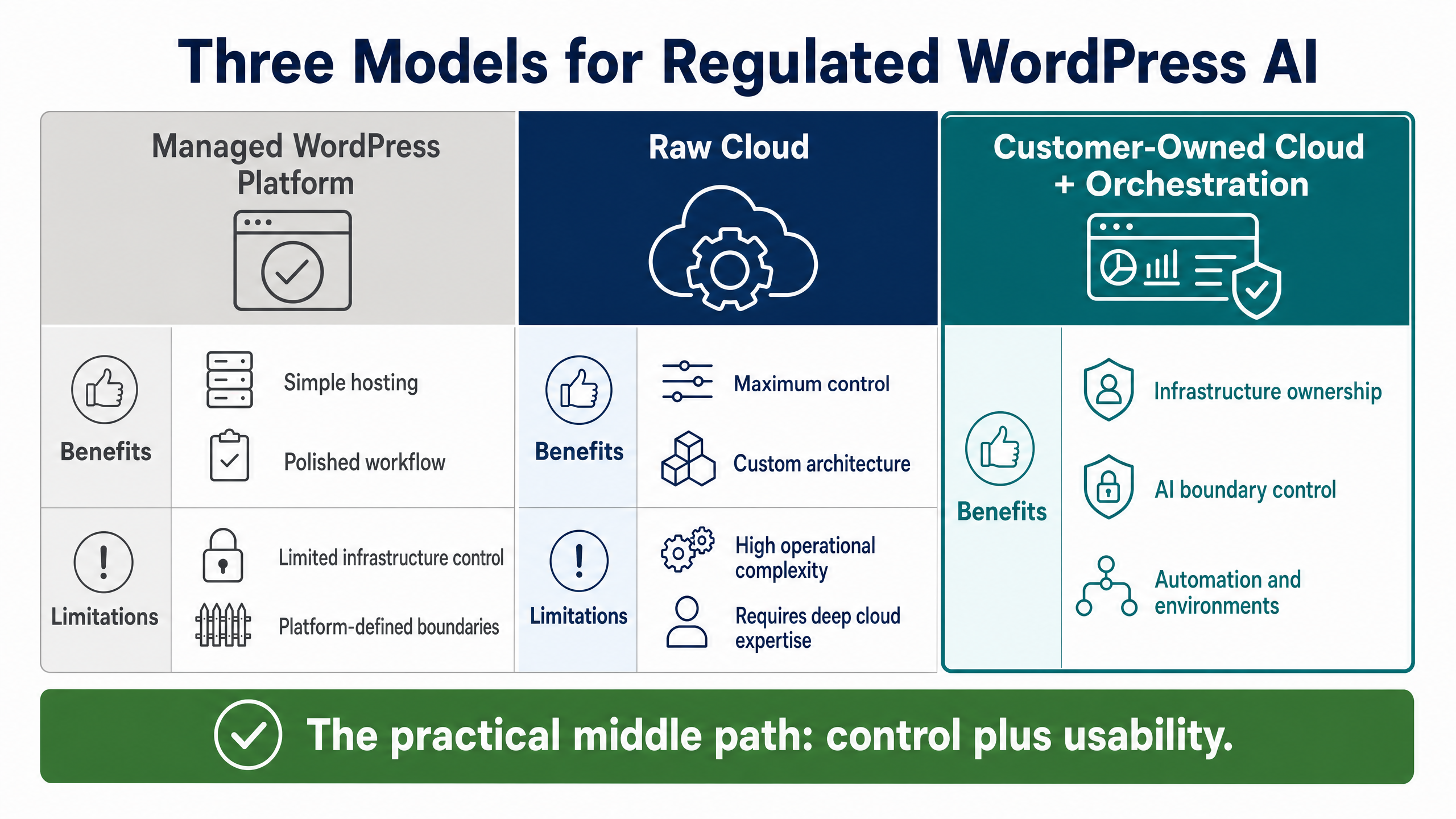
For regulated WordPress teams evaluating sovereign AI, the practical comparison often comes down to three models.
Option 1: Managed WordPress Platform
A managed platform gives convenience. The provider handles much of the hosting complexity, and the customer gets a polished workflow.
This can be useful for many teams.
The limitation is control. The customer usually does not own the underlying infrastructure account. Deep customization, cloud-native AI architecture, data residency controls, and specialized compliance requirements may be constrained by the provider’s platform model.
Option 2: Raw AWS
Raw AWS gives the customer maximum control.
The organization can choose regions, design VPCs, configure IAM, connect to Bedrock, manage private networking, create logging policies, and define its own compliance architecture.
The limitation is operational complexity.
Most WordPress teams do not want to become AWS infrastructure teams. Building and maintaining a secure, scalable, compliant WordPress platform on AWS requires real cloud expertise.
Option 3: AWS with DevPanel
AWS with DevPanel gives the customer infrastructure ownership while reducing day-to-day cloud complexity.
The customer owns the AWS account. DevPanel provides automation, environment management, deployment workflows, developer tooling, and operational support.
This is the strongest model for many regulated WordPress teams because it combines the two things they need most:
control and usability.
The customer owns the compliance boundary. DevPanel helps operate the platform.
Why DevPanel Fits Regulated WordPress AI
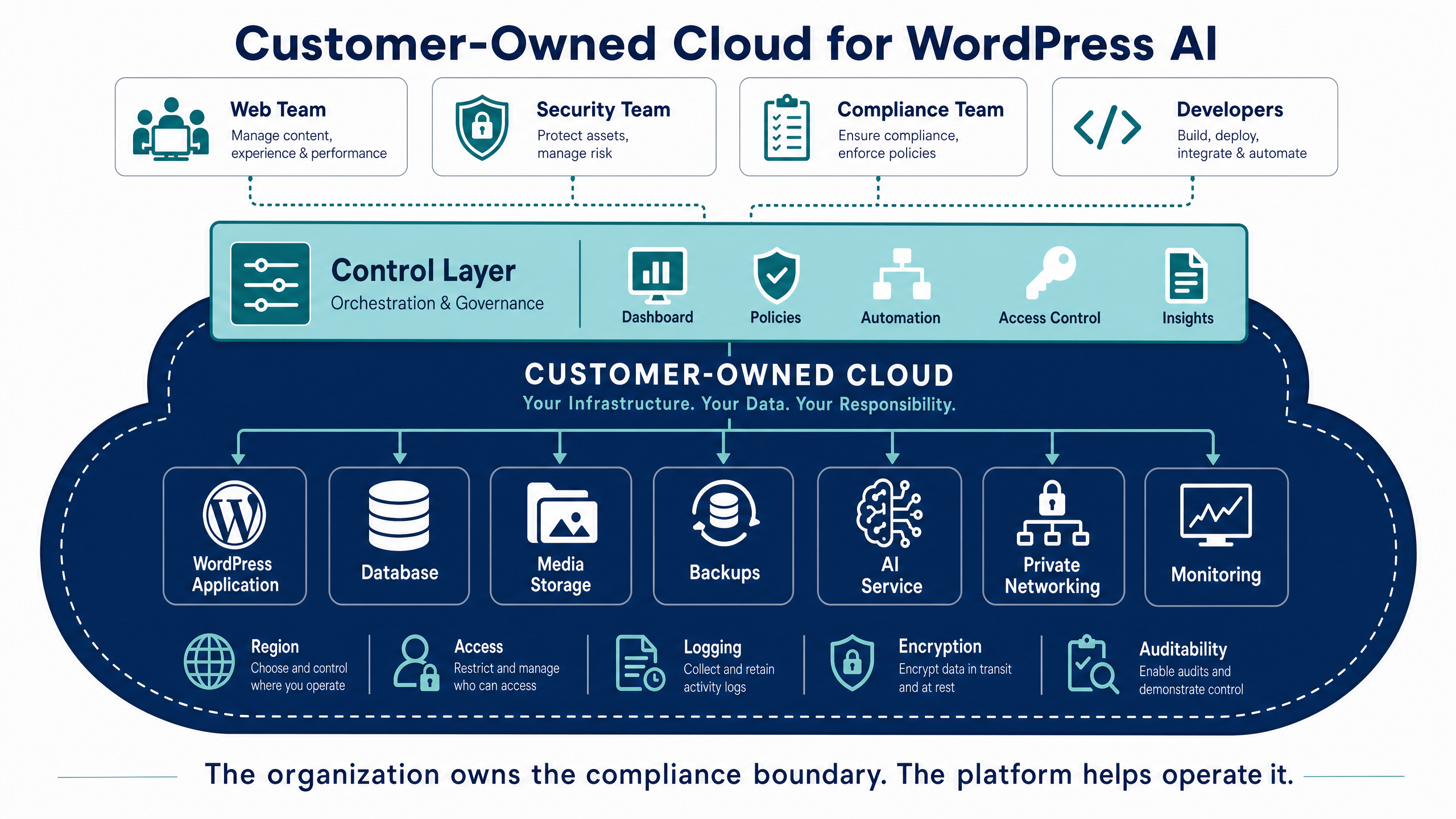
DevPanel is aligned with regulated AI use cases because it is built around customer-owned infrastructure.
That matters for four reasons.
First, the customer owns the cloud account. The WordPress environment, databases, files, and cloud services can live in the customer’s AWS, Azure, DigitalOcean, or other cloud account.
Second, DevPanel automates the operational layer. Teams do not need to manually build every environment, deployment workflow, or cloud process from scratch.
Third, DevPanel supports modern development workflows. Dev, test, staging, and production environments can be standardized and managed more consistently.
Fourth, DevPanel reduces vendor lock-in at the infrastructure layer. If an organization changes tooling in the future, the infrastructure and data are still in the customer’s cloud account.
This is especially important for AI.
AI strategy is changing quickly. Models, regulations, vendors, and best practices will keep evolving. A regulated organization should avoid locking its entire AI-enabled WordPress strategy into a platform it cannot control.
DevPanel lets teams build on their own cloud foundation instead.
Healthcare WordPress and Sovereign AI
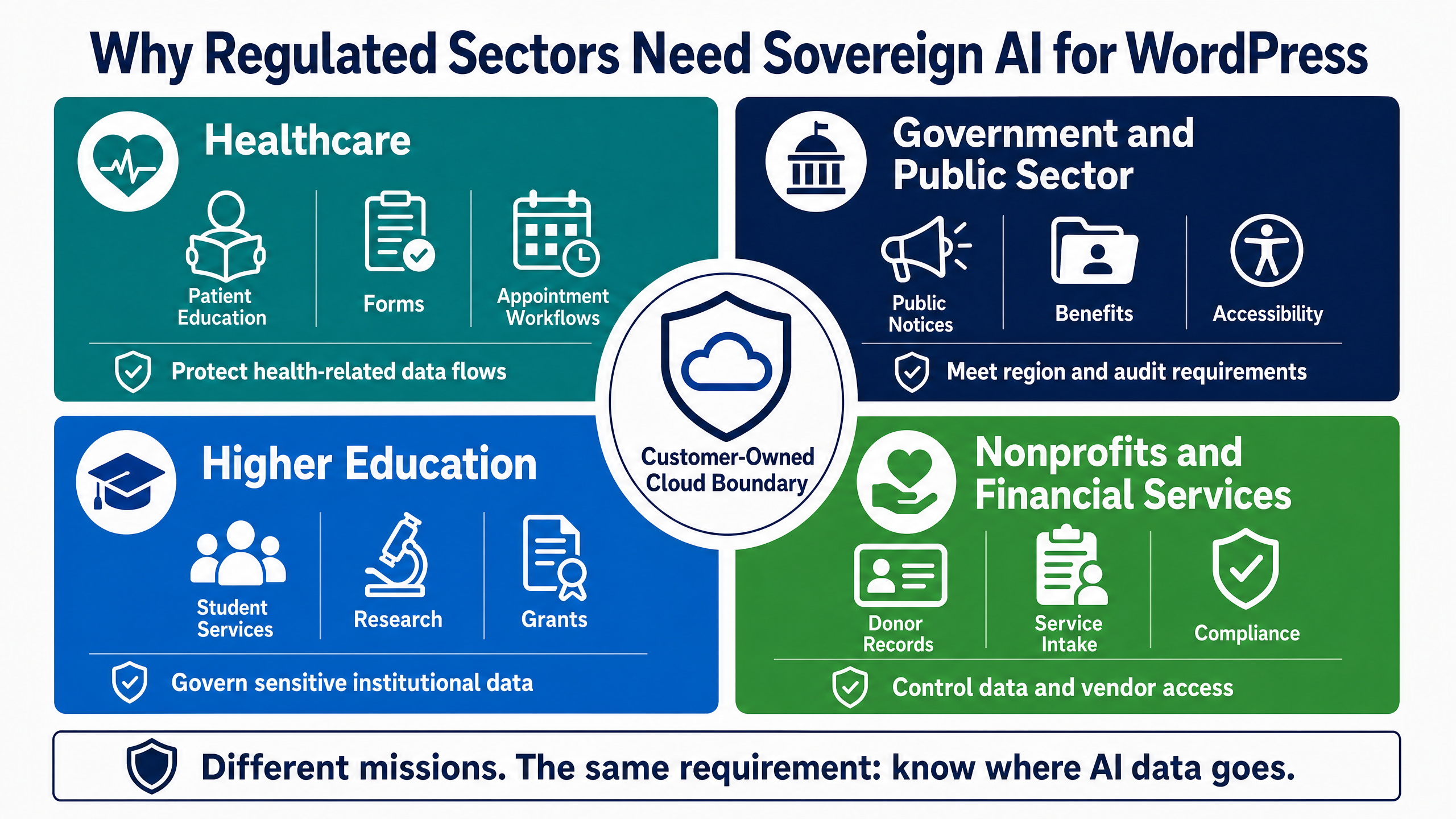
Healthcare organizations need to be especially careful with AI-enabled WordPress experiences.
A public-facing hospital website may seem low risk, but it can quickly become sensitive if it includes patient forms, appointment workflows, symptom checkers, care navigation, member portals, or personalized content.
Healthcare teams should not assume that an AI plugin is safe just because it works.
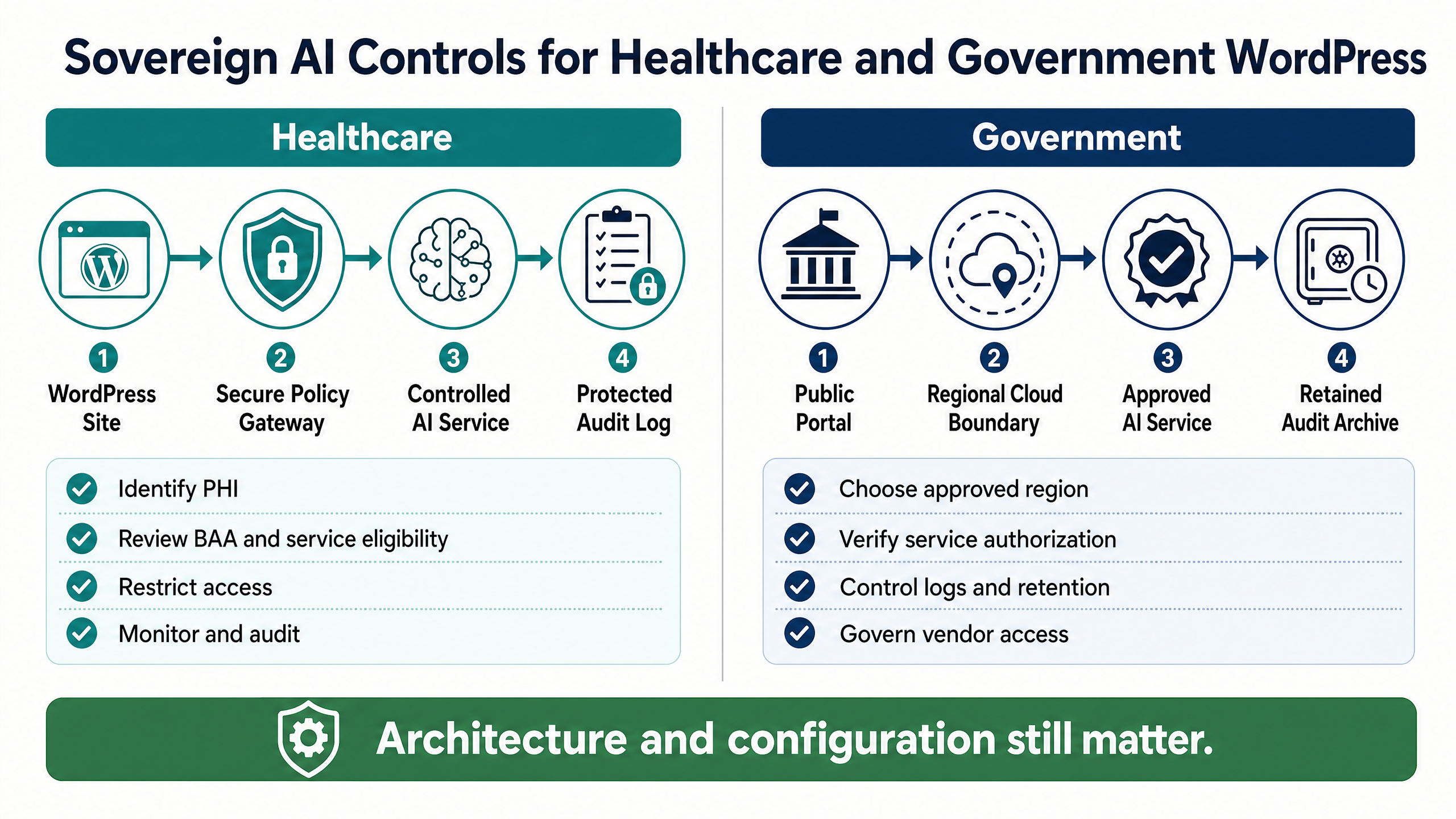
They need to know:
Is protected health information involved?
Where is that information processed?
Is the AI service HIPAA eligible?
Is there a BAA in place where required?
Is data stored, logged, or used for training?
Can the organization audit the flow?
Can access be restricted and monitored?
The practical point is simple: healthcare teams need control over both the WordPress infrastructure and the AI services connected to it.
DevPanel helps by giving healthcare organizations a more controlled cloud foundation for WordPress while reducing the operational burden of managing raw AWS or Azure manually.
Government and Public Sector WordPress
Government agencies face similar challenges.
A public-sector WordPress site may include public notices, service applications, benefits information, accessibility workflows, emergency communications, or public feedback forms.
When AI is added, the agency may need to know whether data is processed in a specific region, whether services meet FedRAMP requirements, whether logs are retained appropriately, and whether external vendors have access.
For government use cases, service eligibility and architecture both matter. Amazon Bedrock’s FedRAMP High status in AWS GovCloud is useful, but it still needs to be implemented in an architecture that matches the agency’s requirements.
A customer-owned cloud model gives government teams more architectural control.
DevPanel can then provide the management layer that makes that architecture usable for web and application teams.
Higher Education and Nonprofits
Universities and nonprofits often face a different version of the same issue.
They may not always identify as “regulated sectors,” but they often handle sensitive information. Universities may deal with student records, research data, grants, donor information, event registrations, and authenticated portals. Nonprofits may handle donor data, client intake, health-related programs, community services, or government-funded reporting.
These organizations usually have limited technical resources.
They need cloud control, but they do not want the full burden of cloud operations.
DevPanel’s customer-owned cloud model gives them a practical path: run WordPress in their own cloud account, standardize environments, and automate operations without depending entirely on a closed hosting provider.
The Academy of Model Aeronautics example shows how this model can work for resource-constrained organizations. AMA managed more than 30 websites across Drupal, Backdrop, and WordPress, wanted AWS benefits without deep AWS expertise, and used DevPanel to centralize management so one person could manage what previously required more people and outside vendor coordination.
The lesson is simple: customer-owned cloud does not have to mean cloud complexity.
With the right control layer, smaller teams can operate at a much higher level.
The Cost Question: Control Without Unnecessary Platform Markup
Regulated organizations often assume that sovereign infrastructure must be expensive.
Sometimes it is.
But cost depends heavily on the model.
A managed platform may charge a premium for convenience. Raw AWS may reduce infrastructure cost, but increase staffing and operational burden. DevPanel creates a middle path: customers pay cloud providers directly for infrastructure, while DevPanel provides the automation and control layer that reduces operational complexity.
This distinction matters for WordPress teams.
The goal is not to be the cheapest option. Regulated teams should not choose infrastructure only by price.
The goal is to pay for the right thing.
Pay for infrastructure you own.
Pay for automation that saves time.
Pay for workflows that reduce risk.
Pay for support that improves reliability.
Avoid paying a premium for a hosting model that limits your control when your AI and compliance needs require more ownership.
Building a Better Executive Case
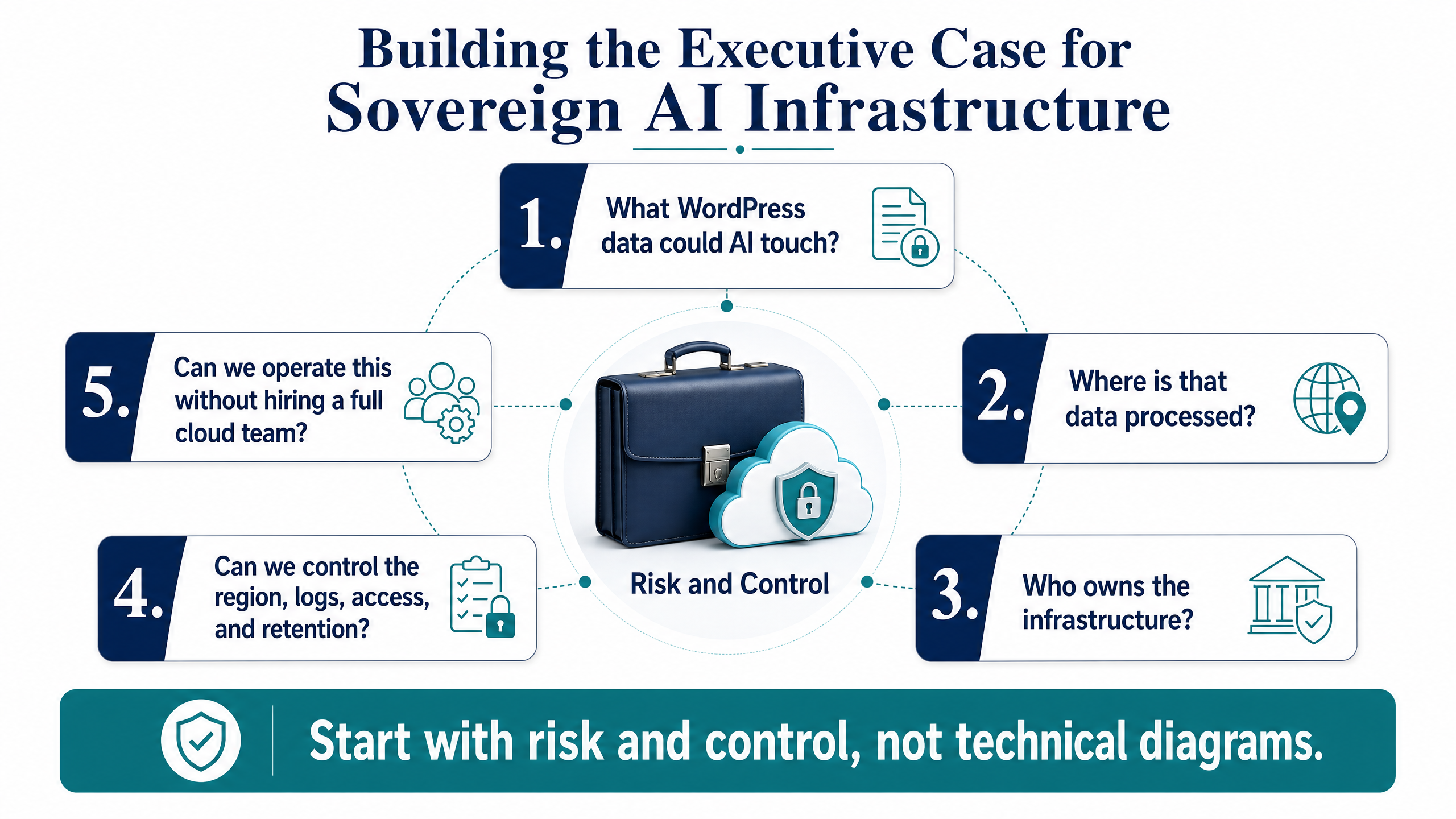
If you need to make the case for sovereign AI infrastructure internally, avoid starting with technical diagrams.
Start with risk and control.
Executives need to understand that AI changes the hosting conversation. Once AI tools process user data, content, forms, search queries, or personalized experiences, the organization needs a clearer answer about where that data goes.
A strong executive case should answer five questions:
What WordPress data could AI touch?
Where is that data processed?
Who owns the infrastructure?
Can we control the region, logs, access, and retention?
Can we operate this model without hiring a full cloud team?
DevPanel helps answer the fifth question.
It gives teams a way to own infrastructure without manually carrying every cloud operation.
That is the real business value.
A Practical Path to Sovereign AI for WordPress
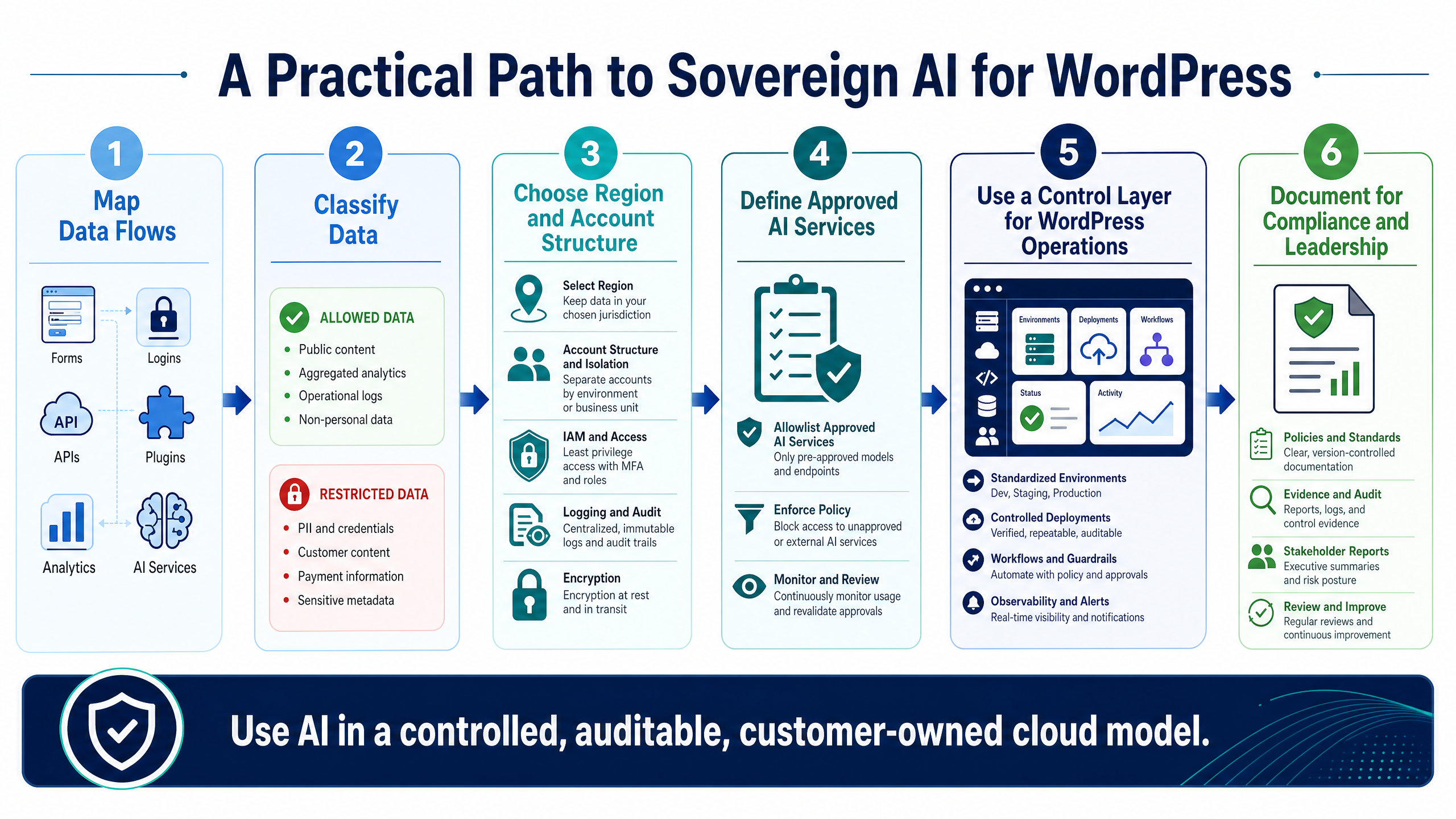
Regulated teams do not need to rebuild everything at once.
A practical path looks like this:
First, map current WordPress data flows. Identify forms, logins, search, analytics, plugins, APIs, CRM integrations, and AI tools.
Second, classify data sensitivity. Decide which data can go to external systems and which data must remain inside a controlled boundary.
Third, choose the cloud region and account structure. For AWS users, this may include region restrictions, IAM policies, logging, encryption, and service controls.
Fourth, define approved AI services. For many AWS-centered organizations, this may include Amazon Bedrock configured according to internal compliance requirements.
Fifth, use DevPanel as the control layer for WordPress environments, deployments, development workflows, and operational management.
Sixth, document the model for compliance, legal, IT, and leadership teams.
This approach gives teams a realistic path forward.
It does not ask them to stop using AI.
It asks them to use AI in a controlled, auditable, customer-owned cloud model.
FAQ
What does sovereign AI mean for WordPress?
Sovereign AI for WordPress means the site, data, AI services, and supporting infrastructure are designed so the organization can control where data is stored, where AI processing happens, who has access, and which jurisdictional or compliance boundaries apply.
Why does AI change WordPress hosting requirements?
AI changes WordPress hosting because prompts, user inputs, search queries, form submissions, and content may be sent to AI systems for processing. Regulated organizations need to know where that processing happens and who controls the infrastructure.
Is managed WordPress hosting enough for regulated AI use cases?
Managed WordPress hosting may be enough for some use cases, but regulated AI workloads often require deeper infrastructure ownership, cloud-region control, logging access, security configuration, and approved AI service integration.
How does DevPanel support sovereign AI for WordPress?
DevPanel supports sovereign AI for WordPress by letting organizations run WordPress inside their own cloud account while using DevPanel as the control layer for environments, deployments, automation, and operational workflows.
Is AWS Bedrock useful for sovereign AI?
AWS Bedrock can be useful for sovereign AI because it gives customers access to foundation models through AWS and includes data privacy and compliance capabilities. Organizations still need to configure Bedrock and their WordPress architecture according to their own legal, security, and compliance requirements.
Is customer-owned cloud the same as unmanaged cloud?
No. Customer-owned cloud means the customer owns the infrastructure, but it does not have to mean the customer manages everything manually. With DevPanel, the customer owns the cloud account while DevPanel provides automation and operational control.
Conclusion
Sovereign AI for WordPress is becoming a real issue for regulated organizations.
Healthcare systems, government agencies, universities, nonprofits, and financial institutions need more than AI features. They need control over where data is processed, which infrastructure supports it, who can access it, and how the environment can be audited.
Legacy managed hosting gives convenience, but it often limits infrastructure ownership. Raw AWS gives control, but it creates operational complexity. DevPanel gives organizations a third path.
With DevPanel, regulated WordPress teams can run in their own cloud account while using automation, development workflows, and platform management to reduce complexity.
That is the future of WordPress infrastructure for regulated AI use cases.
Not closed hosting.
Not unmanaged cloud.
Customer-owned cloud with DevPanel as the control layer.