
How Agencies Can Build Premium Cloud Services on DevPanel
Many agencies already provide hosting, maintenance, and DevOps support for their clients.
The problem is that most agencies deliver these services manually.
A client needs a new staging site, so someone provisions it. A developer needs a test environment, so someone copies files and databases. A site needs updates, so someone schedules the work, checks compatibility, pushes changes, and hopes nothing breaks. A client wants better performance, so the agency investigates caching, server sizing, CDN rules, database load, and deployment workflows.
This work is valuable, but it is often hard to scale.
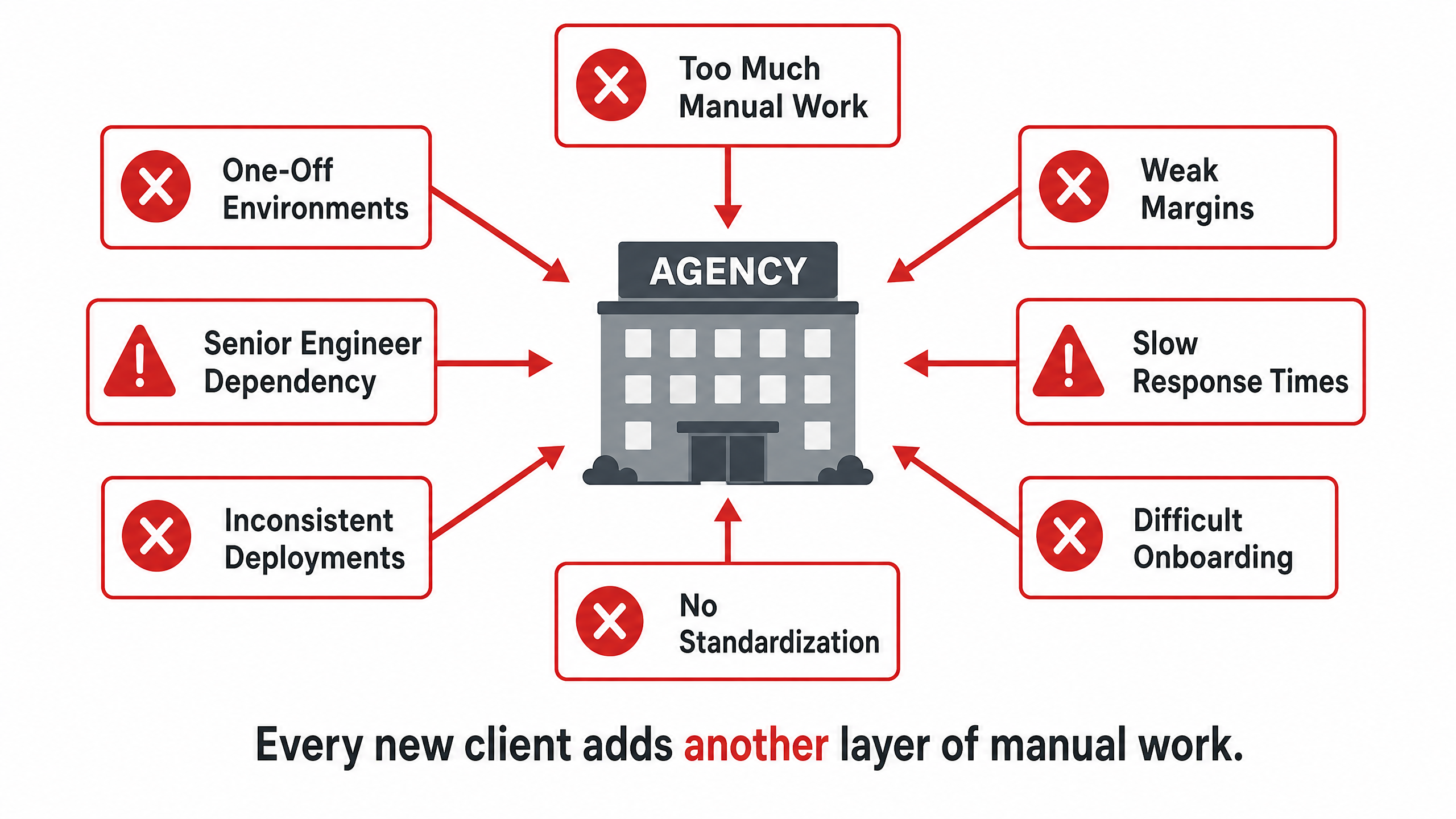
It depends on senior people. It creates operational drag. It turns agency teams into reactive support departments instead of strategic technology partners. It also makes margins harder to protect because every new client adds another layer of manual work.
DevPanel gives agencies a better model.
With DevPanel, agencies can turn hosting, maintenance, cloud operations, and DevOps into repeatable premium cloud services. Instead of managing every client as a custom infrastructure project, an agency can standardize environments, automate workflows, package support, create client-specific templates, and build recurring revenue around a stronger operational platform.
This is not cheap hosting.
This is a premium services model for agencies that want to own the client relationship, increase monthly recurring revenue, and deliver enterprise-grade cloud operations without rebuilding DevOps from scratch for every project.
Why Agencies Need a Better Cloud Services Model
The agency business has changed.
Clients no longer want only a website build. They want performance, security, compliance, uptime, backups, updates, deployment workflows, cloud development environments, and support after launch.
That creates an opportunity.
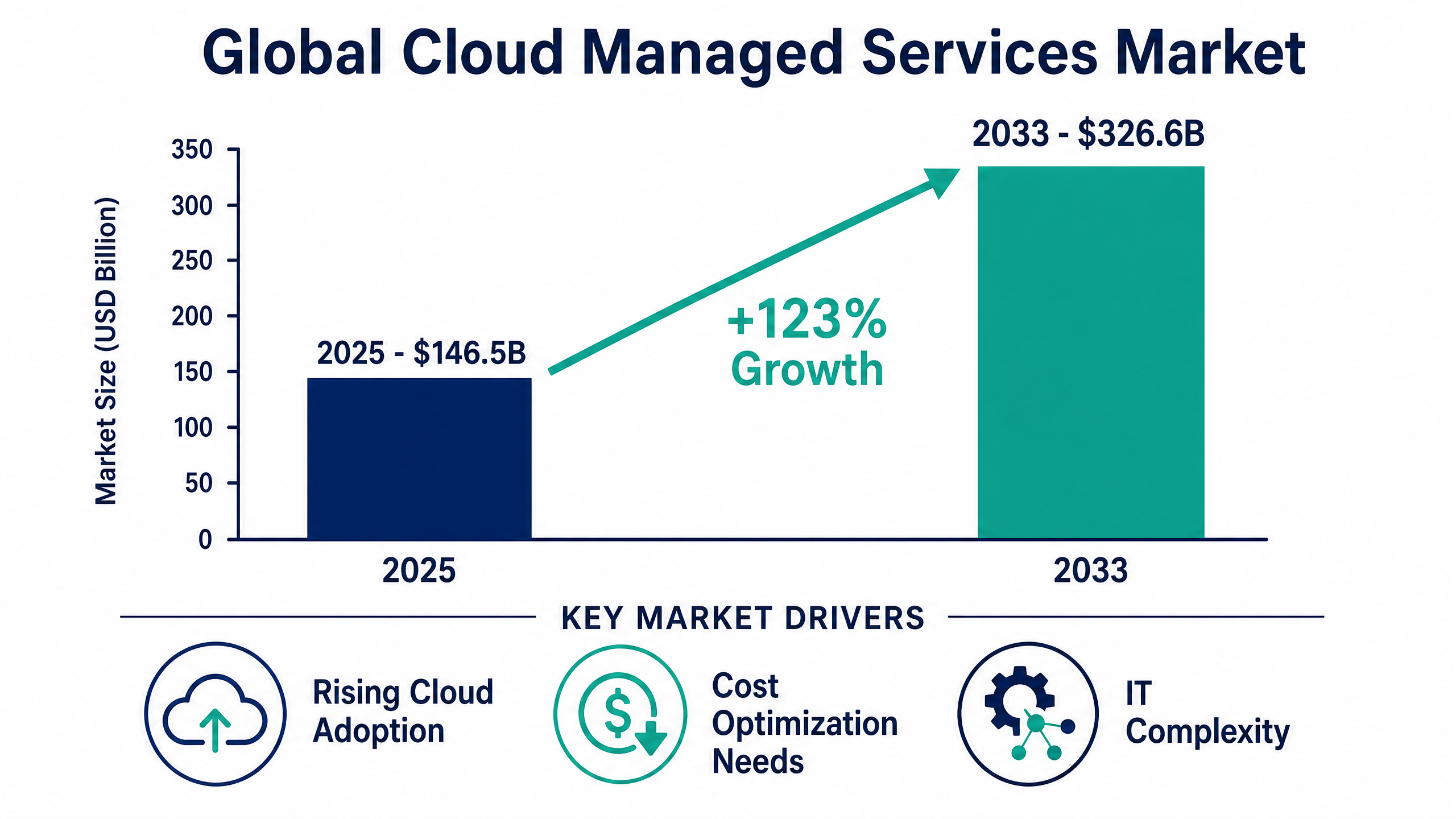
The global cloud managed services market was valued at $146.5 billion in 2025 and is projected to reach $326.6 billion by 2033, driven by rising cloud adoption, cost optimization needs, and the increasing complexity of IT environments.
For agencies, this means cloud operations should not be treated as an afterthought.
It should be a productized service line.
The agencies that win will not be the ones selling basic hosting at the lowest price. They will be the ones that package cloud infrastructure, development workflows, automation, and support into clear premium offerings.
That is where DevPanel fits.
DevPanel gives agencies the platform layer needed to deliver premium cloud services repeatedly, without turning every project into a custom DevOps engagement.
The Problem With Traditional Agency Hosting
Many agencies start with hosting because it is simple recurring revenue.
They build the website. They host the website. They charge a monthly fee. They provide support and updates.
That model works early, but it becomes fragile as the agency grows.
Every client may have a different setup. One site is on a shared host. Another is on a managed WordPress provider. Another is on AWS. Another has a custom deployment process. Another has no staging environment. Another has a fragile plugin stack. Another requires a developer who remembers how everything was configured three years ago.
This creates several problems:
•Too much manual work
•Too many one-off environments
•Too much dependence on senior engineers
•Inconsistent deployment workflows
•Weak margins on support retainers
•Slow response times when clients need changes
•Difficulty onboarding new developers
•Limited ability to standardize quality
The agency may technically have recurring revenue, but it does not have a scalable operating model.
True premium cloud services require standardization.
Standardized Client Environments Create Agency Leverage
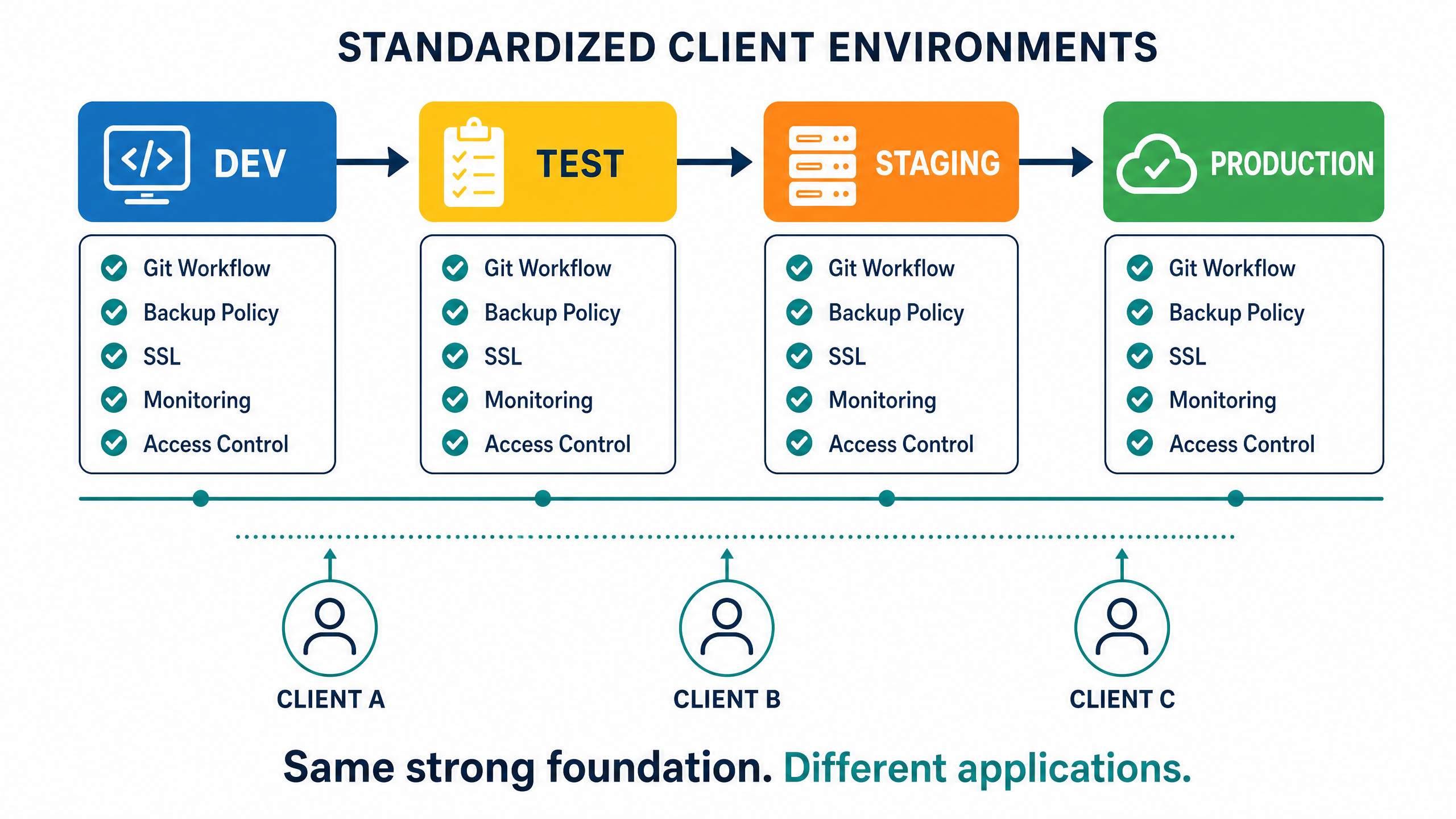
The first step toward premium cloud services is standardizing client environments.
A standardized environment does not mean every client gets the same website. It means every client benefits from the same strong operational foundation.
For example, an agency could standardize:
•Dev, test, staging, and production environments
•Git-based deployment workflows
•Cloud-based development tools
•Backup policies
•SSL and domain workflows
•Security settings
•Monitoring and alerting
•Update testing workflows
•Rollback processes
•Access controls
•CMS-specific templates
DevPanel helps agencies create this kind of standard foundation.
Instead of reinventing the operating model for every client, the agency can use DevPanel as the platform for provisioning and managing cloud environments. The team can support many clients with a consistent workflow while still customizing the application layer for each client.
This is how agencies create leverage.
The agency is no longer selling only labor.
It is selling a system.
DevPanel Turns DevOps Into a Repeatable Offering
DevOps is valuable, but custom DevOps is expensive.
Most clients need the benefits of DevOps, but they do not want to pay an agency to design everything from scratch. They want safer deployments, faster environments, better testing, fewer emergencies, and clearer support.
DevPanel allows agencies to package those outcomes into a repeatable offer.
For example, an agency could offer a “Cloud Operations Plan” that includes:
•Managed AWS or Azure environments
•Dev, test, staging, and production workflows
•CI/CD setup and support
•Scheduled updates
•Backup monitoring
•Security hardening
•Emergency response
•Performance reviews
•Developer onboarding
•Monthly reporting
The client sees a premium managed service.
The agency runs it through a repeatable platform.
That difference matters.
ITPro recently described how managed service providers are moving beyond reactive support into infrastructure intelligence, automation, visibility, risk management, and strategic guidance. Agencies can follow the same path. They can move from “we host and fix things” to “we operate and improve your cloud platform.”
That is a stronger position.
Recurring Revenue Becomes Easier to Defend
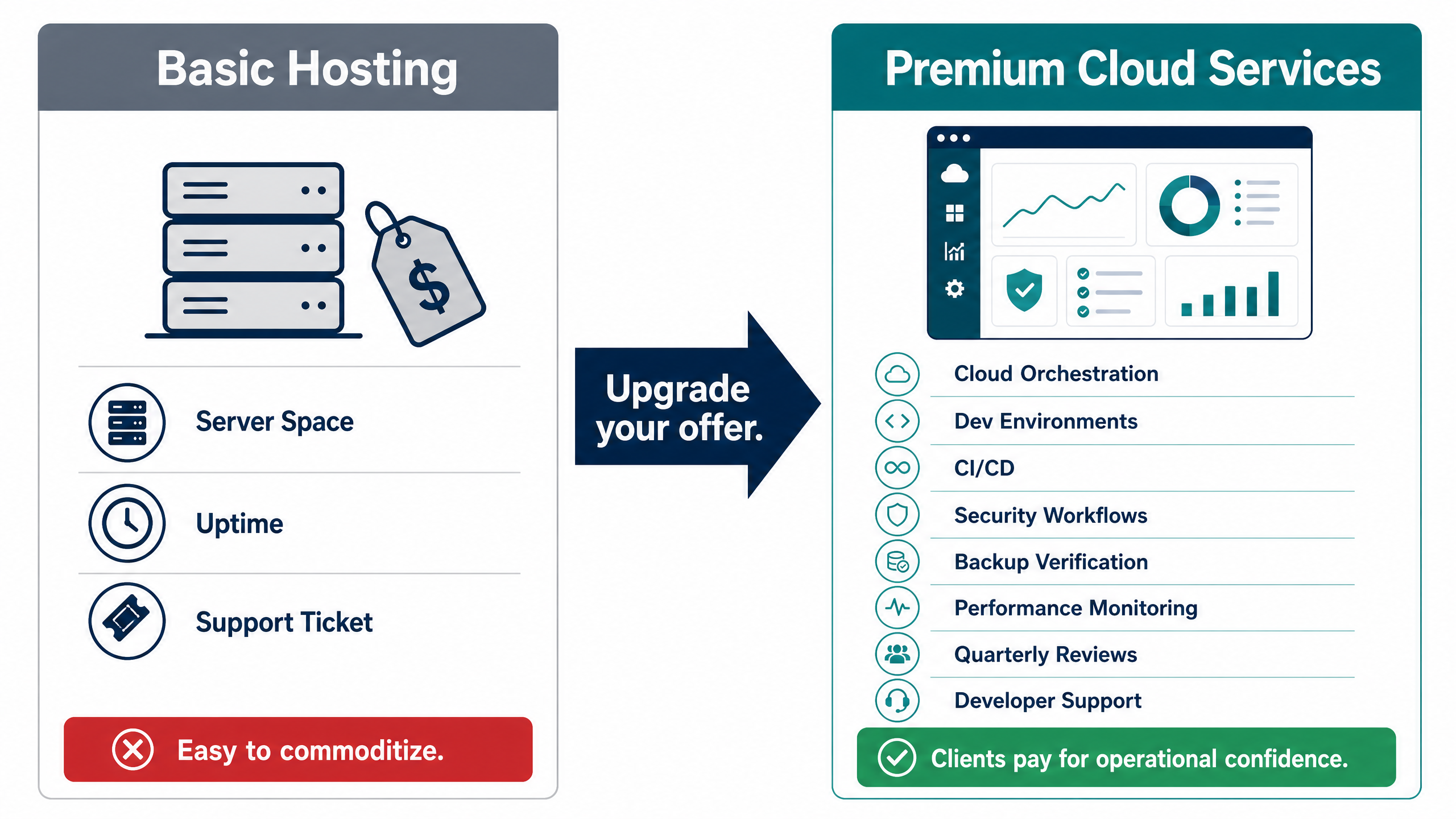
Recurring revenue is most valuable when the client understands what they are paying for.
Basic hosting is easy to commoditize. A client can compare it to a low-cost host and ask why the agency charges more.
Premium cloud services are different.
The agency is not just charging for server space. It is charging for a managed operating model that protects the client’s website, improves delivery speed, reduces risk, and gives the client access to cloud capabilities they would not want to manage internally.
That makes the monthly fee easier to defend.
A premium DevPanel-based agency package might include:
•Cloud hosting orchestration
•Development environments
•Staging workflows
•CI/CD support
•Monthly updates
•Performance monitoring
•Security workflows
•Backup verification
•Developer support
•Quarterly infrastructure reviews
This gives the client a clearer reason to stay.
They are not buying hosting.
They are buying operational confidence.
Client-Specific Templates Create a Stronger Delivery Model
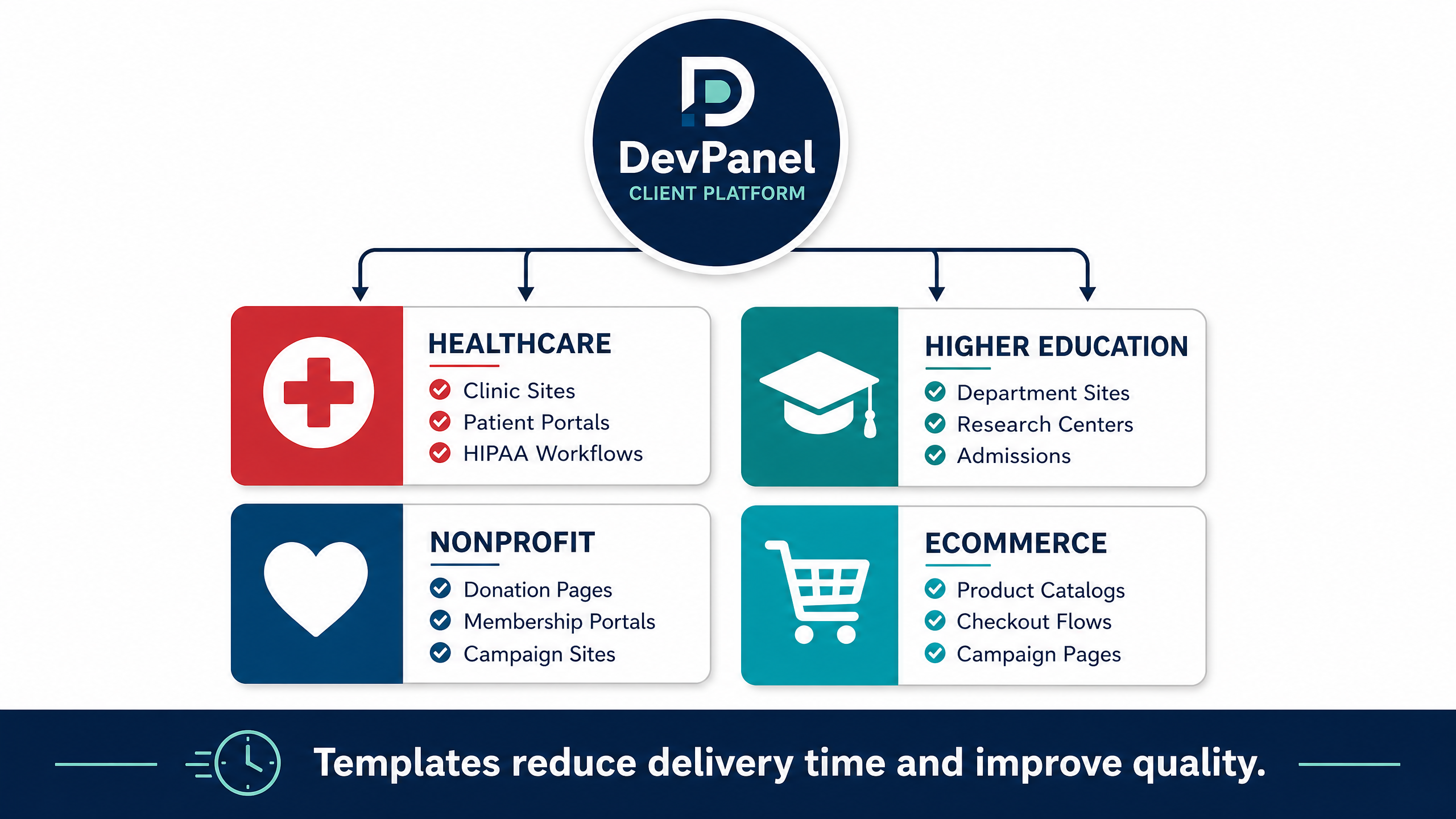
One of the most powerful ways agencies can use DevPanel is by creating client-specific templates.
A template can include the client’s preferred CMS, modules, plugins, theme structure, integrations, deployment scripts, environment settings, and standard configuration.
For agencies serving specific industries, templates become even more valuable.
A healthcare agency can create templates for clinic websites, provider directories, patient education portals, and HIPAA-aware workflows.
A higher education agency can create templates for department sites, research centers, event microsites, and admissions campaigns.
A nonprofit agency can create templates for donation pages, membership portals, campaign sites, and event registration systems.
An ecommerce agency can create templates for product catalogs, checkout flows, payment integrations, and campaign landing pages.
These templates reduce delivery time and improve quality.
Instead of starting from a blank page, the agency starts from a proven foundation. New projects become faster to launch. Developers spend less time on repetitive setup and more time solving the client’s real business problems.
DrupalForge shows this model in action. It was built on DevPanel as a Drupal-focused platform for instant environments, training, demos, development needs, and template workflows. The case study notes that DrupalForge was designed to support instant, disposable development environments and enable contributors to share and monetize Drupal site templates.
Agencies can use the same pattern for their own markets.
Reduced Manual Operations Protect Agency Margins
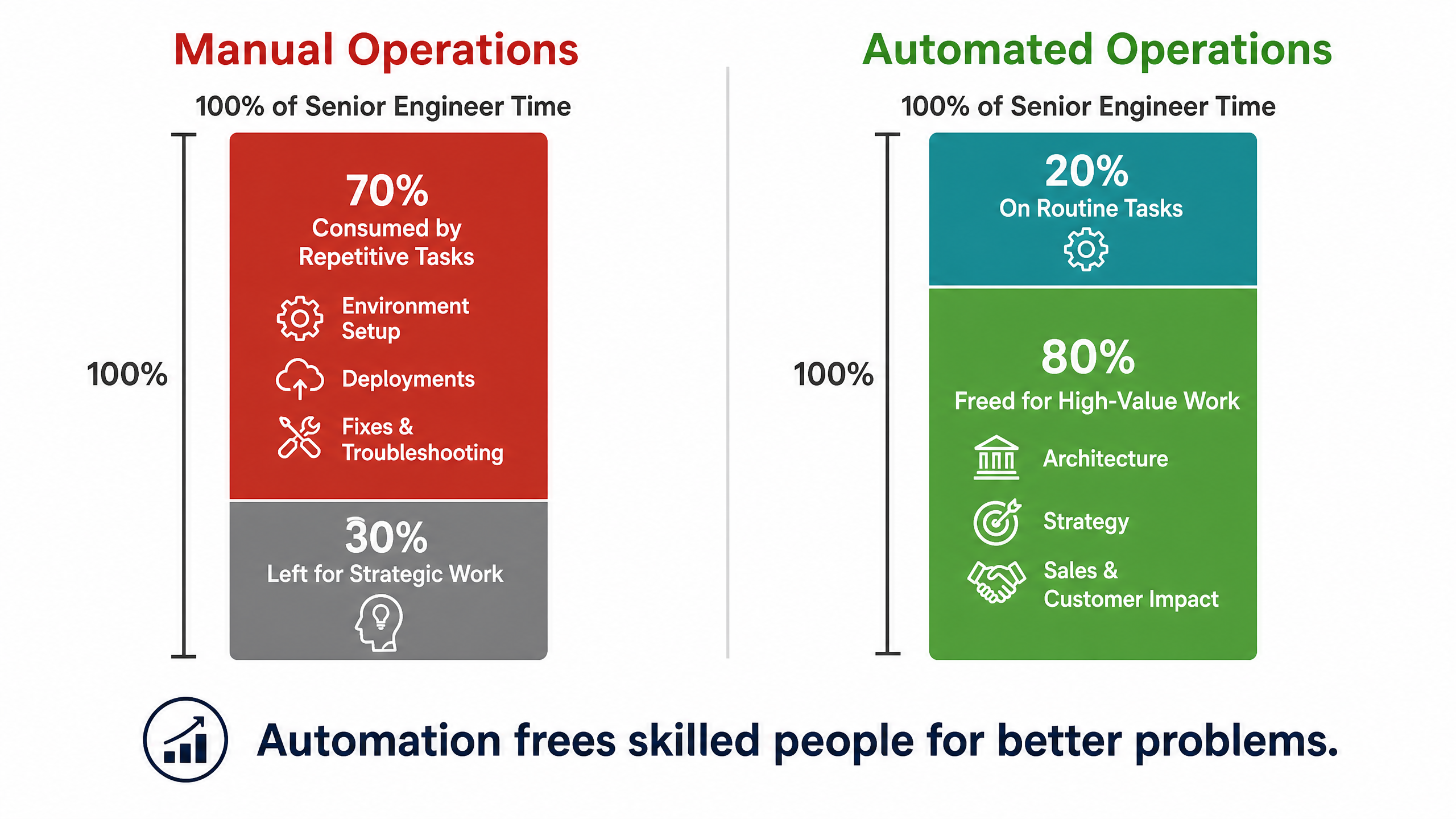
Manual operations destroy margins.
Every manual environment setup, deployment, update, backup check, and emergency fix consumes time that could be used for higher-value work.
Worse, manual operations are often handled by the agency’s most experienced people. That means senior engineers spend time on repetitive tasks instead of architecture, client strategy, product development, or sales support.
ITPro recently noted that many MSPs face a growing problem where their best engineers are stuck maintaining complex multi-cloud environments and handling repetitive provisioning and firefighting instead of strategic work. The article presents platform engineering and self-service platforms as a way to standardize infrastructure and turn providers into more strategic partners.
This applies directly to agencies.
If senior developers are constantly fixing environments, the agency cannot scale.
DevPanel reduces that burden by giving agencies a standardized way to manage cloud environments, development workflows, and application operations.
The result is not that people become unnecessary.
The result is that skilled people work on better problems.
Agencies Can Build Their Own Platform Layer
The most strategic agencies will not think of DevPanel as only a tool.
They will think of DevPanel as the platform layer behind their own cloud services business.
That means the agency can create its own branded operating model:
•Its own cloud service packages
•Its own client onboarding process
•Its own templates
•Its own update workflows
•Its own support tiers
•Its own reporting structure
•Its own managed DevOps offering
•Its own partner delivery network
This is where agencies can move beyond project delivery and toward platform-enabled services.
DevPanel provides the infrastructure and workflow engine. The agency provides domain expertise, client relationships, strategy, design, implementation, and support.
Together, that becomes a premium agency platform.
The Agency-of-Agencies Model
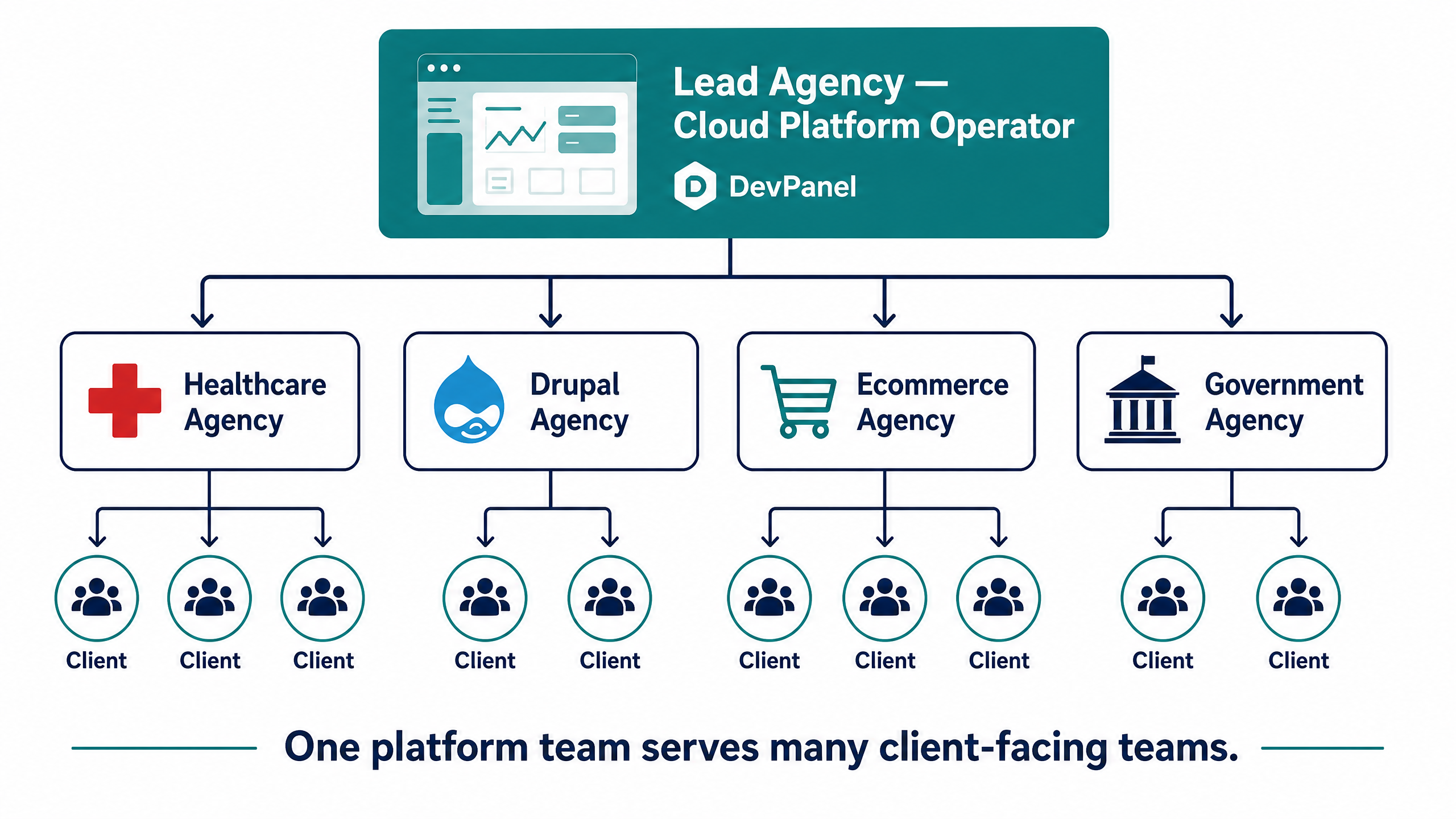
The agency-of-agencies model is especially important.
Many agencies are strong in strategy, design, branding, content, SEO, UX, or implementation, but not all of them want to operate cloud infrastructure.
At the same time, many technical agencies have DevOps and platform expertise but do not want to handle every industry, design style, or client relationship directly.
A DevPanel-based model can support both.
One lead agency can operate the cloud platform and infrastructure services, while partner agencies deliver design, development, content, marketing, or industry-specific implementation.
This creates a stronger network.
The lead agency owns the cloud services platform. Partner agencies bring clients and specialized delivery. Clients get a more complete solution. DevPanel becomes the operational backbone.
This model can work especially well for vertical markets.
For example:
•A healthcare web agency could partner with smaller design shops that serve clinics.
•A Drupal agency could support nonprofit agencies that need better hosting and DevOps.
•An ecommerce agency could support branding agencies that need production-grade Shopware or WooCommerce infrastructure.
•A government-focused agency could provide compliant cloud workflows to subcontractors.
The agency-of-agencies model lets one platform team serve many client-facing teams.
That creates scale without requiring every agency to build its own DevOps department.
DevPanel Helps Agencies Sell Premium, Not Cheap
Agencies should avoid positioning DevPanel-based services as cheaper hosting.
That attracts the wrong buyer.
The stronger message is:
“Our agency gives you a premium cloud operating model, built on your preferred cloud infrastructure, with standardized environments, deployment workflows, security practices, and ongoing support.”
That is a very different offer from:
“We can host your website.”
Premium buyers care about outcomes:
•Faster launches
•Safer deployments
•Better reliability
•Better performance
•Clearer ownership
•Fewer emergencies
•Less vendor lock-in
•Better developer workflows
•More predictable support
DevPanel helps agencies deliver those outcomes.
The pricing should reflect that.
A client paying for premium cloud services should understand that the agency is managing a higher-value operating layer, not reselling commodity hosting.
Proof From Real DevPanel Use Cases
DevPanel’s value for agencies is easier to understand when looking at real use cases.
The Academy of Model Aeronautics managed more than 30 websites across Drupal, Backdrop, and WordPress. Before DevPanel, the organization relied on third-party vendors for tasks like creating development and staging environments. With DevPanel, AMA migrated 30+ sites to AWS, centralized management, and enabled one person to manage what previously required multiple team members.
That is exactly the kind of operational leverage agencies need.
A U.S. government news agency used DevPanel on AWS after facing high costs, limited control, slow support, and development friction. DevPanel provided a point-and-click dashboard, browser-based development tools, AWS-native integration, full infrastructure access, VPN support, and 24/7 hands-on DevOps support inside the agency’s own AWS account.
That shows how DevPanel can support premium, high-control environments.
Kaplan needed to migrate a student portal to Azure with HIPAA compliance, multiple environments, secure API endpoints, scalable architecture, and limited internal DevOps resources. DevPanel provided automated Azure provisioning, HIPAA-compliant architecture, multi-environment management, security integration, and contractor collaboration without direct Azure access.
That is the kind of story agencies can build around: complex cloud outcomes delivered through repeatable automation.
Productizing Agency Cloud Services
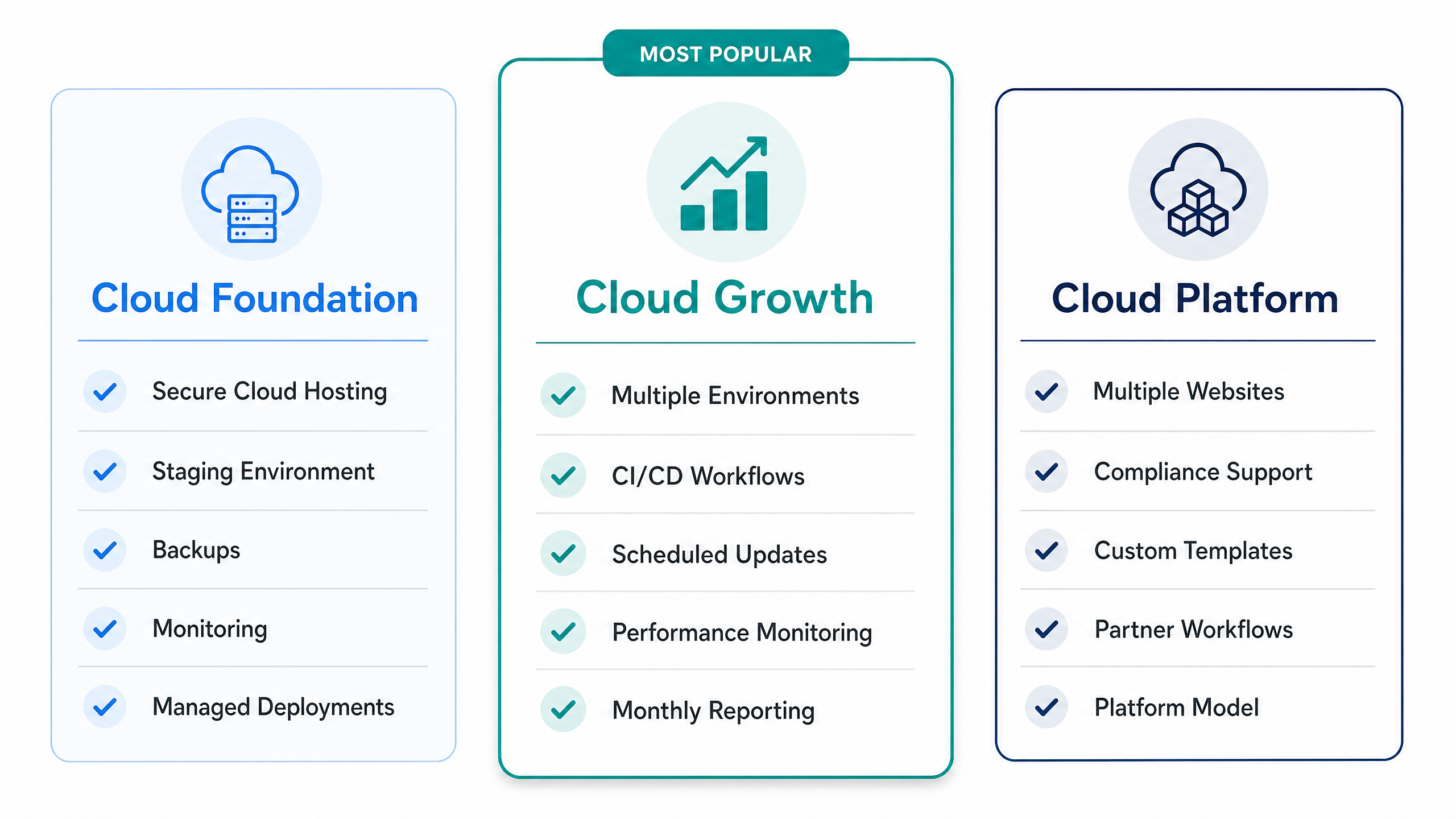
To turn DevPanel into a premium agency offer, agencies should productize the service.
Do not sell vague “hosting and support.”
Package the offer clearly.
A simple structure might look like this:
Cloud Foundation Package
For clients that need secure cloud hosting, staging, backups, monitoring, and managed deployment workflows.
Cloud Growth Package
For clients with active development needs, multiple environments, CI/CD workflows, scheduled updates, performance monitoring, and monthly reporting.
Cloud Platform Package
For clients with multiple websites, compliance needs, custom templates, partner workflows, or a need to build a platform-like model around their applications.
The exact names and prices can vary, but the principle is the same.
The agency should sell outcomes and operating maturity, not server space.
What Agencies Should Standardize First
An agency does not need to productize everything at once.
Start with the workflows that create the most repeated work.
The first areas to standardize are usually:
•New client onboarding
•Environment creation
•Dev, test, staging, and production setup
•Backup policies
•Git and deployment workflows
•Update testing
•Security baseline
•Monitoring
•Access control
•Launch checklist
•Monthly reporting
Once these are standardized, the agency can build higher-value services on top.
That is when templates, vertical platforms, and agency-of-agencies models become easier.
Without standardization, every premium idea becomes another custom project.
With standardization, premium services become repeatable.
Why DevPanel Makes the Offer More Credible
Clients are more likely to trust premium services when the agency can explain the system behind them.
DevPanel gives agencies that system.
Instead of saying, “We manually manage your hosting,” the agency can say:
“We manage your cloud operations through DevPanel, which gives us standardized environments, cloud development workflows, deployment automation, security controls, and scalable infrastructure management.”
That sounds more mature because it is more mature.
It shows the client that the agency is not improvising operations behind the scenes.
It also gives the agency a stronger sales story.
The agency can demonstrate environment creation, staging workflows, developer access, templates, deployment controls, and monitoring. That turns the service from an invisible monthly fee into a visible operating platform.
The Future Agency Is a Platform Operator
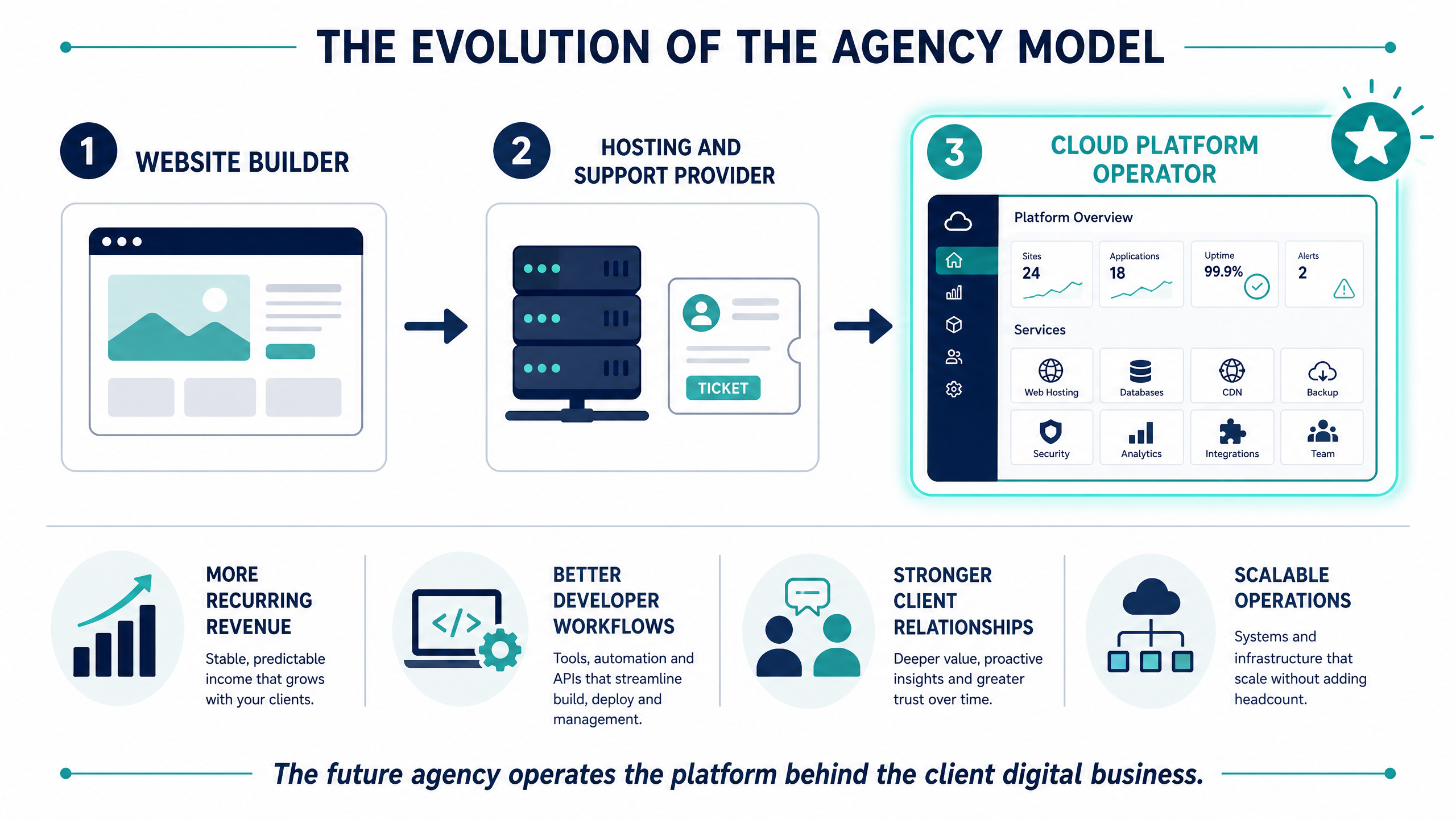
The strongest agencies of the next decade will not only build websites.
They will operate platforms.
They will help clients modernize infrastructure, standardize workflows, support developers, manage cloud environments, and create repeatable digital capabilities.
This aligns with where the market is going. Platform engineering is increasingly described as the practice of creating self-service platforms that reduce operational burden and help teams deliver software faster. Agencies that understand this shift can turn it into a business advantage.
DevPanel gives agencies a practical way to make that shift.
They do not need to build every cloud automation layer themselves. They can use DevPanel as the foundation and build their agency services on top.
That is how hosting becomes premium cloud services.
That is how maintenance becomes managed operations.
That is how DevOps becomes a repeatable offer.
That is how agency knowledge becomes a platform.
FAQ
How can agencies use DevPanel?
Agencies can use DevPanel to manage client cloud environments, create dev, test, staging, and production workflows, support cloud development tools, automate deployments, standardize backups, and package hosting, maintenance, and DevOps as premium cloud services.
Why should agencies offer premium cloud services instead of basic hosting?
Basic hosting is easy to commoditize. Premium cloud services give agencies a stronger recurring revenue model by bundling cloud infrastructure, automation, security, performance, deployment workflows, and ongoing support.
Can DevPanel help agencies reduce manual work?
Yes. DevPanel helps agencies reduce manual operations by standardizing environment creation, cloud management, deployment workflows, and developer access across client projects.
What are client-specific templates?
Client-specific templates are reusable application foundations that include preferred CMS settings, modules, plugins, integrations, themes, deployment scripts, and configuration. They help agencies launch future projects faster and with more consistency.
What is the agency-of-agencies model?
The agency-of-agencies model is a partner structure where one agency operates the cloud platform and infrastructure layer while other agencies deliver design, development, content, marketing, or vertical expertise to clients.
Conclusion: DevPanel Lets Agencies Sell a Better Operating Model
Agencies do not need to compete in cheap hosting.
They can build something better.
With DevPanel, agencies can turn hosting, maintenance, and DevOps into repeatable premium cloud services. They can standardize client environments, create recurring revenue, build client-specific templates, reduce manual operations, and support partner agencies through an agency-of-agencies model.
That is a stronger business.
It gives clients more confidence. It gives developers better workflows. It gives agency owners more recurring revenue. It gives senior engineers more time for strategic work. It gives the agency a platform it can build on.
The future of agency services is not just building websites.
It is operating the cloud platform behind the client’s digital business.