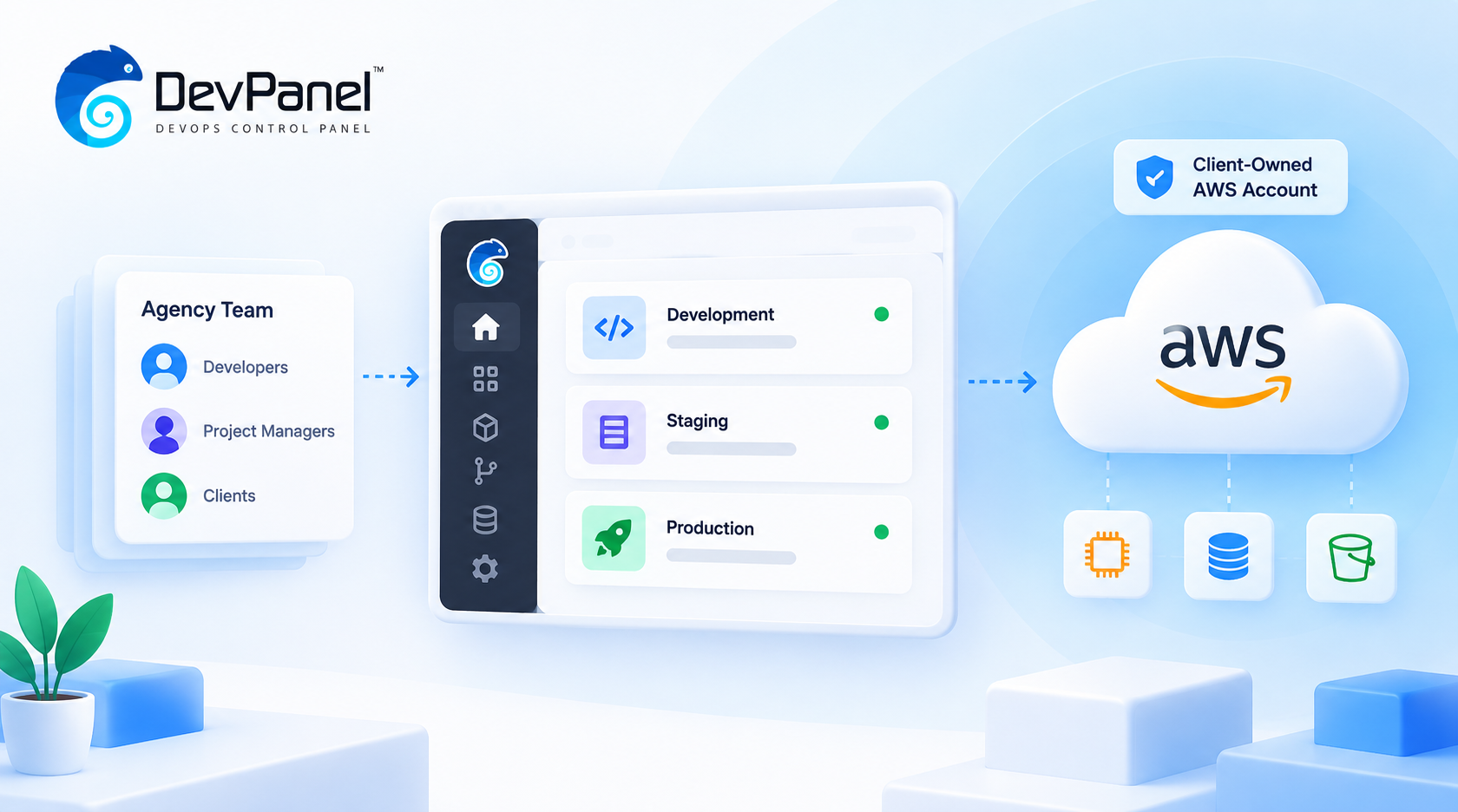
How Agencies Can Deploy Into Client-Owned AWS Accounts Without Creating an Ops Team per Client
Agencies are under pressure to deliver more cloud capability for clients without turning every engagement into a custom DevOps project.
One client wants its application in AWS.
Another has existing account structures, security policies, and procurement requirements.
Another wants to keep ownership of its infrastructure.
Another needs multiple environments, controlled access, Git-based deployments, and predictable release workflows.
The agency still has to deliver.
That is where the challenge begins.
Deploying into client-owned AWS accounts sounds attractive because it gives the client more control. But if every client account requires custom setup, custom access, custom runbooks, and custom deployment logic, the agency can quickly end up building a separate operations model for every engagement.
That does not scale.
The better model is to separate infrastructure ownership from delivery orchestration.
The client owns the AWS account.
The agency manages the application delivery workflow.
A platform layer standardizes environments, access, templates, deployments, and operational workflows.
This is the model DevPanel supports.
DevPanel helps agencies deploy and manage applications in client-owned cloud accounts without rebuilding the same DevOps operating system for every client.
The result is a more scalable way to deliver cloud services: client-owned AWS infrastructure, standardized application orchestration, and repeatable agency workflows.
Why Client-Owned AWS Is Becoming More Important for Agencies
Many clients no longer want their critical applications hidden inside a vendor-owned hosting environment.
They want to know where infrastructure lives.
They want access to their own cloud account.
They want clearer data ownership.
They want to use existing AWS agreements, governance models, credits, controls, and security processes.
They want portability.
For agencies, this creates an opportunity.
Instead of selling basic hosting, the agency can offer a more strategic service:
“We deploy and manage your application inside your AWS account, using a standardized delivery platform and repeatable workflows.”
That is a stronger message than “we host your site.”
It positions the agency as a cloud operations partner.
But it also raises the bar.
If the agency is going to deploy into client-owned AWS accounts, it needs a repeatable model. Otherwise, every client becomes a snowflake.
The Problem With Per-Client DevOps
The manual approach usually starts innocently.
A client provides AWS access.
The agency creates an environment.
A developer writes a deployment script.
Someone documents the steps.
Someone else configures permissions.
A staging environment is added.
A production deployment process is created.
Then the next client arrives with a different account structure, different IAM rules, different approval process, different networking constraints, different naming conventions, and different security expectations.
The agency repeats the work.
Over time, delivery becomes harder to manage.
The team spends more time on environment setup, access issues, deployment troubleshooting, and operational cleanup than on the application itself.
Common problems include:
•Inconsistent AWS account setup across clients
•Repetitive environment creation
•Manual deployment steps
•Access management overhead
•Different runbooks for every engagement
•Poor visibility across client environments
•Release drift between dev, staging, and production
•Senior engineers becoming the bottleneck
•Difficulty packaging recurring managed services
This is how an agency accidentally creates an ops team per client.
The agency may not call it that, but the work behaves that way.
Each client requires a separate operational model.
That creates margin pressure and slows growth.
The Better Model: BYOC Plus Application Orchestration
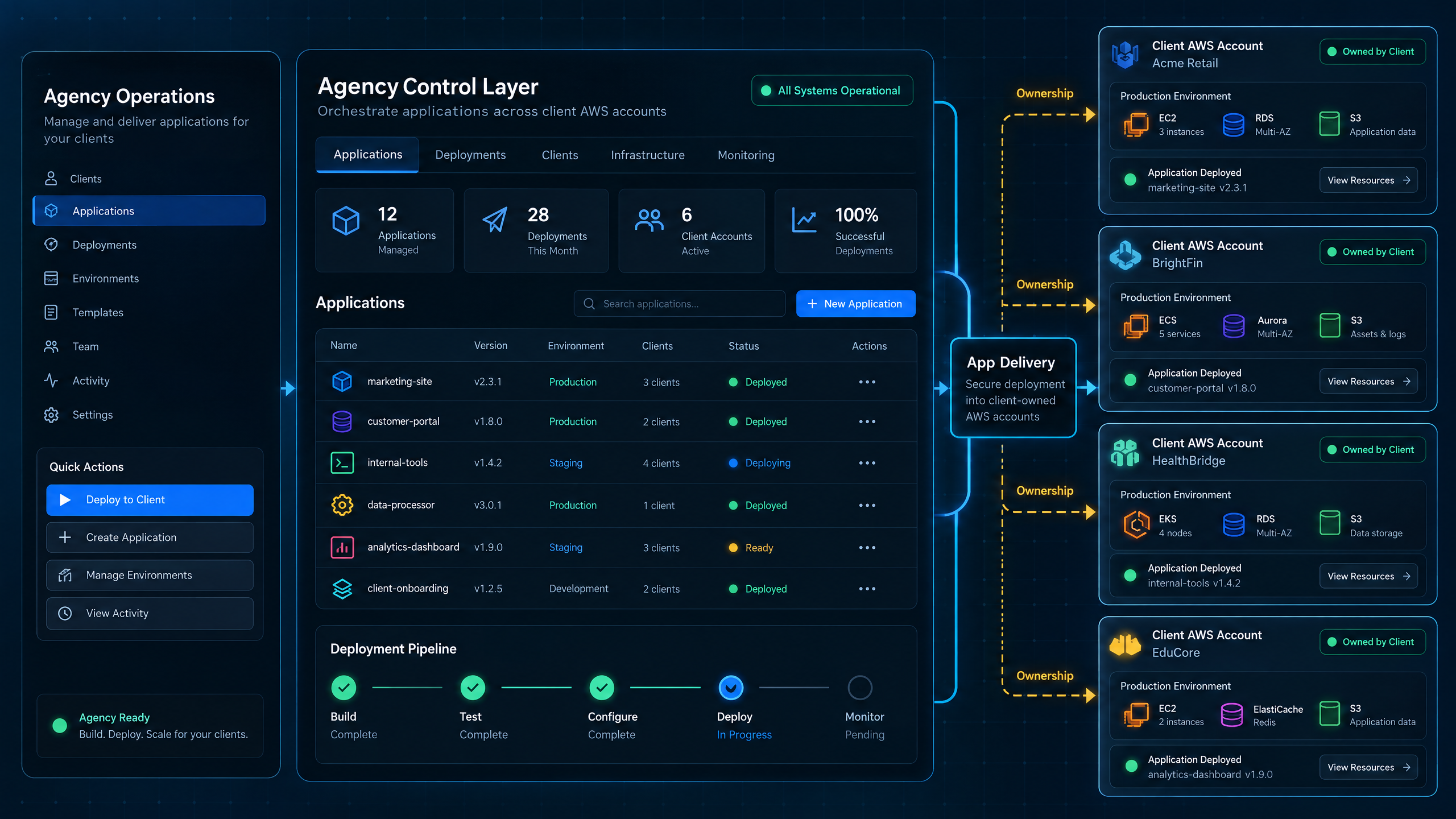
BYOC works at scale when a reusable application orchestration layer separates infrastructure ownership from delivery operations.
Bring Your Own Cloud, or BYOC, gives the client ownership of the underlying infrastructure.
But BYOC alone is not enough.
If the client owns the AWS account but the agency still handles every deployment manually, the agency has only moved the complexity into a different place.
The better model is BYOC plus application orchestration.
In this model:
•The client owns the AWS account.
•The agency manages application delivery.
•The platform standardizes environments.
•Templates reduce repetitive setup.
•Workspaces organize clients and teams.
•Git-based workflows control releases.
•Access is managed through repeatable patterns.
•Deployments become consistent across accounts.
This gives agencies the control they need without taking infrastructure ownership away from the client.
It also makes the agency’s service model easier to scale.
The agency can support many client-owned AWS accounts through a shared operating pattern instead of inventing a new process every time.
DevPanel as the Orchestration Layer
DevPanel is an application orchestration platform for teams that want to manage applications in customer-owned cloud infrastructure.
For agencies, that means DevPanel can become the control layer between the agency’s delivery workflow and the client’s AWS account.
The client keeps ownership of the infrastructure.
The agency uses DevPanel to standardize how applications are deployed, cloned, organized, accessed, and managed.
This matters because agencies do not only need infrastructure access.
They need a repeatable operating model.
DevPanel helps agencies create that model through:
•Git-based workflows
•Cloud development environments
•Automated deployment patterns
•Controlled access
•Customer-owned cloud infrastructure
Instead of creating a unique DevOps setup for every client, the agency can use DevPanel as the reusable platform layer.
That creates consistency.
It also gives the agency a better foundation for recurring cloud services.
Client-Owned Infrastructure Builds Trust
Client-owned AWS infrastructure creates a stronger trust model.
The client knows the infrastructure belongs to them.
The agency can still provide managed services, platform workflows, support, and operational expertise, but the underlying cloud account remains under the client’s control.
This matters for clients with security, compliance, procurement, or governance requirements.
It also matters for long-term relationships.
A client may be more comfortable approving an agency-managed cloud service when the client knows the infrastructure is not trapped inside the agency’s proprietary hosting account.
That does not reduce the agency’s value.
It increases it.
The agency’s value is not simply owning the server.
The agency’s value is building and operating the delivery model.
That includes deployment workflows, environment strategy, access control, templates, release processes, support, monitoring, maintenance, and ongoing application operations.
DevPanel supports that model by letting agencies provide a managed experience while preserving client infrastructure ownership.
Standardized Templates Reduce Repetitive Setup
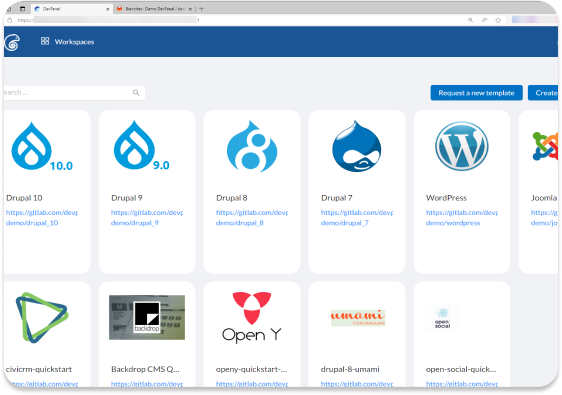
Templates reduce per-client setup and create consistent starting points for agency delivery.
Templates are one of the most important pieces of an agency cloud model.
Most agencies repeat similar patterns across projects.
A WordPress site may need common plugins, environment variables, deployment steps, staging setup, and backup policies.
A Drupal site may need standard modules, Composer workflows, configuration management, and environment promotion rules.
A Laravel application may need a specific runtime, queue setup, database configuration, and deployment path.
Without templates, every project starts from scratch.
That wastes time.
It also creates inconsistency.
With templates, the agency can define approved starting points for different application types, client tiers, or service packages.
Templates can include:
•Application structure
•Runtime configuration
•Environment patterns
•Deployment defaults
•CMS or framework setup
•Security defaults
•Access patterns
•Git workflow expectations
•Dev, staging, and production structure
DevPanel helps agencies use templates as a repeatable foundation.
That means teams can move faster without sacrificing consistency.
For agencies deploying into client-owned AWS accounts, templates reduce the amount of custom DevOps work required per engagement.
Workspaces Keep Clients and Teams Organized
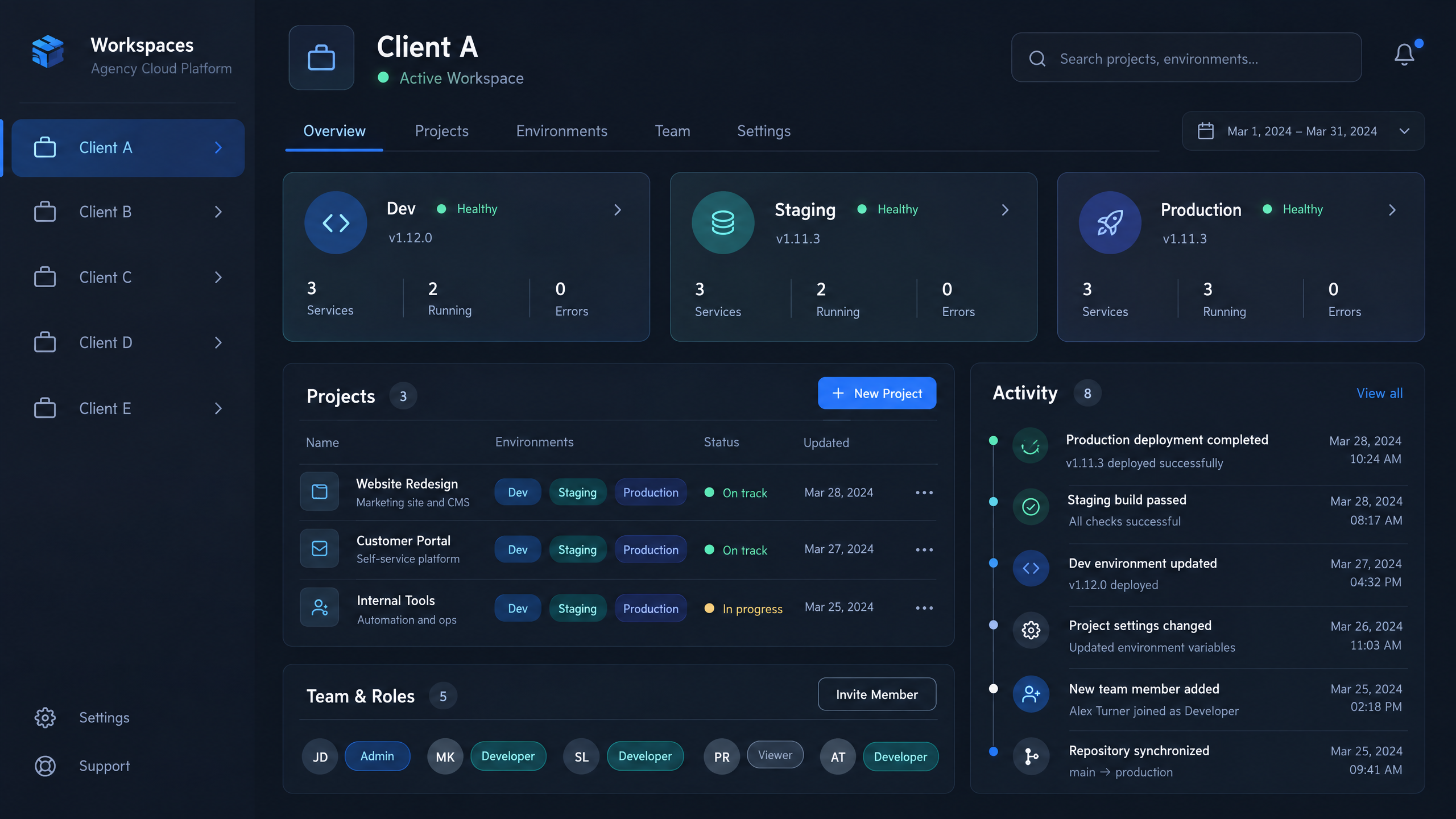
Workspaces give agencies centralized visibility while keeping client projects and access boundaries separate.
As an agency grows, organization becomes a major operational issue.
The agency may have multiple developers, contractors, project managers, support engineers, and clients accessing different systems.
Without clear separation, access becomes messy.
One person may have too much access.
Another may not have enough.
Client environments may be mixed together.
Internal teams may lose track of which applications belong to which account.
Workspaces help solve this problem.
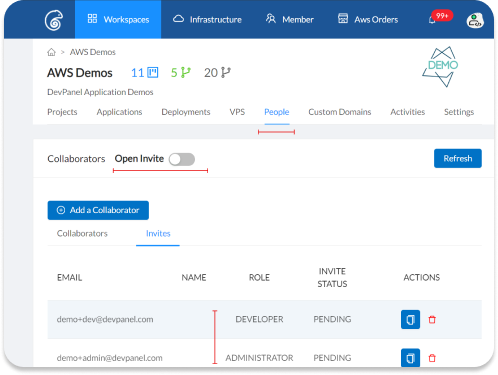
A Workspace can represent a client, a project, a department, or an internal delivery group. It creates a cleaner boundary for managing access, environments, and applications.
For agencies, Workspaces make multi-client management more practical.
They help teams separate client activity while still operating from a centralized platform.
This is especially useful when deploying into client-owned AWS accounts because each client may have different governance expectations.
The agency needs centralized visibility, but the client still needs clear boundaries.
DevPanel’s Workspace model supports that balance.
Git-Based Workflows Make Deployments Repeatable
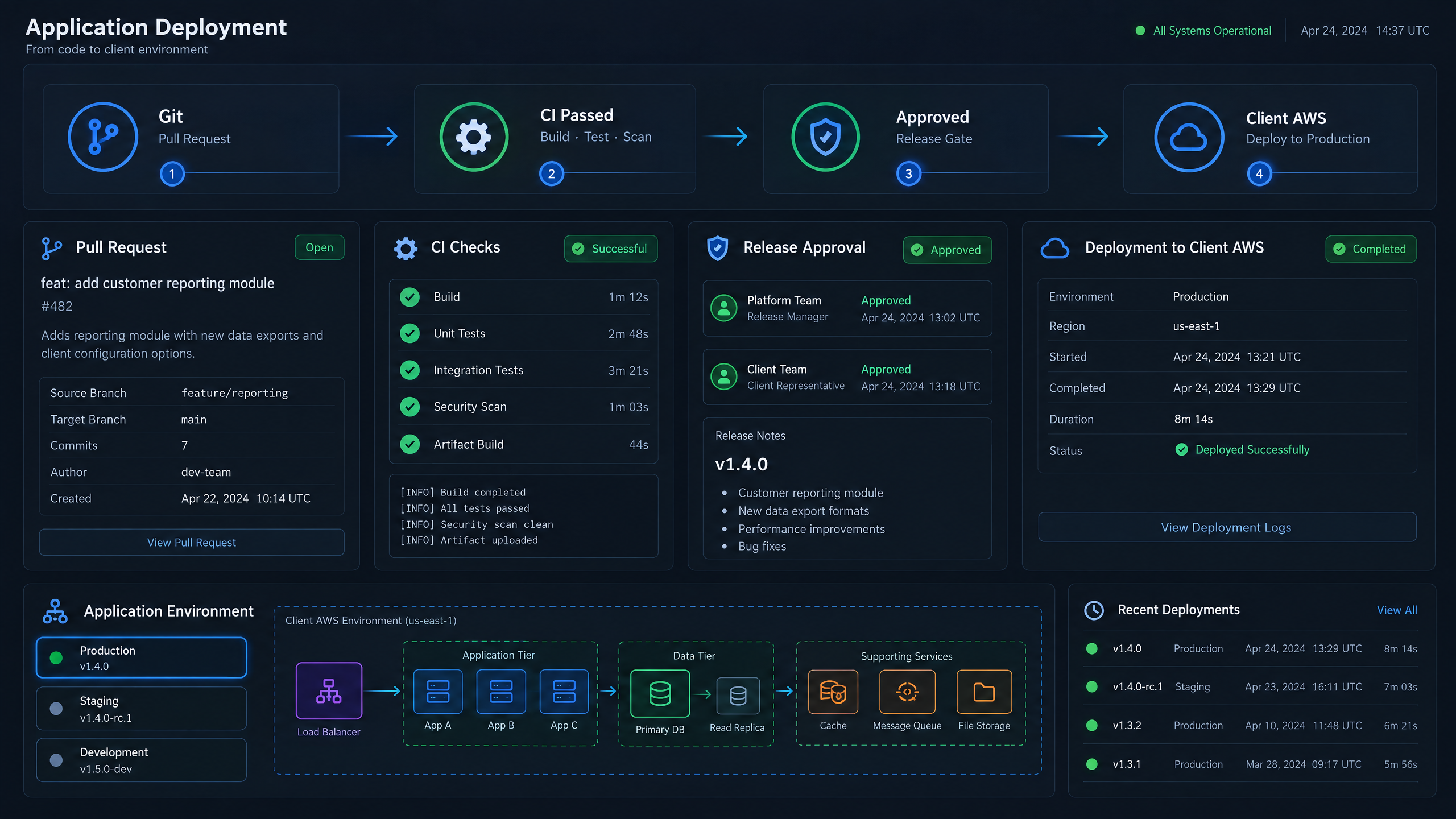
Git workflows turn application changes into a clearer, repeatable path to release.
Agencies need deployment workflows that developers can trust.
Manual deployment steps are risky because they depend on memory, timing, and individual experience.
A Git-based workflow creates a clearer path from change to release.
A developer makes a change.
The change goes into Git.
A branch or pull request is created.
The team reviews it.
The application is deployed through a repeatable workflow.
The environment is updated in a controlled way.
This matters when an agency manages many client applications.
Without a repeatable deployment pattern, every release becomes a new coordination effort.
With Git-based workflows, agencies can standardize how changes move across environments.
DevPanel supports this by helping teams connect Git workflows with application environments, deployment processes, and release patterns.
That gives agencies a stronger delivery model across multiple client-owned AWS accounts.
Cloud Development Environments Help Teams Move Faster
Developer setup is another hidden cost in agency work.
A new developer joins a project and needs access.
A contractor needs a temporary environment.
A support engineer needs to reproduce an issue.
A client project requires a specific version of PHP, Node, Composer, Drush, WP-CLI, or another tool.
Local setup can consume hours or days.
Cloud development environments help reduce that friction.
Instead of every developer recreating the stack locally, the platform can provide ready-to-use environments that match the application workflow.
For agencies, this improves onboarding and reduces delays.
It also makes it easier to shift team members between projects.
DevPanel supports cloud development environments as part of the broader application orchestration model.
That helps agencies move faster without creating a custom setup process for every client.
Deploy and Clone Workflows Reduce Operational Toil
Agencies often need to clone applications.
A developer may need a copy of production for debugging.
QA may need a realistic staging environment.
A client may need a demo environment.
A project manager may need a review URL.
A team may need to test an update before production.
If cloning is manual, it becomes a recurring source of operational toil.
The same is true for deployments.
If every release requires manual commands, custom checks, and hand-written steps, the agency’s delivery capacity is limited by the people who know the process.
DevPanel’s deploy and clone workflows help agencies make these actions more repeatable.
That does not eliminate engineering judgment.
It reduces repetitive operational work.
The agency can focus on application quality and client outcomes instead of repeatedly rebuilding the same environment mechanics.
Governance Without Slowing Delivery
Client-owned AWS accounts often come with governance requirements.
There may be IAM controls.
There may be approval processes.
There may be security policies.
There may be account boundaries, networking constraints, or audit expectations.
Agencies need to respect those boundaries while still delivering efficiently.
That is difficult if every deployment depends on custom access patterns and one-off scripts.
A standardized orchestration layer helps.
It gives the agency a consistent way to manage delivery while working within each client’s AWS environment.
This creates a better balance between speed and control.
The client gets infrastructure ownership and governance.
The agency gets repeatable delivery workflows.
DevPanel supports this balance by giving teams a platform model for access, Workspaces, templates, environments, and deployments.
Turning AWS Delivery Into a Recurring Service
Agencies often want more recurring revenue.
But recurring revenue should not be based only on basic hosting resale.
The stronger offer is managed cloud operations.
An agency can package services around:
•Client-owned AWS infrastructure
•Application deployment workflows
•Dev, staging, and production environments
•Cloud development environments
•Backup and recovery processes
•Access management
•Git-based releases
•Performance support
•Security coordination
•Ongoing application operations
This is a more valuable service than commodity hosting.
The client is not only paying for a server.
The client is paying for a managed operating model.
DevPanel gives agencies the platform foundation to deliver that model repeatedly across clients.
That makes it easier to build packages, define service tiers, and protect margins.
A Practical Deployment Model for Agencies
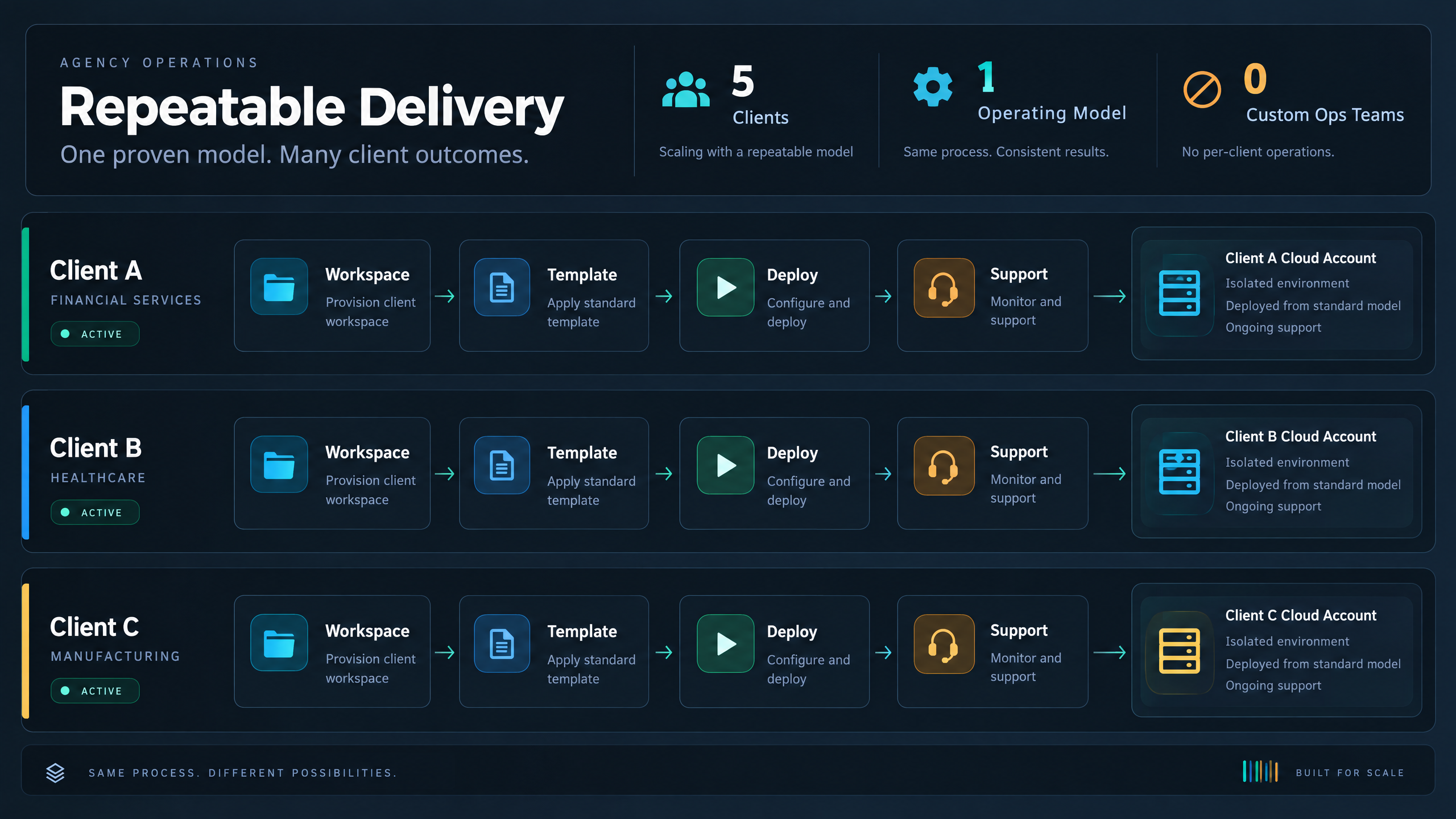
One operating model can support many client accounts without creating a separate custom ops team for each client.
A practical agency workflow may look like this.
First, the client keeps ownership of the AWS account.
Second, the agency links the client account to the orchestration platform.
Third, the agency creates a Workspace for the client or project.
Fourth, the agency selects an application template.
Fifth, the platform creates the required environments.
Sixth, developers work through Git-based workflows.
Seventh, changes are reviewed and deployed through standard processes.
Eighth, support and maintenance continue through the same operating model.
This workflow turns deployment into a repeatable system instead of a custom project.
It also gives the agency a clearer way to explain its value.
The agency is not just “putting the site on AWS.”
The agency is building and operating a cloud delivery model inside the client’s AWS environment.
Example: Multi-Client AWS Delivery
Imagine an agency that manages applications for five enterprise clients.
Each client requires AWS ownership.
Each client has its own account.
Each client has different access requirements.
Each client needs development, staging, and production environments.
Without a platform layer, the agency may end up creating different deployment scripts, runbooks, and access processes for every client.
That becomes hard to maintain.
With DevPanel, the agency can create a more consistent approach.
Each client can have a Workspace.
Each project can start from a template.
Each application can follow the same environment model.
Developers can use Git-based workflows.
Deployments can follow repeatable processes.
Access can be managed more cleanly.
The client keeps ownership of AWS, while the agency keeps delivery consistent.
This is how agencies avoid creating a separate ops model for every client.
What Agencies Should Standardize First
Agencies do not have to standardize everything at once.
The best starting point is usually the work that repeats most often.
Start with:
•Environment structure
•Client Workspaces
•Application templates
•Git workflow expectations
•Deployment paths
•Access roles
•Backup and recovery process
•Naming conventions
•Support escalation rules
•Client handoff documentation
Once those pieces are standardized, the agency has a stronger foundation for managed services.
DevPanel helps because it gives agencies a platform layer where these patterns can be repeated across clients.
That is what turns cloud delivery into a scalable business model.
Why This Matters for Agency Margins
Margins are affected by more than hosting cost.
Margins are affected by manual work.
Margins are affected by rework.
Margins are affected by support tickets.
Margins are affected by slow onboarding.
Margins are affected by unclear ownership.
Margins are affected by deployment mistakes.
Margins are affected by senior engineers spending too much time on repetitive setup.
A client-owned AWS model can improve the agency’s service offering, but only if the agency has a repeatable way to deliver inside those accounts.
Without a platform layer, BYOC can become more complex than traditional hosting.
With DevPanel, agencies can use BYOC as the foundation for a premium service model.
The client owns the AWS infrastructure.
The agency delivers the operating model.
That is a better path for both sides.
What to Look For in a Platform
Agencies evaluating cloud deployment platforms should look for more than a dashboard.
A strong platform should support:
•Customer-owned AWS accounts
•Multi-client organization
•Workspaces
•Templates
•Git-based workflows
•Cloud development environments
•Deploy and clone workflows
•Controlled access
•Environment management
•Repeatable release patterns
•Multi-cloud flexibility
•Support for recurring managed services
The goal is not simply to see all client sites in one interface.
The goal is to reduce manual work and make delivery repeatable.
DevPanel brings these capabilities together as an application orchestration platform for agencies that want to manage applications in client-owned cloud environments.
FAQ
How can agencies deploy into client-owned AWS accounts without creating an ops team per client?
Agencies can use a BYOC model with an application orchestration platform. The client keeps ownership of the AWS account, while the agency standardizes templates, environments, Workspaces, access controls, Git-based workflows, and deployments through a reusable platform layer.
What does BYOC mean for agencies?
BYOC means Bring Your Own Cloud. For agencies, it means the client owns the cloud account while the agency manages application delivery and operations through a standardized workflow.
Is DevPanel a hosting provider?
DevPanel is not a traditional hosting provider. It is an application orchestration platform that helps teams manage applications in customer-owned cloud accounts.
Why do agencies need Workspaces?
Workspaces help agencies separate clients, teams, projects, and access boundaries. They make it easier to manage multiple client environments from a centralized platform without mixing permissions or operational activity.
How do templates help agencies deploy faster?
Templates give agencies reusable starting points for applications, environments, configuration, and deployment workflows. This reduces repetitive setup and improves consistency across client projects.
Can agencies use Git-based workflows with client-owned AWS accounts?
Yes. Git-based workflows help standardize how changes move from development to release. With a platform like DevPanel, agencies can connect Git workflows to environments and deployment processes inside client-owned cloud infrastructure.
How does this create recurring revenue?
Agencies can package managed cloud operations around application delivery, environment management, deployment workflows, support, security coordination, and ongoing maintenance. This creates a stronger recurring service than basic hosting resale.
Conclusion: Client-Owned AWS Needs a Repeatable Operating Model
Deploying into client-owned AWS accounts is a strong model for agencies.
It gives clients infrastructure ownership.
It gives agencies a more strategic service offering.
But it only works at scale when delivery is standardized.
Without a repeatable platform layer, every client becomes a custom DevOps project.
DevPanel gives agencies a better path.
Use client-owned AWS infrastructure.
Standardize delivery with templates and Workspaces.
Connect Git-based workflows.
Automate deployment patterns.
Manage environments consistently.
Build recurring services around cloud operations instead of commodity hosting.
That is how agencies can deploy into client-owned AWS accounts without creating an ops team per client.