
DevPanel vs Acquia for Drupal Hosting: Cost, Control, Dev Environments, and Cloud Flexibility Compared
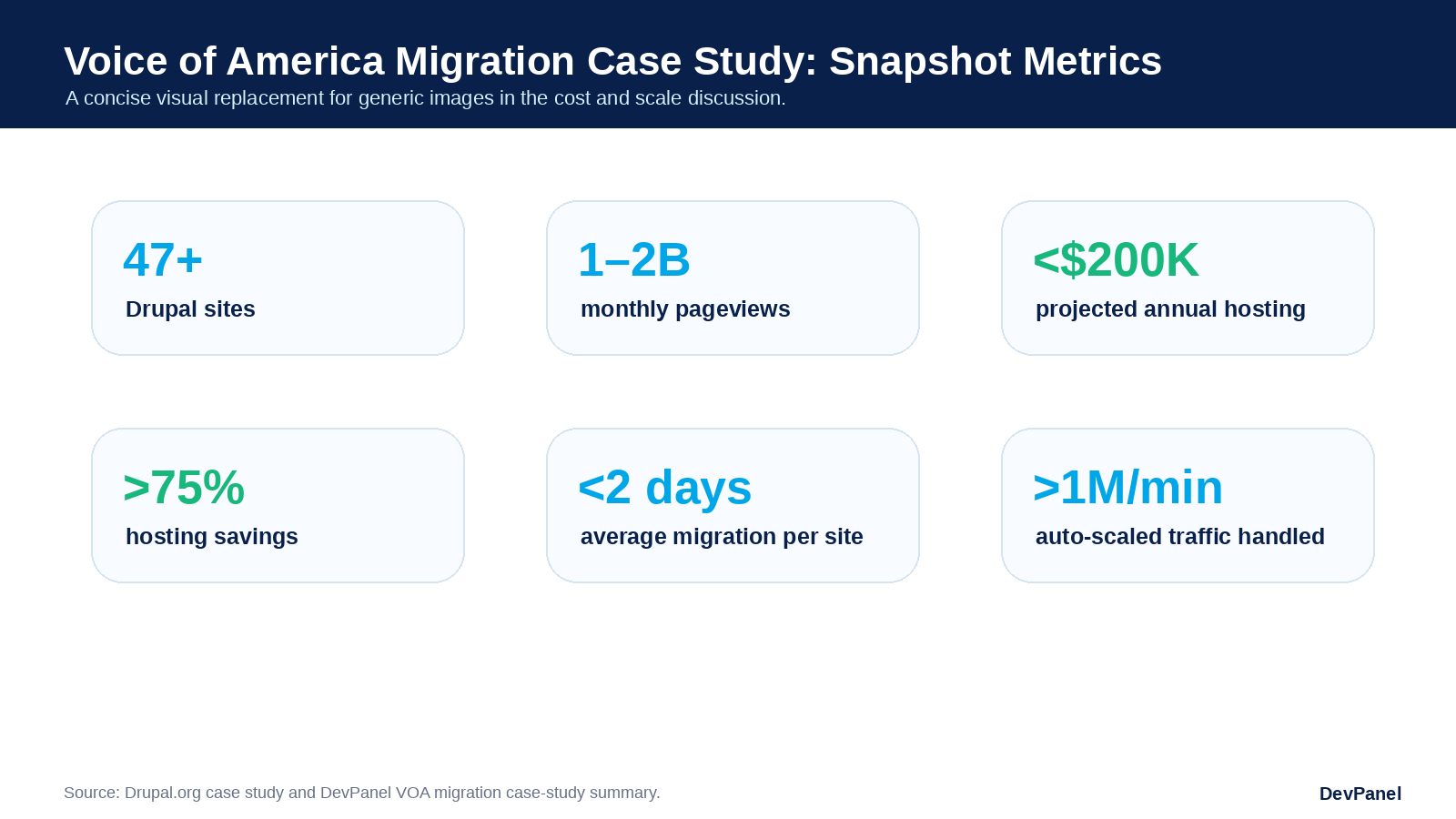
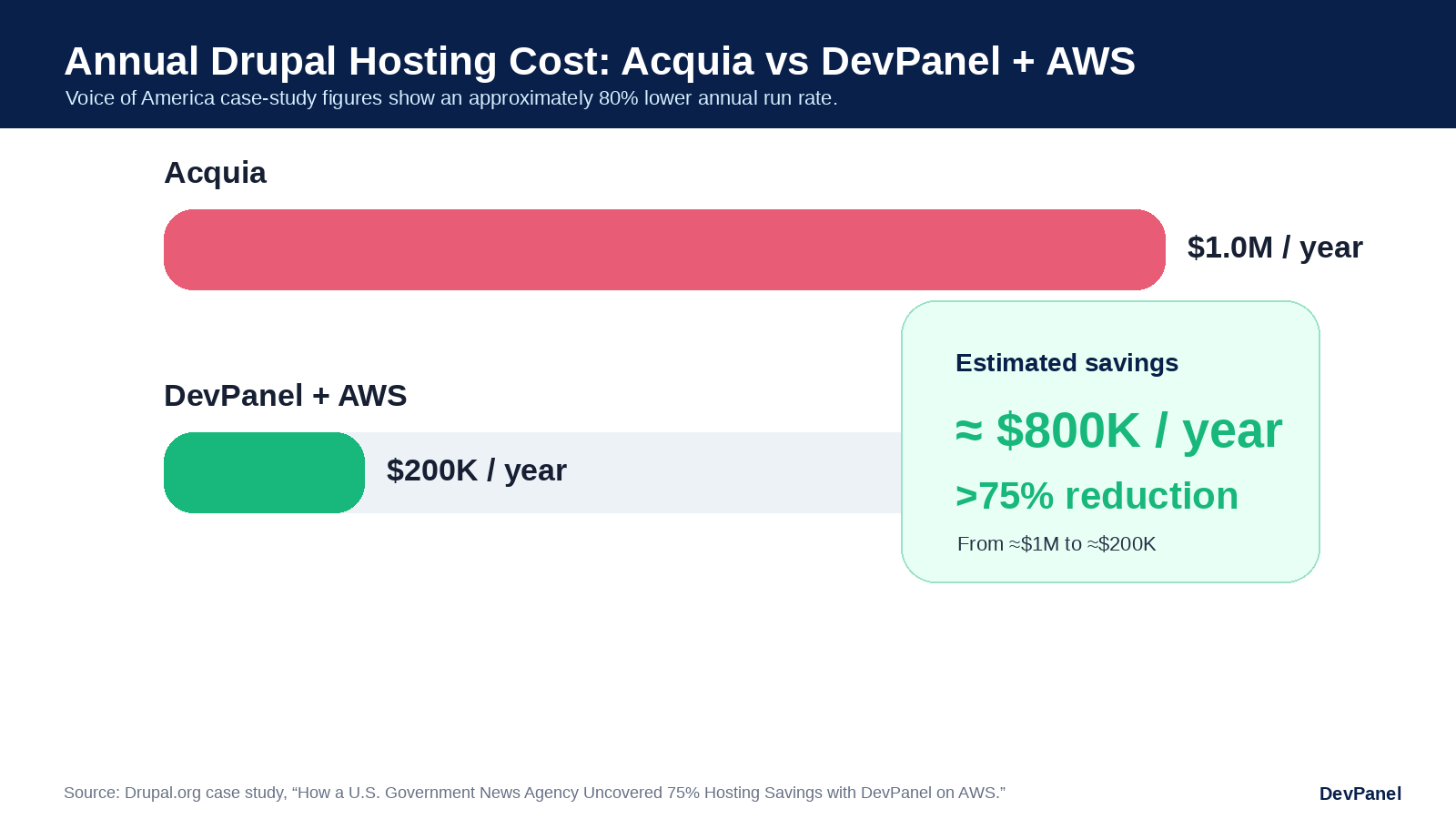
When it comes to DevPanel vs Acquia for Drupal hosting, the most important differences are not just feature-level details. They are strategic differences in cost, ownership, development velocity, infrastructure control, and long-term cloud flexibility. A Drupal.org case study for a U.S. government news agency associated with Voice of America reported that Acquia hosting was projected at approximately $1 million per year for only four sites, while a DevPanel-on-AWS approach reduced projected hosting to approximately $200,000 per year, representing more than 75% savings.
For organizations running Drupal at scale, that kind of cost delta changes the conversation. The question is no longer simply whether a managed Drupal platform is convenient. The better question is whether vendor-managed infrastructure is worth the premium when modern cloud orchestration, automated environments, browser-based development tools, and CI/CD workflows can run directly in an organization’s own cloud account.
Key Takeaways
DevPanel is strongest for organizations that want cloud ownership, lower infrastructure costs, flexible development environments, and integration with existing DevOps tools. Its bring-your-own-cloud model lets teams run Dev, Test, and Live environments inside their own AWS, Azure, DigitalOcean, or Kubernetes infrastructure, with auto-scaling, resource optimization, browser-based VS Code, CI/CD, GitOps, blue/green deployments, automated security, backups, and SSL listed as included platform capabilities.
Acquia is strongest for teams that prefer a managed Drupal platform where the vendor controls the underlying infrastructure. Acquia Cloud Platform remains a mature Drupal hosting option with managed workflows, support structures, and plan-tiered platform capabilities. The trade-off is that key capabilities such as Cloud CD Dev Environments, support contacts, advisory hours, and SLA levels vary by subscription tier or add-on status.
The central difference is ownership. With DevPanel, the customer owns the cloud account and DevPanel acts as the automation and orchestration layer. With Acquia, the customer runs within Acquia’s managed cloud model, which can simplify operations but limits the amount of infrastructure-level control available to the customer.
What Are DevPanel and Acquia? A Quick Overview
Acquia is a managed Drupal hosting and digital experience platform. It built its reputation around enterprise-grade Drupal infrastructure, managed hosting workflows, support options, and a platform ecosystem designed specifically for Drupal applications. Acquia’s own documentation describes Cloud Platform Professional as a self-service Drupal hosting environment and Cloud Platform Enterprise as a fully managed, high-availability, scalable, clustered Drupal environment for complex Drupal applications.
DevPanel is an all-in-one platform for accelerating web development, deploying applications, and managing cloud environments. Its key distinction is that DevPanel runs in the customer’s own cloud account rather than forcing the customer into a vendor-owned infrastructure account. DevPanel’s pricing page summarizes the model as “Your Apps. Your Cloud. Automated. Secure. Scalable.” It also states that DevPanel can manage Dev, Test, and Live environments in the customer’s own cloud provider account, with support for AWS, Azure, DigitalOcean, and Kubernetes.
This distinction matters because DevPanel was not designed to replace the tools developers depend on. It was designed to integrate the development tools, cloud resources, pipelines, security checks, and deployment processes that teams already use, then bring them under one operational umbrella.
DevPanel vs Acquia for Drupal Hosting: The Real Cost Comparison
Cost is where this comparison becomes sharp very quickly. Acquia’s platform model is built around managed infrastructure, defined subscription tiers, storage, environments, support levels, and enterprise features. For enterprise-scale Drupal, those contracts can reach significant annual commitments, and the Voice of America case study provides a concrete example: approximately $1 million per year projected for Acquia hosting versus approximately $200,000 per year projected for DevPanel plus AWS.
DevPanel’s cost model is built around the customer’s own cloud account, auto-scaling, and resource optimization. The practical difference is that idle or elastic development workloads can be managed more efficiently because the customer is not simply buying a fixed vendor-hosted package. DevPanel’s pricing page lists auto-scaling and resource optimization, unlimited users and teams, unlimited projects and sites, and use of the customer’s own AWS, Azure, or DigitalOcean account among the included capabilities.
Acquia’s pricing model, by contrast, is a platform fee for a managed Drupal environment. For some organizations, that managed model is worth the premium because they want the vendor to own the infrastructure experience. For many others, especially teams with cloud or DevOps capability, the additional cost becomes harder to justify when the same or greater operational control can be achieved in the organization’s own cloud account.
Did you know? Acquia’s public Cloud Platform pricing table shows Cloud CD Dev Environments as an add-on for one tier and then as plan-tiered allotments of 3, 5, and 10 in higher tiers.
Dev Environments Compared: DevPanel vs Acquia for Drupal Development Teams
Development environments are one of the most important practical differences between DevPanel and Acquia because they affect daily developer productivity. They also affect cost in ways that are easy to underestimate. A modern Drupal team often needs feature-branch environments, pull-request previews, parallel testing, onboarding sandboxes, and short-lived client review environments.
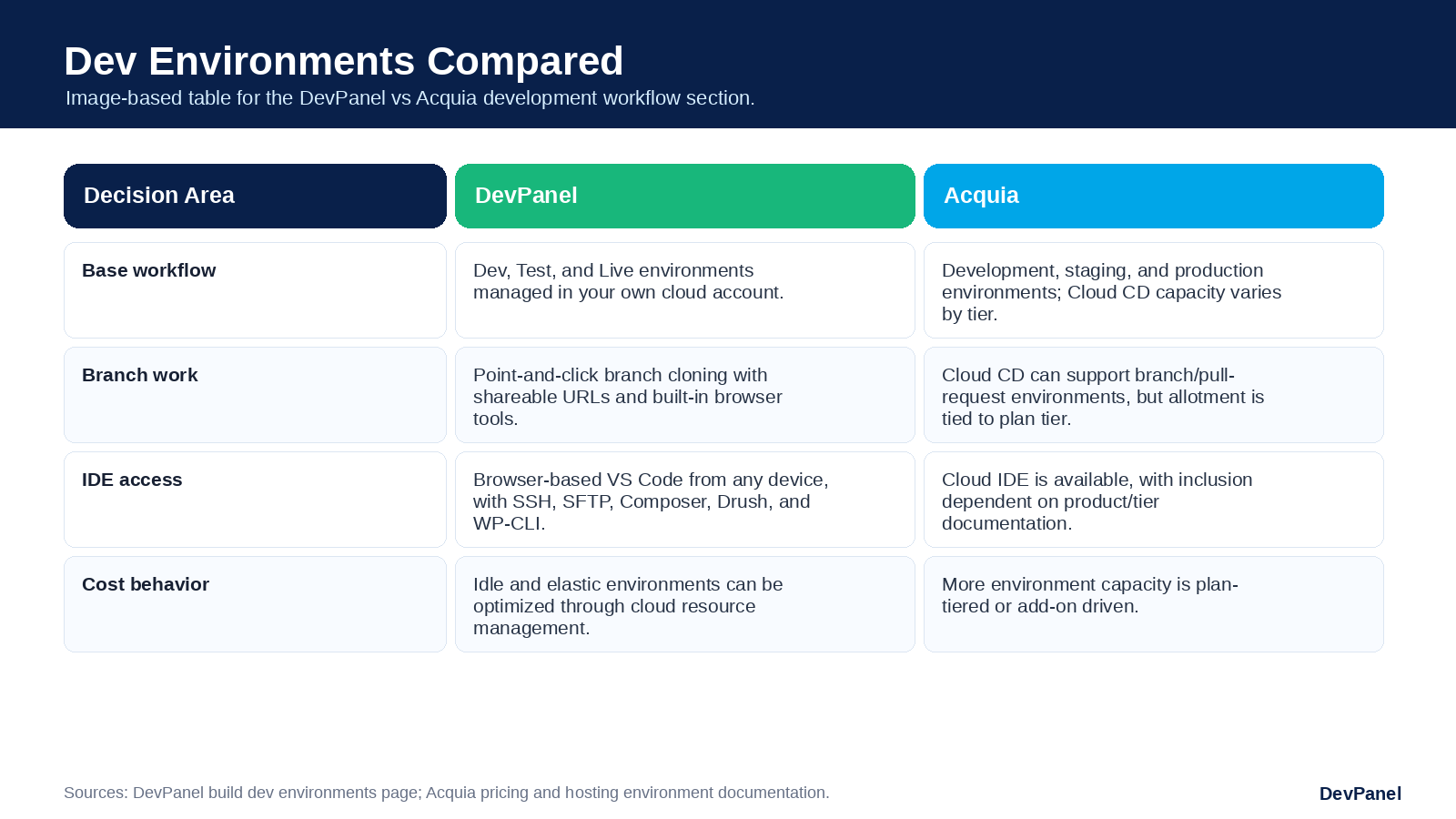
DevPanel’s development-environment page states that teams can clone branches, sites, and databases through a point-and-click workflow. It describes building a branch in about five minutes, sharing a URL with team members or users, and programming immediately with built-in browser-based development tools. The same page states that VS Code IDE is included and can be used from a browser on any device or operating system, with built-in SSH, SFTP, Composer, Drush, WP-CLI, and related tooling.
Acquia also supports development workflows, but its public pricing and documentation show that Cloud CD Dev Environments are tied to plan tiers or add-ons. Acquia’s hosting-environment documentation also notes that paid Professional and Enterprise applications have development, staging, and production environments by default, while optional additional environments are available in the Enterprise context.
The difference is not that Acquia lacks development tooling. The difference is that DevPanel’s model is oriented around cloud-controlled, repeatable, branch-friendly environments in the customer’s infrastructure, while Acquia’s model is oriented around managed platform tiers.
Cloud Flexibility and Infrastructure Control: DevPanel vs Acquia
The clearest philosophical difference between DevPanel and Acquia is the cloud control model. Acquia is a managed cloud provider. It controls the infrastructure and the customer works inside the operational boundaries of Acquia’s platform. That is a valid trade-off for teams that want managed convenience, but it also means the organization is a tenant in the vendor’s infrastructure model rather than the owner of its cloud environment.
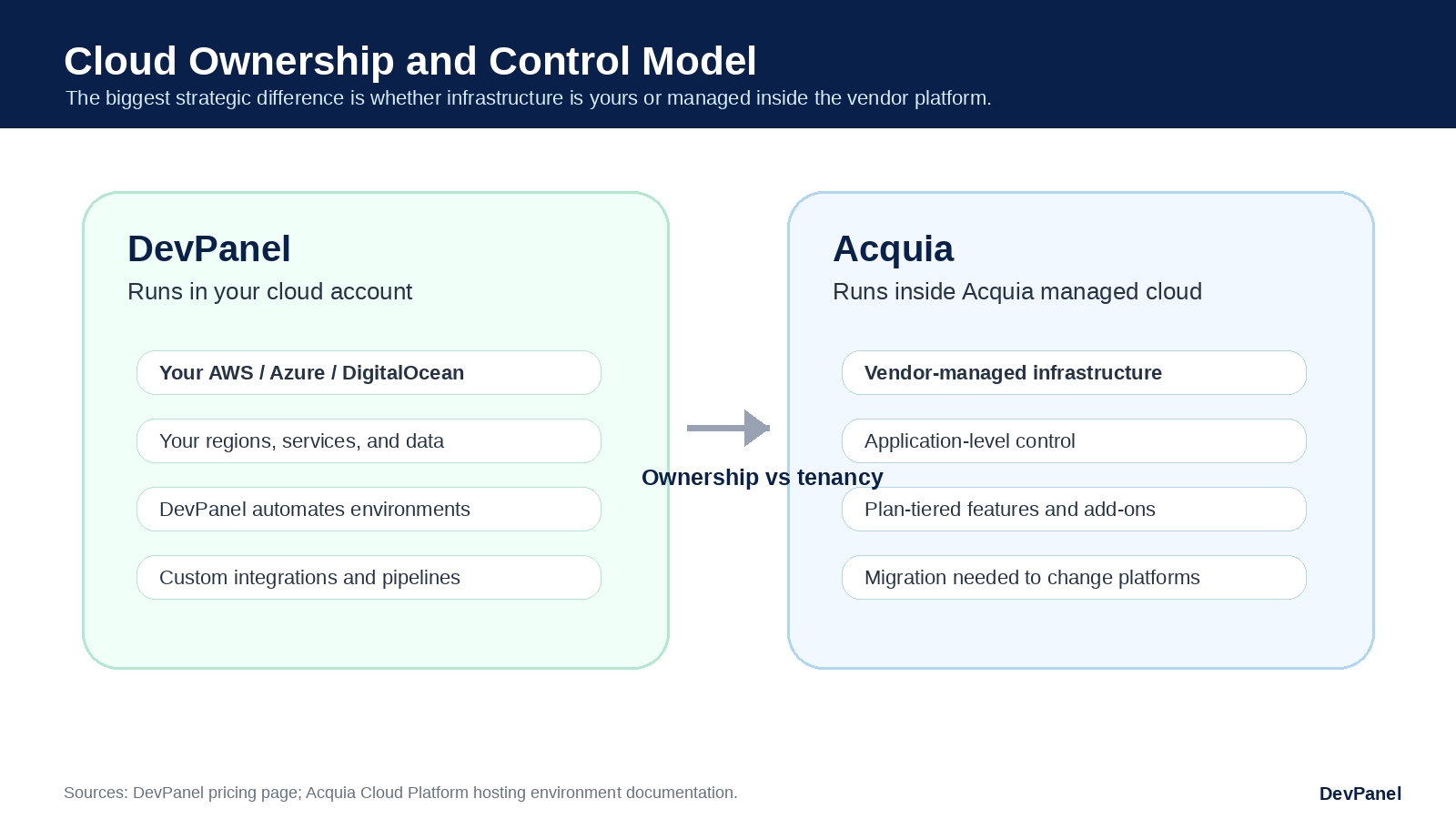
DevPanel’s bring-your-own-cloud model changes the risk profile. The customer owns the cloud account, the data, the regions, the instance choices, the network design, and the long-term infrastructure roadmap. DevPanel then adds automation, orchestration, deployment workflows, development environments, and centralized management on top of that cloud account.
With Acquia, switching infrastructure models generally means migrating away from the managed platform. With DevPanel, the infrastructure is already the customer’s. That distinction matters for agencies, government organizations, healthcare teams, universities, nonprofits, and enterprises thinking about three-to-five-year cloud strategy, procurement flexibility, compliance architecture, and long-term vendor leverage.
Deployment, Pipelines, and CI/CD: A Practical Comparison
Drupal teams rarely operate in a vacuum. They already use GitHub, GitLab, Bitbucket, Jenkins, automated tests, deployment approvals, ticketing systems, monitoring tools, and security scanners. A hosting platform becomes far more valuable when it integrates with existing workflows rather than forcing teams into a proprietary release process.
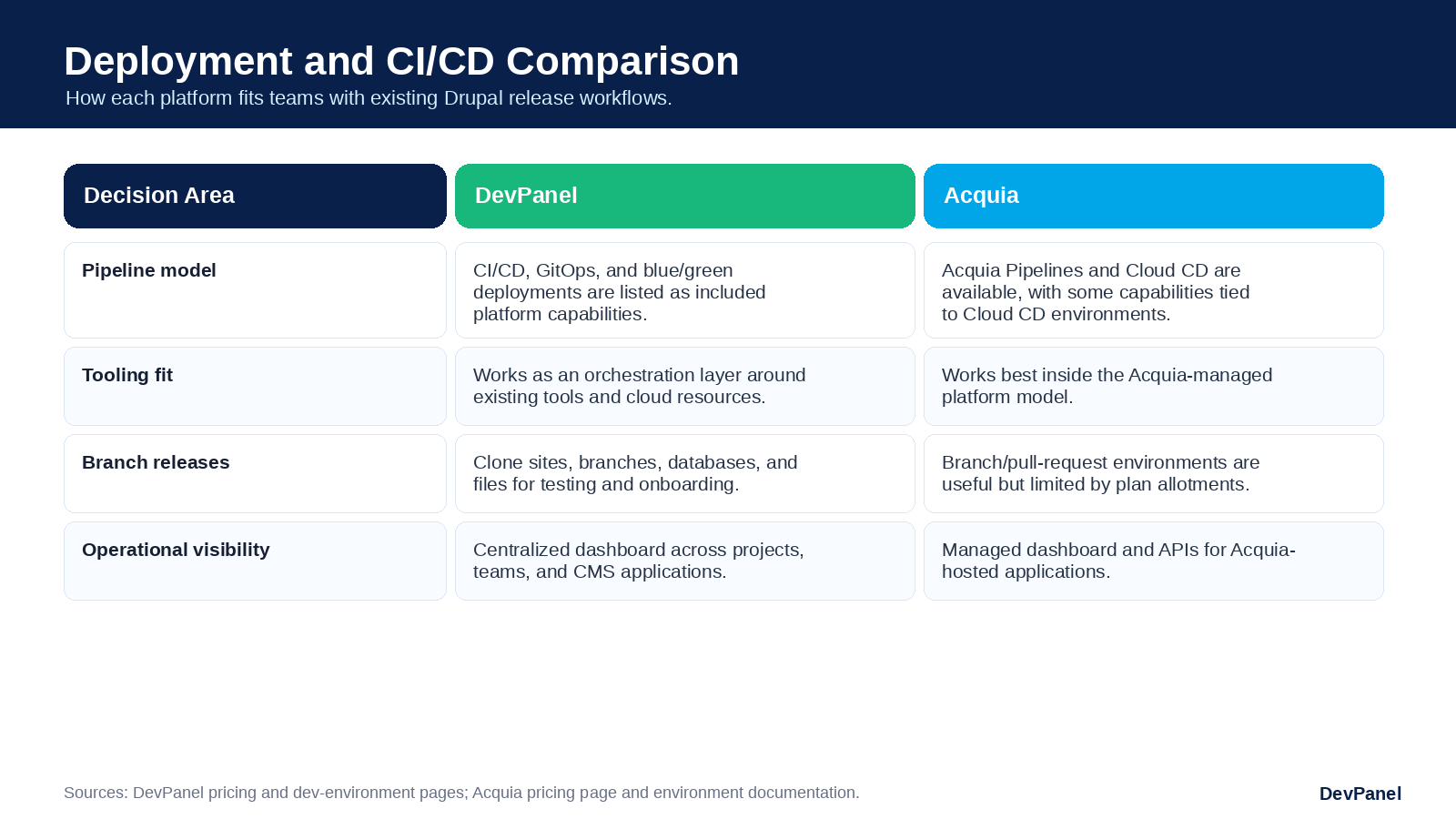
DevPanel’s pricing page lists CI/CD, GitOps, and blue/green deployments as included capabilities. Its development-environment page emphasizes point-and-click cloning of branches, sites, and databases, which supports a practical release workflow for feature branches, testing, and stakeholder review.
Acquia’s platform also provides deployment tooling and APIs within the Acquia-managed model. However, the pricing table indicates that Acquia Pipelines are associated with Cloud CD environments and that Cloud CD Dev Environments are either add-ons or tiered by plan. For teams running many active feature branches across multiple Drupal projects, that tiering can become both an operational constraint and a cost driver.
The practical distinction is that DevPanel is better positioned as an orchestration layer for teams that already have CI/CD preferences, while Acquia is better positioned for teams that want to standardize inside the Acquia platform ecosystem.
Security, Compliance, and Support: What Each Platform Delivers
Security and compliance should not be treated as checkboxes. They are architectural decisions. The right model depends on whether an organization wants vendor-managed compliance packaging or cloud-level control over how compliance is implemented.
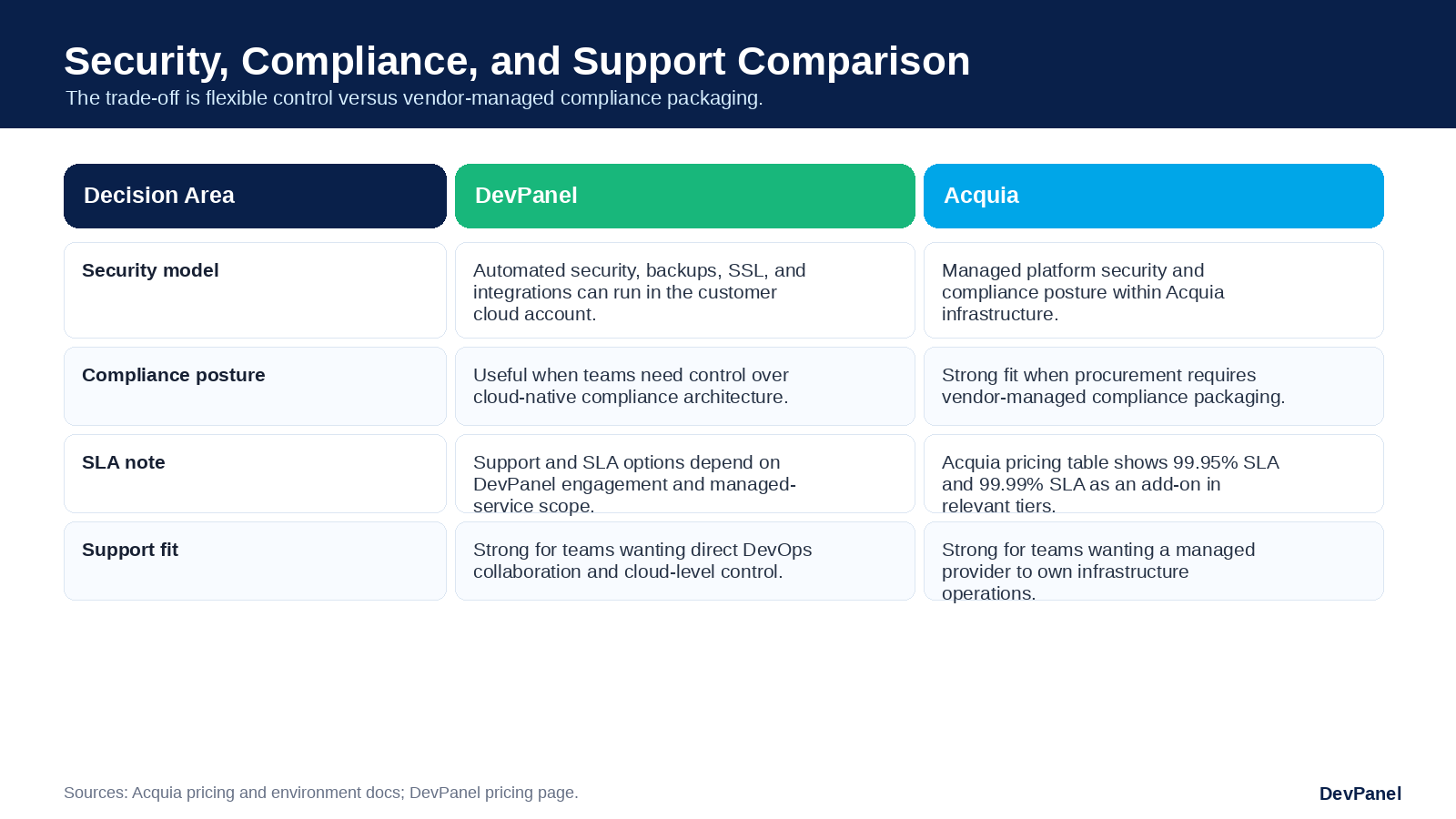
DevPanel’s public pricing page lists automated security, backups, and SSL as included capabilities and emphasizes that the platform runs in the customer’s own cloud account. For organizations that need cloud-native control, this model can be powerful because teams can combine DevPanel with their own AWS, Azure, Kubernetes, security, monitoring, logging, and compliance architecture.
Acquia’s compliance and managed-platform strengths are also real. Its environment documentation describes Cloud Platform Enterprise as a fully managed, high-availability, scalable Drupal environment, and its pricing page displays SLA-related features, including a 99.95% Uptime SLA and a 99.99% Uptime SLA shown as an add-on in the pricing table. For procurement environments where vendor-managed compliance packaging is essential, Acquia may remain a strong fit.
The trade-off is cost and control. With Acquia, the customer pays for a managed provider’s infrastructure and platform posture. With DevPanel, the customer gains more control over infrastructure decisions while still using a platform layer to automate and standardize operations.
Apps, Templates, and Workspaces: Building Drupal Faster
For agencies and enterprise teams managing many Drupal sites, repeatability is a major source of savings. It is not enough to host one site well. Teams need to create new projects quickly, onboard developers quickly, clone environments quickly, and isolate workspaces so that one project does not interfere with another.
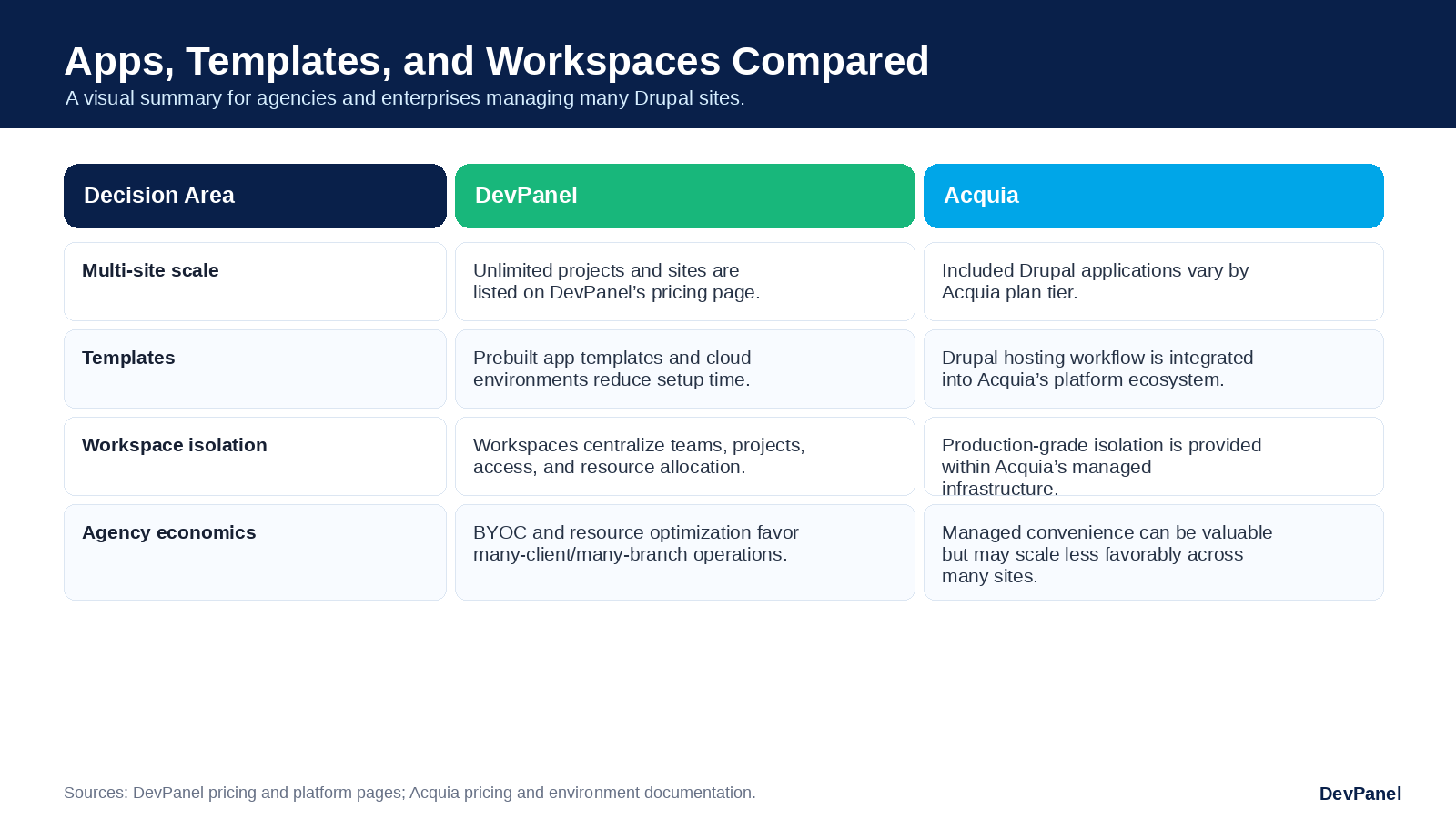
DevPanel’s model is especially relevant for agencies and organizations with many CMS projects because its pricing page lists unlimited projects and sites, unlimited users and teams, a centralized dashboard, browser-based VS Code and PhpMyAdmin, and use of the customer’s own cloud account. These features align closely with the needs of multi-client and multi-project Drupal teams.
Acquia also provides production-grade Drupal hosting workflows and environment management within its platform ecosystem. The difference is that Acquia’s pricing table shows included Drupal applications, storage, search, support contacts, and related capabilities varying by plan tier. That can be appropriate for organizations that want a managed platform package, but it may scale less favorably for agencies running many client sites and frequent branch environments.
Who Should Choose DevPanel and Who Should Choose Acquia?
This comparison is not one-size-fits-all. The right decision depends on budget, team capability, procurement expectations, compliance requirements, and how much control the organization wants over its cloud future.
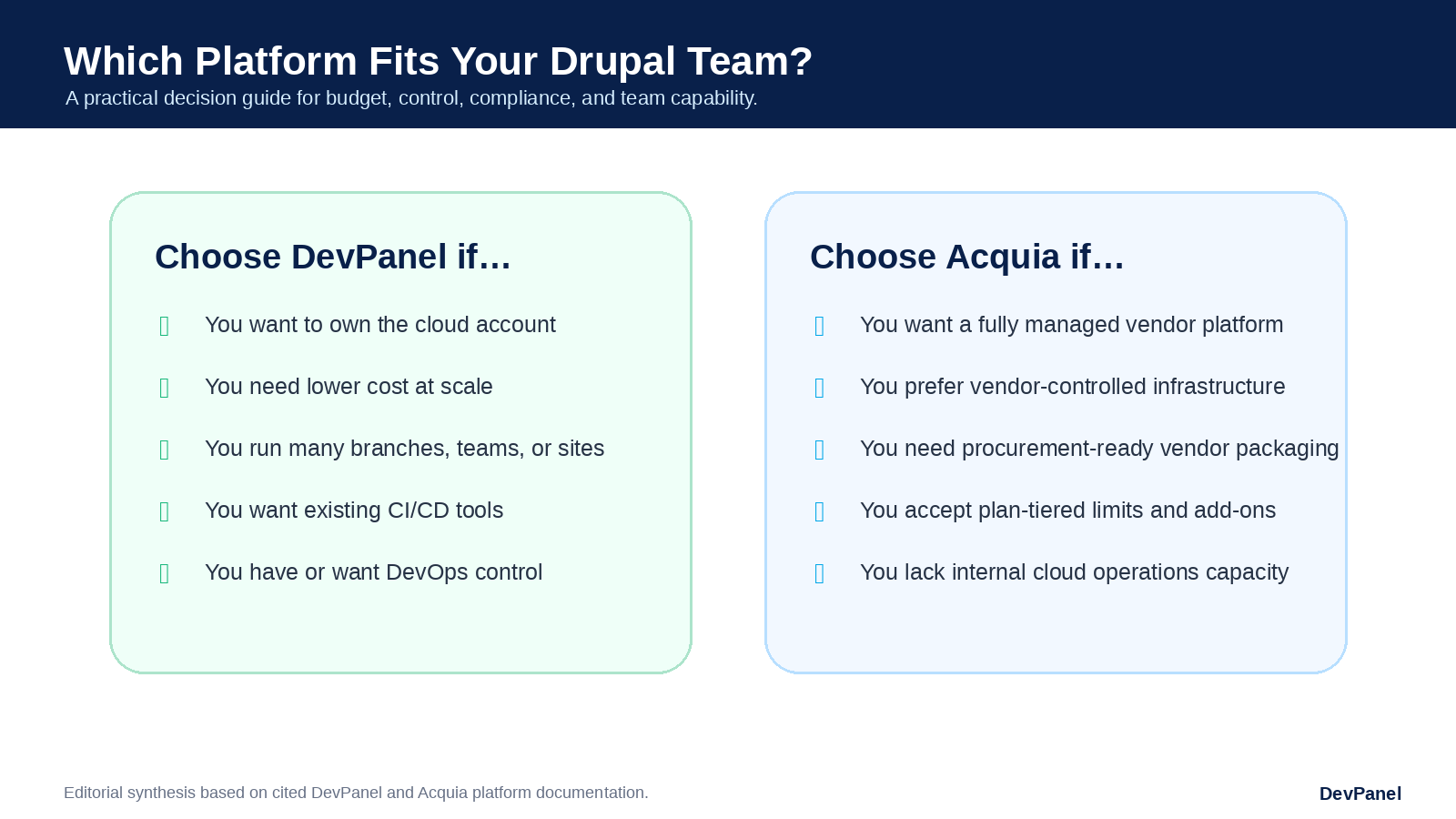
Choose DevPanel if you want to own your cloud infrastructure, control costs through auto-scaling and resource optimization, run many Drupal sites or development environments, use browser-based developer tooling, and integrate your existing pipelines under one platform. DevPanel is also a strong fit when your organization wants to avoid infrastructure lock-in and preserve flexibility across AWS, Azure, DigitalOcean, or Kubernetes.
Choose Acquia if your team lacks internal cloud operations capacity and wants a vendor-managed Drupal hosting platform where the infrastructure is handled for you. Acquia can also be a strong fit in procurement environments where vendor-managed packaging, platform documentation, and a managed support model matter more than cloud ownership or cost flexibility.
The most important internal question is simple: How much does your team want to own the cloud layer? For teams with strong DevOps capability, DevPanel delivers more control and potentially much better value per dollar. For teams that truly need a managed provider to own infrastructure operations, Acquia fills that role at a higher cost.
Conclusion
The DevPanel vs Acquia comparison comes down to a clear strategic choice. Acquia provides a managed Drupal platform where the vendor controls the infrastructure. DevPanel provides an orchestration platform that lets organizations run Drupal in their own cloud account while gaining automated environments, development tooling, deployment workflows, and centralized management.
For teams comparing cost, control, development environments, and cloud flexibility, DevPanel’s model is compelling. The Voice of America case study shows why: a projected move from approximately $1 million per year to approximately $200,000 per year is not a minor optimization. It is a major change in total cost of ownership.
Acquia remains a capable platform with genuine strengths in managed Drupal hosting, enterprise packaging, and vendor-managed operations. But for teams that want ownership, cloud flexibility, repeatable development environments, and cost efficiency at scale, DevPanel is the stronger strategic choice.
Ready to see the difference? Contact the DevPanel team or schedule a live demo to see how DevPanel handles Drupal workloads in your cloud, at your cost, with your tools.
Frequently Asked Questions
Is DevPanel cheaper than Acquia for Drupal hosting in 2026?
In many real-world scenarios, DevPanel can be significantly cheaper because it runs in the customer’s own cloud account and supports resource optimization rather than forcing all workloads into a fixed vendor-hosted model. The Voice of America case study reported Acquia hosting projected at approximately $1 million per year compared with approximately $200,000 per year for DevPanel plus AWS.
How many dev environments do you get with Acquia vs DevPanel?
Acquia’s public pricing page shows Cloud CD Dev Environments as an add-on for one tier and then as plan-tiered allotments of 3, 5, and 10 in higher tiers. DevPanel’s public materials emphasize Dev, Test, and Live environments in the customer’s cloud account, branch cloning, browser-based tooling, and the ability to manage unlimited projects and sites.
Can DevPanel replace Acquia for enterprise Drupal hosting?
For many enterprise Drupal teams, DevPanel can replace Acquia when the organization wants more infrastructure control, lower cost, cloud ownership, and integration with existing DevOps workflows. Acquia may still be a better fit when a team wants a fully managed Drupal vendor to own infrastructure operations.
Does DevPanel support Drupal-specific development workflows?
Yes. DevPanel’s development-environment page describes branch, site, and database cloning, browser-based VS Code, SSH, SFTP, Composer, Drush, and WP-CLI. Those capabilities are directly relevant to Drupal teams that need fast onboarding, repeatable environments, and consistent branch-based workflows.
What cloud providers does DevPanel support compared to Acquia?
DevPanel’s pricing page presents a bring-your-own-cloud model across AWS, Azure, DigitalOcean, and Kubernetes. Acquia operates as a managed Drupal cloud platform where the customer works inside Acquia’s hosting environment.
Is Acquia’s 99.99% uptime SLA included in every plan?
Acquia’s pricing page displays 99.95% Uptime SLA as a listed feature and shows 99.99% Uptime SLA as an add-on in the pricing table. Organizations evaluating Acquia should confirm the exact SLA terms for their selected subscription tier.
Which is better for a Drupal agency managing multiple client sites?
DevPanel is often the stronger fit for agencies managing many client sites because it emphasizes unlimited projects and sites, unlimited users and teams, cloud ownership, browser-based tooling, CI/CD, GitOps, and resource optimization. Acquia may still be appropriate for agencies that specifically want to resell or operate inside a vendor-managed Drupal hosting model.