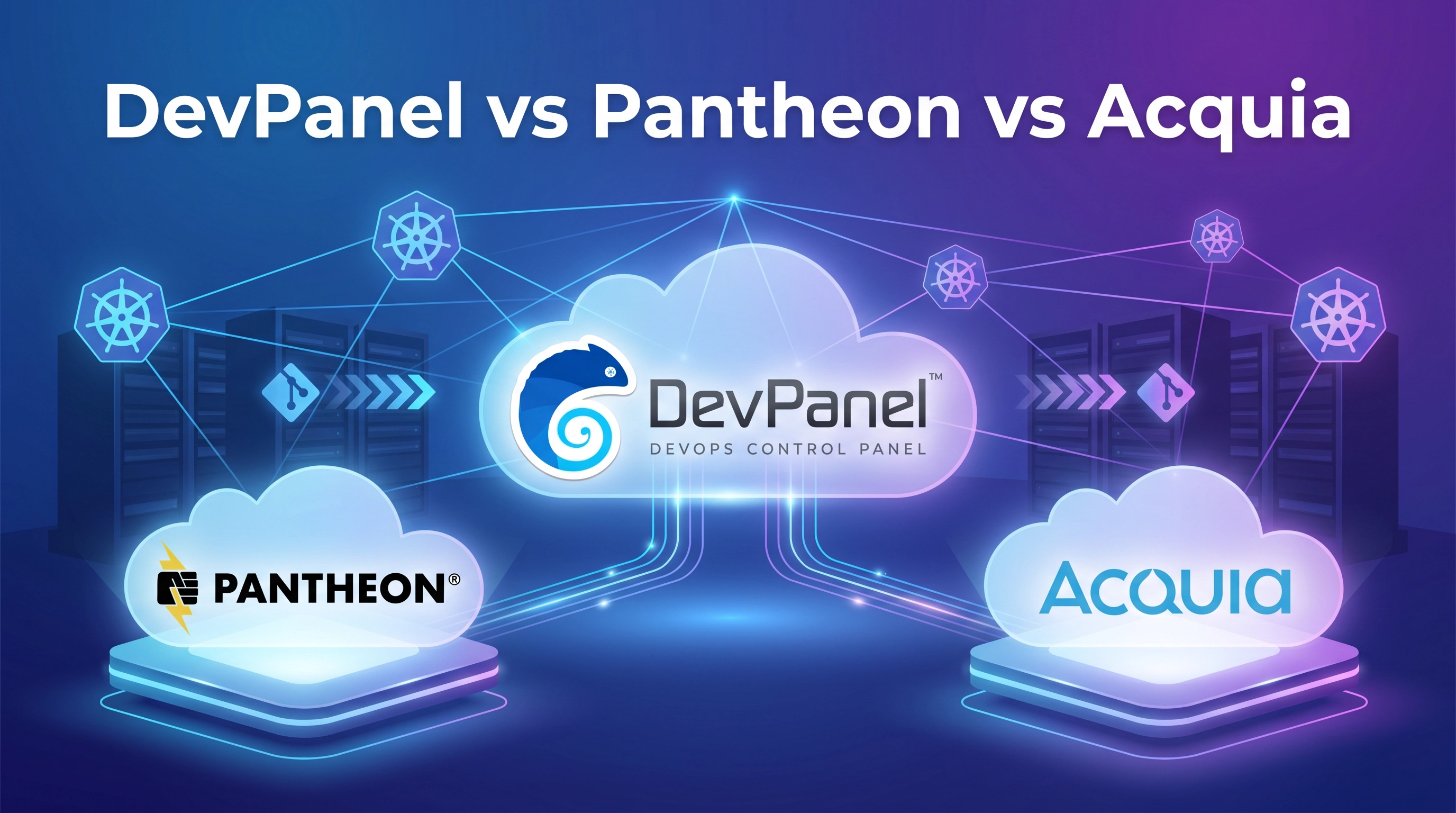
DevPanel vs Pantheon vs Acquia: The Shift from Legacy WebOps to Cloud Orchestration Ownership
The evolution of web infrastructure has reached a critical tipping point. For nearly a decade, platforms like Pantheon and Acquia improved an old model by abstracting the complexities of server management into a streamlined workflow. They made websites easier to operate, but they did not solve the foundational challenges of cloud ownership, deployment freedom, or cost transparency.
Today, a new category is emerging above them: Application Orchestration. This is not a mere hosting comparison; it is a fundamental shift from running website operations inside a vendor-controlled platform to managing application orchestration inside your own cloud. Once you see the difference in the DevPanel vs Pantheon vs Acquia landscape, legacy platforms start to look less like a strategic choice and more like a technical constraint.
1. The BYOC Wedge: Your Apps, Your Cloud, Your Policies
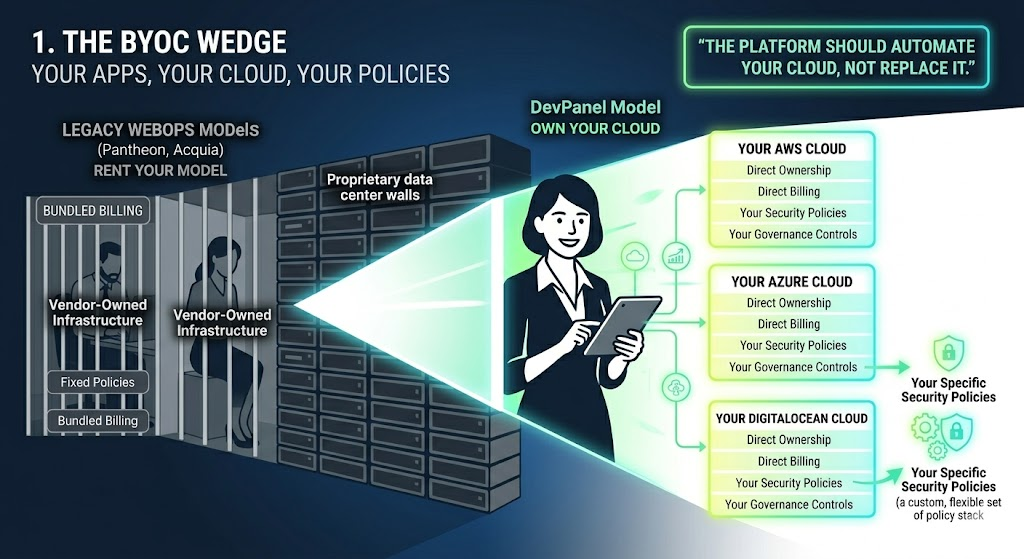
The most significant differentiator in this new era is the Bring Your Own Cloud (BYOC) model. Legacy WebOps platforms require you to “rent” your operating model by placing your data and infrastructure inside their proprietary walls.
- Infrastructure Ownership: With DevPanel, you use your own cloud account (AWS, Azure, or DigitalOcean), maintaining direct ownership and direct billing.
- No Vendor-Owned Infrastructure: Unlike the vendor-operated models of Pantheon and Acquia, you are no longer running your future inside someone else’s cloud abstraction.
- Policy Alignment: Because the infrastructure is yours, governance is aligned to your specific cloud controls and security policy models, rather than the boundaries set by a vendor.
The platform should automate your cloud, not replace it. This change dictates who ultimately controls spend, optimization, and long-term architecture.
2. Eliminating the “Platform Tax” and Unlocking 80% Savings
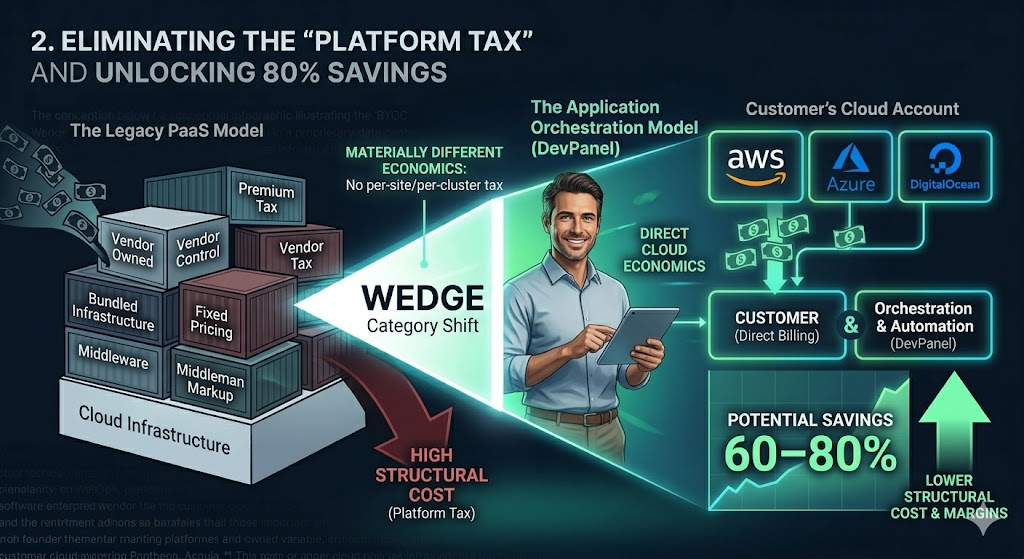
In the legacy PaaS (Platform as a Service) world, convenience is priced into every layer. This often manifests as a “platform tax”—bundled pricing that includes managed infrastructure and high markups for the “privilege” of easy deployment.
- Materially Different Economics: DevPanel does not charge per site or per cluster, creating a fundamentally different financial structure.
- Direct Cloud Economics: Customers pay their cloud provider directly for the resources they actually use, eliminating the middleman markup.
- Economic Room for Ambition: By moving away from legacy economics, organizations can realize potential savings of 60–80%.
Lower structural costs create room for better margins, faster launches, and more ambitious scaling. When you stop paying a premium for a vendor-managed environment, you regain the “optimization headroom” necessary for enterprise-level growth.
3. Beyond Websites: Designing for Scale, Not Just Sprawl
A common limitation of legacy platforms is their “website-first” assumption. In the DevPanel vs Pantheon vs Acquia debate, it becomes clear that legacy providers focus on sites, while the future requires a focus on applications.
- Modern Teams Operate Fleets: Today’s developers are managing more than just pages; they are managing application fleets that require one control layer.
- SiteFleet-Style Orchestration: DevPanel standardizes how environments, templates, and orchestration operate across wider application footprints.
- Kubernetes-Native Scaling: Instead of managed scaling restricted to website logic, you gain Kubernetes orchestration with customer-controlled scaling levers.
Your next platform should match the portfolio you are becoming, not the stack you inherited. Scaling operations matters more than simply scaling pages.
4. Modern Maturity: Speed Without Surrendering Control
Legacy platforms make onboarding feel easy, but they often hard-code the relationship into the way your team deploys, governs, and scales. If your exit costs are high, your “flexibility” is mostly a marketing story.
- Git-Driven and Cloud-Native: DevPanel is built on the premise that Kubernetes, GitOps, and templates belong inside the customer’s cloud model.
- Deployment Flexibility: It offers a GitOps-friendly operating model that supports AWS, Azure, DigitalOcean, or your own Kubernetes clusters.
- Cloud Dev Environments: Unlike the opinionated platform boundaries of the past, you can launch cloud development environments directly in your own infrastructure.
Modern platform maturity means gaining the speed of automation without surrendering the control of your architecture.
5. Strategic Implication: The Road to 2026
What looked like a simplification in 2018 increasingly behaves like a dependency in 2026. As application portfolios evolve, governance demands increase, and AI workloads become the norm, the “managed-platform-first” approach begins to show its age.
- AI Readiness: Composable cloud architecture is inherently better suited for evolving AI workloads than website-centric platforms.
- Structural Advantage: Choosing DevPanel is an operating model decision that allows you to own the infrastructure while standardizing delivery.
- Future Readiness: While legacy models optimize for the current era of website operations, DevPanel upgrades the entire category to prepare for the next decade of application delivery.
6. Detailed Comparison: Features and Functionality
When breaking down DevPanel vs Pantheon vs Acquia, the technical advantages of orchestration become undeniable.
| Capability | DevPanel Advantage | Pantheon Legacy Model | Acquia Legacy Model |
|---|---|---|---|
| Vendor Lock-in | Lower lock-in through BYOC and portable architecture. | Higher dependency on managed environments. | Higher dependency on managed stacks and tooling. |
| Multi-cloud Support | Deploy to AWS, Azure, DigitalOcean, or your own Kubernetes. | Managed platform, not customer-owned control. | Managed cloud experience rather than orchestration. |
| Template Marketplace | Template-driven launches and reusable delivery patterns. | Workflow-first, less marketplace centric. | Starter kits and low-code assets for Drupal only. |
| Customization | Greater freedom across architecture, infra, and policy. | Limited by managed abstraction. | Limited by platform model and Drupal assumptions. |
7. The CFO’s Case: The Real Cost of “Convenience”
The economic argument in the DevPanel vs Pantheon vs Acquia comparison is often the deciding factor for enterprise leaders. Legacy WebOps platforms bundle convenience into their costs, but that convenience becomes exponentially expensive at scale.
- No Per-Site Tax: DevPanel eliminates the artificial cost barriers that prevent organizations from launching experimental or small-scale sites.
- Direct Billing: By paying the cloud provider directly, organizations capture the “cloud economics” and volume discounts they are entitled to.
- Optimization Headroom: Owning the cloud account allows for specific infrastructure tuning that can significantly lower the total cost of ownership (TCO).
8. Kubernetes-Native: The Technical Bedrock
Why does the “Application Orchestration” category represent such a massive leap? It is because it leverages Kubernetes natively within the customer’s own cloud.
- Programmable Scale: Unlike the black-box scaling of Pantheon and Acquia, DevPanel gives you programmable control over how your infrastructure responds to demand.
- Portable Operating Model: Because it is built on Kubernetes and GitOps, the entire operating model remains portable.
- Governance Inside Your Boundaries: Compliance and governance are not something you “rent” from a vendor; they are policies you enforce inside your own cloud boundaries.
9. Preparing for the AI Pivot
As we look toward 2026 and beyond, the ability to support AI workloads will define platform success.
- Composable Architecture: DevPanel’s approach allows teams to integrate AI-specific services (like vector databases or GPU clusters) directly into their application environment.
- Data Sovereignty: For AI workloads, keeping data inside your own cloud account is critical for compliance and security.
- Beyond Content Tools: While Acquia offers strong content marketing tools, DevPanel provides the architectural foundation for actual AI application development.
Conclusion: The Real Choice
Choosing DevPanel is not a simple tooling decision; it is a choice of who owns your future. Pantheon and Acquia still ask organizations to improve their outcomes within a vendor-controlled system.
DevPanel offers a more structural advantage: own the infrastructure, keep the economics, and build on an architecture that remains flexible as your world changes. The real question in the DevPanel vs Pantheon vs Acquia debate is no longer which managed platform is “less limiting.” It is whether your organization should still be running its future inside someone else’s cloud abstraction.