
Best Pantheon Alternatives for Enterprise WordPress Site Management in 2026
If you’re evaluating the best Pantheon alternatives for enterprise WordPress site management, you’re already asking the right question. On a traditional $1,000 monthly hosting bill with a managed PaaS like Pantheon, approximately 80% of that ($800) is pure platform markup, with only $200 actually spent on compute resources. That’s not a hosting cost. That’s the Simplicity Tax, and at enterprise scale, it compounds fast.
Key Takeaways
- The Simplicity Tax is real and measurable: Managed PaaS platforms like Pantheon charge 200% to 500% markup over raw cloud infrastructure costs. Enterprise teams at scale feel this immediately.
- BYOC (Bring Your Own Cloud) is the structural alternative: Platforms like DevPanel let you run the same automation layer inside your own AWS, Azure, or DigitalOcean account, eliminating the markup entirely.
- Pantheon’s walled garden limits data sovereignty: You don’t own the underlying infrastructure, which creates compliance and data residency risks for regulated industries like healthcare and government.
- Enterprise WordPress needs CI/CD, multi-environment workflows, and team isolation: Not every Pantheon alternative delivers all three. DevPanel’s workspace isolation model does.
- Nonprofit and higher education enterprises can eliminate hosting costs entirely: AWS and Azure nonprofit cloud grants ($2,000 to $5,000/year) cover infrastructure when you use a BYOC platform. Traditional managed hosts like Pantheon don’t support this model.
- Performance benchmarks matter: Top enterprise WordPress providers hit load times of 19ms. Any Pantheon alternative you choose must target or beat that threshold at scale.
- DevPanel’s Community Edition is free forever: See the full DevPanel pricing breakdown to understand what zero-markup hosting actually looks like for enterprise teams.
Why Enterprise Teams Are Leaving Pantheon in 2026
Pantheon built its reputation on WebOps simplicity. For small to mid-sized teams, that proposition worked. For enterprise, it’s become a liability.
The core problem is structural. Pantheon is a walled garden. You get their containers, their CDN, their infrastructure decisions, and their pricing. You don’t get your own VPC. You don’t get direct cloud account ownership. You don’t get Data Sovereignty.
At enterprise scale, those constraints start appearing as hard blockers. Compliance officers flag the shared infrastructure model. Finance teams notice the markup. DevOps engineers want CI/CD pipelines that don’t terminate at a proprietary boundary.
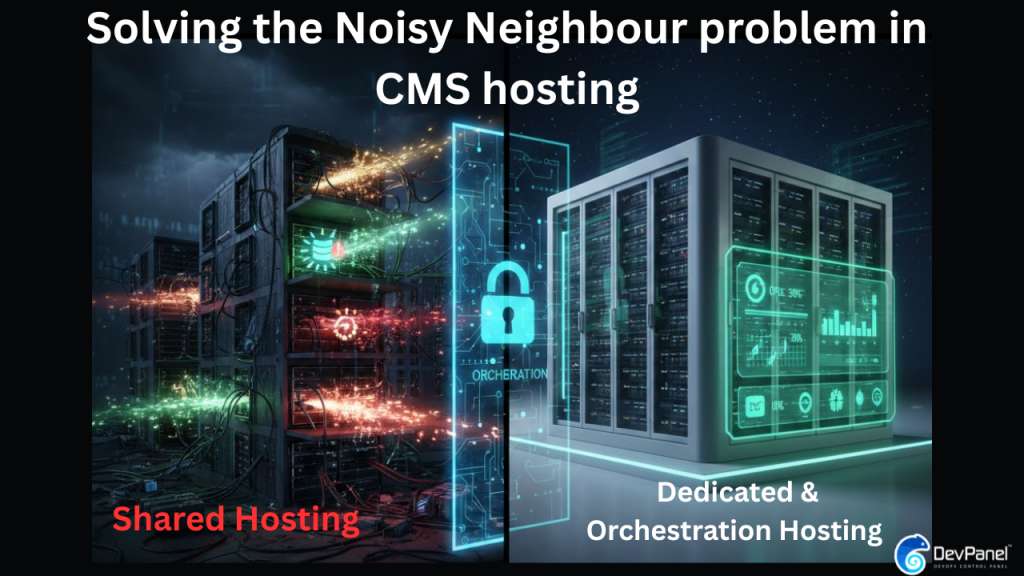
The Noisy Neighbor Problem is also real on Pantheon’s container-based shared infrastructure. High-traffic neighbor sites spike resource contention, and your enterprise WordPress site absorbs the impact with no recourse.
By 2026, the enterprise WordPress market has bifurcated clearly. Teams that prioritize a simple UI stay with managed PaaS. Teams that prioritize cost, control, and compliance are moving to the best Pantheon alternatives for enterprise WordPress site management that actually hand them cloud ownership.
The Cloud Hosting Trilemma Pantheon Forces on You
There’s a Cloud Hosting Trilemma that every enterprise team faces: you can have cost efficiency, operational simplicity, or infrastructure control. Traditional wisdom says you can pick two.
Pantheon picks simplicity and control for you, then bills you for it. That’s the deal. And for most enterprise buyers in 2026, that’s no longer an acceptable trade.
The old choice between DIY cloud complexity and the costly walled gardens of managed hosting is a false dichotomy. Modern BYOC platforms like DevPanel break the trilemma entirely by running the automation layer inside your own cloud account.
Did You Know?
Agencies moving to a BYOC (Bring Your Own Cloud) model for WordPress management can retain 20% to 30% higher profit margins per project by eliminating platform markups on client hosting.
Source: Enterprise WordPress Management 2026
Best Pantheon Alternatives for Enterprise WordPress Site Management: The Full Breakdown
We’re covering six serious contenders. Each one solves a different piece of the enterprise WordPress puzzle. None of them are identical, and that’s the point.
Choose based on where your pain actually is: cost, control, compliance, performance, or developer workflow. Here’s the honest breakdown.
This infographic highlights the five key differentiators among Pantheon alternatives for enterprise WordPress site management, helping you choose the best fit.
1. DevPanel on AWS or Azure (Best BYOC Alternative to Pantheon for Enterprise WordPress)
We built DevPanel specifically to eliminate the Simplicity Tax by running the same automation layer inside your own AWS, Azure, or DigitalOcean account. You get PaaS-style point-and-click simplicity. You keep full Digital Sovereignty.
This is the structural distinction that separates DevPanel from every other name on this list. You bring your own cloud. DevPanel’s Control Plane handles the rest.
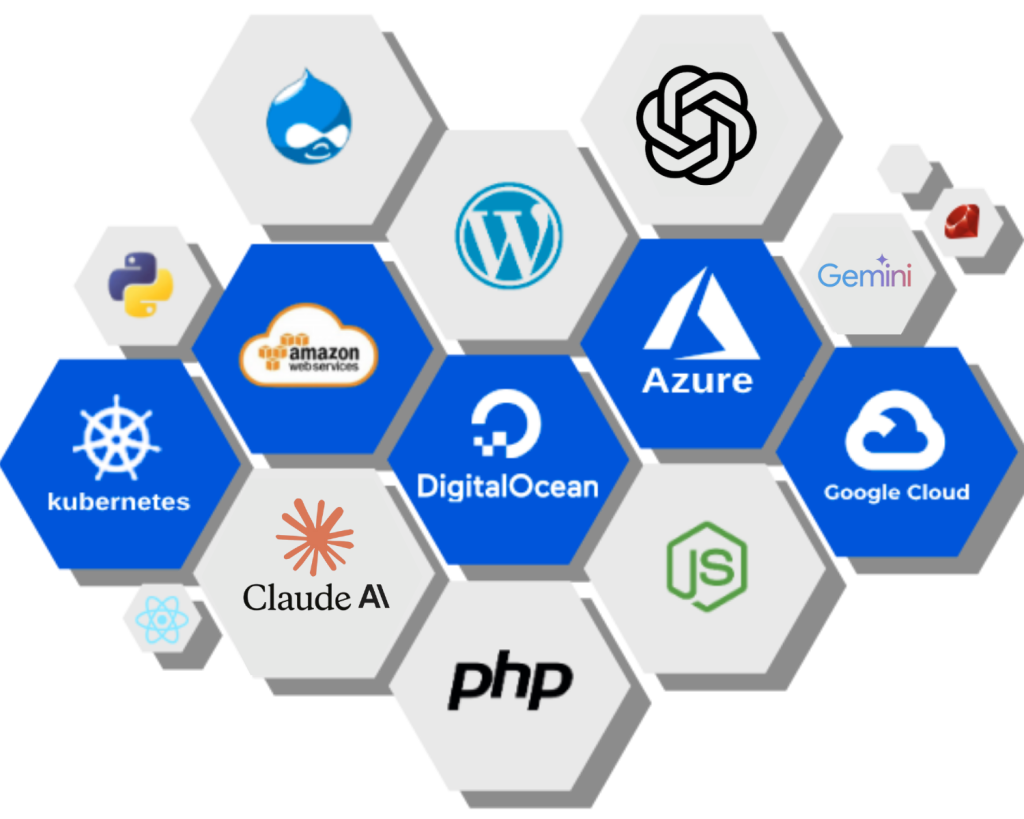
The Control Plane then works 24/7 to ensure the Actual State of your WordPress environments matches your Desired State. No manual server babysitting. No 3 AM pager alerts for a misconfigured container.
For enterprise teams, the workspace isolation model is where DevPanel gets serious. Each client, team, or project gets its own workspace. Permissions, environments, and resources are cleanly separated. You can create as many workspaces as you want inside a single cluster, or connect workspaces to different clusters entirely.
Our prebuilt application templates and preconfigured frameworks let you spin up a new client WordPress environment in minutes. Not days. Not a devops ticket.
CI/CD and Blue/Green Deployments are built in. Git-based workflows, preview environments, and automated testing pipelines come standard. The deploy and clone workflow means you can replicate a production environment for staging in a single action.
Pricing: The DevPanel Community Edition is free forever. You pay only for the cloud compute you actually use in your own account. Zero Markup. Enterprise plan pricing (with SSO, SLA, and compliance features) is available on request.
Best for: Enterprise agencies, nonprofits leveraging cloud grants, higher education, government, and any organization where data residency and cost control are non-negotiable.
Not ideal for: Teams with zero internal cloud familiarity who want fully managed hands-off infrastructure with no involvement in cloud account setup.
2. WP Engine (Best Managed WordPress Alternative to Pantheon for Enterprise Scale)
WP Engine is the closest managed-platform comparison to Pantheon in terms of market positioning. Both are opinionated PaaS solutions built specifically for WordPress at scale.
WP Engine offers a stronger WordPress-specific feature set than Pantheon in several areas. Their Genesis framework ecosystem, Headless WordPress architecture support, and dedicated enterprise account management are meaningful differentiators.
Performance benchmarks are real. Enterprise WP Engine infrastructure achieves load times in the 19ms range, which is competitive at the top tier. For pure WordPress performance without infrastructure ownership, WP Engine is a credible Pantheon alternative.
The catch: It’s still a walled garden. You still pay the Simplicity Tax. You still don’t own your infrastructure. For regulated industries, the data sovereignty question remains unanswered.
Pricing: Enterprise plans start at approximately $3,600/year and scale significantly based on traffic and site count.
Best for: Marketing-heavy organizations that want fully managed WordPress with strong editorial and headless capabilities and no appetite for cloud account management.
3. Acquia (Best Pantheon Alternative for Drupal-WordPress Mixed Portfolios)
Acquia is the enterprise-grade alternative for teams running both Drupal and WordPress across a large site portfolio. Their platform is purpose-built for digital experience management at the government, healthcare, and higher education level.

The Acquia Cloud Platform includes strong multi-site management, CDN integration, and enterprise security controls. Their support tier is genuine enterprise-grade, with SLAs that actually mean something.
Paying a 200% to 500% markup to a managed platform like Acquia (or Pantheon) for the convenience of not owning your own infrastructure is the Simplicity Tax we think you should stop paying. Acquia is not cheap. Contracts routinely start at $30,000 to $60,000 annually for enterprise accounts.
Best for: Large organizations with complex multi-CMS portfolios where Drupal is the primary platform and WordPress is secondary, and where budget is less of a constraint than compliance and vendor support.
4. Kinsta (Best Pantheon Alternative for Performance-First Enterprise WordPress)

Kinsta runs on Google Cloud Platform infrastructure, which is a meaningful distinction from Pantheon’s proprietary container stack. Every site on Kinsta gets isolated resources on GCP’s premium tier network, which eliminates the Noisy Neighbor Problem that shared infrastructure creates.
Their MyKinsta dashboard is clean and genuinely developer-friendly. Edge caching, automatic scaling, and a staging environment workflow that mirrors what Pantheon offers, but with better raw performance on GCP’s backbone.
Pricing: Enterprise plans start around $1,500/month, scaling with traffic and the number of sites.
Best for: Performance-obsessed enterprise WordPress teams that want GCP infrastructure without managing it themselves, and can absorb the monthly cost without concern.
5. Cloudways (Best Mid-Market Pantheon Alternative for Cost-Conscious Enterprise Teams)

Cloudways sits at an interesting intersection: managed hosting with underlying cloud provider choice (AWS, GCP, Azure, DigitalOcean, Vultr). You get more cloud flexibility than Pantheon offers without full infrastructure ownership.
The platform is strong for teams managing multiple client WordPress sites that need a simple control panel without full DevOps infrastructure management. You don’t own the cloud account directly, but the pricing is significantly more transparent than Pantheon’s tiered model.
Pricing: Enterprise-grade configurations on AWS or GCP typically run $250 to $800/month depending on server specs and site count.
Best for: Digital agencies managing 10 to 50 client WordPress sites that need a middle ground between managed PaaS and full BYOC infrastructure ownership.
6. SpinupWP (Best Lightweight Pantheon Alternative for Dev-First Enterprise WordPress Teams)

SpinupWP is a server control panel that provisions and manages WordPress sites on your existing cloud servers. It occupies the opposite end of the spectrum from Pantheon: minimal abstraction, maximum control.
You connect SpinupWP to your own DigitalOcean, AWS, or Vultr account. It handles server provisioning, Nginx/PHP configuration, Let’s Encrypt SSL, and automated backups. The WordPress management layer is clean and functional.
It’s not a full DevOps platform. There’s no built-in CI/CD, no blue/green deployments, no workspace isolation at the team level. For pure server management at a low cost, though, it’s a solid tool.
Pricing: Plans start at $39/month for managing up to 5 servers.
Best for: Developer-led enterprise teams that already have cloud infrastructure and want a lightweight WordPress management layer without a full PaaS cost structure.
Comparing the Best Pantheon Alternatives for Enterprise WordPress Site Management
| Platform | Infrastructure Ownership | CI/CD Built-In | Data Sovereignty | Pricing Model |
|---|---|---|---|---|
| DevPanel (BYOC) | Full (your cloud account) | Yes | Full | Free CE + pay cloud costs only |
| Pantheon | None (vendor infrastructure) | Yes | Limited | $30/mo to $800+/mo (markup-heavy) |
| WP Engine | None (vendor infrastructure) | Partial | Limited | $3,600+/year enterprise |
| Acquia | None (vendor infrastructure) | Yes | Partial | $30,000 to $60,000+/year |
| Kinsta | None (GCP-backed) | Partial | Limited | $1,500+/month enterprise |
| Cloudways | Partial (cloud of your choice) | No | Partial | $250 to $800+/month |
| SpinupWP | Full (your servers) | No | Full | $39/month |
The Simplicity Tax: What Pantheon Is Actually Charging You For
Let’s be precise about what you’re paying for when you pay Pantheon. It’s not compute. It’s not storage. It’s not bandwidth.
You’re paying for their UI. Their container orchestration layer. Their workflow opinionation. When you run DevPanel inside your own cloud account, it costs us nothing in terms of your infrastructure bill. We don’t charge you for hosting, compute, or storage. Those costs go directly to AWS, Azure, or DigitalOcean at raw rates.
At $1,000/month on a managed PaaS, $800 is effectively a fee for not logging into AWS yourself. At $10,000/month enterprise contracts, $8,000 is the price of that abstraction layer. The Simplicity Tax scales linearly. Your markup doesn’t plateau.
For nonprofits and higher education institutions, this is especially consequential. AWS and Azure both offer nonprofit cloud grants ranging from $2,000 to $5,000 per year. DevPanel is built to run inside those grant accounts. Traditional managed hosts like Pantheon absorb or ignore those credits entirely. See how this applies to nonprofit WordPress hosting and higher education hosting.
Enterprise WordPress CI/CD and Multi-Environment Workflows: What Pantheon Does vs. What You Actually Need
Pantheon’s multidev environments are a genuine strength. The Git-based workflow, dev/test/live environment pipeline, and visual regression testing integration are well-designed for mid-market teams.
Enterprise requirements, though, tend to exceed what Pantheon’s fixed pipeline model allows.
You need branch-based environments that spin up and down dynamically. You need blue/green deployments with zero-downtime cutover. You need workspace-level isolation for separate client teams, not just separate sites. You need Terraform-driven provisioning that integrates with your existing DevOps toolchain.
DevPanel’s full feature set includes Terraform/Ansible-driven provisioning, CI/CD pipelines, blue/green deployments, cloud IDE integration, and serverless computing support. It’s a Cloud-Agnostic Control Plane, not a WordPress-specific walled garden.
Did You Know?
Wheaton College reported a 100% increase in developer productivity after migrating to a managed WebOps workflow, emphasizing the high cost of manual infrastructure handling without an automation layer.
Source: Pantheon Case Studies 2025
Compliance and Data Sovereignty: Where Pantheon Falls Short for Regulated Enterprise WordPress
If you’re in healthcare, government, financial services, or higher education, this section is the most important one you’ll read.
Pantheon’s infrastructure is multi-tenant by design. You’re sharing compute and network resources with thousands of other WordPress sites. For HIPAA, FedRAMP, GDPR, and SOC 2 Type II environments, this creates real risk.
You cannot get a Business Associate Agreement (BAA) for HIPAA from Pantheon’s standard plans. Data residency guarantees are limited because you don’t control the underlying infrastructure. Digital Sovereignty, in any meaningful compliance sense, requires owning the cloud account where your data lives.
When you run DevPanel inside your own AWS or Azure account, your data never leaves your VPC. You control the region, the access policies, the encryption at rest and in transit. For healthcare WordPress hosting and government WordPress sites, that’s not a nice-to-have. It’s a regulatory requirement.
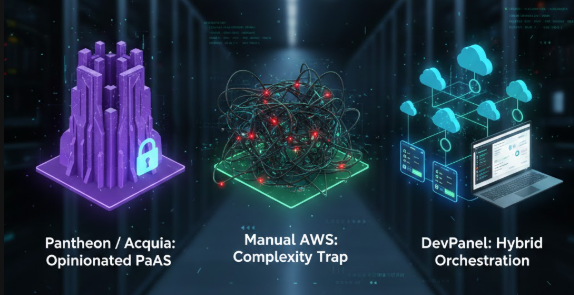
How to Choose the Right Pantheon Alternative for Enterprise WordPress in 2026
Start with the right diagnostic questions. Cost structure first. Compliance requirements second. Developer workflow third.
If your primary pain is the Simplicity Tax, the answer is BYOC. DevPanel on AWS or Azure eliminates the markup entirely. Your infrastructure costs drop to raw cloud rates, and the automation layer costs nothing extra.
If your primary pain is compliance and data residency, the answer is also BYOC. Only infrastructure ownership gives you the control that regulated industries require.
If your primary pain is developer velocity with zero infrastructure management appetite, WP Engine or Kinsta are credible managed alternatives with better WordPress-specific feature sets than Pantheon.
If you’re running a mixed Drupal and WordPress portfolio at scale, Acquia is the only purpose-built enterprise platform that addresses both CMSs natively. The cost is real, but so is the depth of the compliance and support infrastructure.
If you’re a digital agency managing a large client portfolio and want to understand how these platforms apply to your specific vertical, start with the DevPanel agency solutions overview.
Conclusion: The Best Pantheon Alternative for Enterprise WordPress Is the One That Eliminates the Tax
The best Pantheon alternatives for enterprise WordPress site management in 2026 all share one thing: they give you more control, more transparency, or more cost efficiency than Pantheon’s walled garden model allows.
For agencies, nonprofits, healthcare organizations, government entities, and higher education institutions, the answer is increasingly clear. You don’t need to pay 80 cents of every hosting dollar to a platform’s abstraction layer. You need a Control Plane that runs inside your own cloud account, manages your WordPress environments with PaaS-style simplicity, and charges you nothing for the markup.
We built DevPanel to be exactly that. It’s a secure, application-agnostic DevOps and hosting platform that runs inside your cloud account. No Simplicity Tax. No vendor lock-in. No walled garden.
If you’re ready to see what Zero Markup hosting actually looks like for enterprise WordPress, explore the DevPanel demo or review the enterprise and business platform overview.
Frequently Asked Questions
What is the best alternative to Pantheon for enterprise WordPress hosting in 2026?
The best Pantheon alternative for enterprise WordPress site management depends on your primary constraint. If cost and infrastructure control are the priority, DevPanel on AWS or Azure eliminates platform markup entirely through the BYOC model. If you want fully managed hosting without touching a cloud account, WP Engine and Kinsta are the strongest managed-platform alternatives.
Is Pantheon worth it for large enterprise WordPress sites in 2026?
For most enterprise teams evaluating cost and compliance in 2026, Pantheon’s value proposition has weakened. Approximately 80% of a typical managed PaaS bill is platform markup rather than actual compute cost, and Pantheon’s shared infrastructure model creates data sovereignty limitations that regulated industries cannot accept.
How much cheaper is hosting WordPress on AWS vs Pantheon for enterprise teams?
Enterprise teams using a BYOC platform like DevPanel on AWS typically pay only raw cloud compute costs, which can be 60% to 80% lower than an equivalent Pantheon enterprise plan. On a $10,000/month Pantheon contract, up to $8,000 represents platform markup rather than actual infrastructure spend.
Can I use AWS nonprofit cloud grants instead of paying for Pantheon?
Yes. AWS and Azure both offer nonprofit cloud grants ranging from $2,000 to $5,000 annually. DevPanel runs inside your cloud account, which means those grant credits cover your infrastructure costs directly. Traditional managed hosts like Pantheon do not support this model, so grant credits cannot offset their subscription fees.
What Pantheon alternatives support HIPAA-compliant enterprise WordPress hosting?
HIPAA-compliant enterprise WordPress hosting requires infrastructure that you own and control within a defined VPC. DevPanel on AWS or Azure lets you configure encryption, access controls, and data residency to HIPAA standards because the infrastructure lives in your own cloud account. Pantheon’s shared multi-tenant infrastructure does not support this level of compliance control on standard plans.
Does DevPanel support CI/CD workflows for enterprise WordPress like Pantheon does?
Yes. DevPanel includes Git-based CI/CD pipelines, blue/green deployments, preview environments, automated testing, and Terraform/Ansible-driven provisioning. The feature set meets or exceeds Pantheon’s multidev workflow for enterprise teams, with the added benefit of running inside your own cloud account rather than a proprietary container stack.
What are the best Pantheon alternatives for digital agencies managing multiple WordPress client sites?
For digital agencies, DevPanel’s workspace isolation model is purpose-built for multi-client WordPress management: each client gets a separate workspace, environment set, and access control structure. Cloudways is a credible mid-market alternative for agencies that want managed hosting with cloud provider choice but don’t need full infrastructure ownership. See the DevPanel SMB agency platform for more context on multi-client WordPress management at scale.