

The Best Hosting Platform Is the One Your Team Can Build On
Commodity hosting is no longer enough for serious web operations. In 2026, the strongest digital teams are not just looking for a place to put their website—they are looking for a platform engineering foundation.
The best hosting platform is not always the cheapest platform, the most familiar platform, or the one with the most polished marketing page. For serious organizations, the best hosting platform is fundamentally the one your team can build on.
A modern hosting platform should actively help your engineering team launch environments instantly, test changes safely, deploy code with confidence, scale seamlessly, automate repeatable workflows, and create entirely new digital products—all without forcing your developers to rebuild underlying cloud infrastructure from scratch.
This is exactly why the industry conversation around hosting is rapidly changing.
For years, organizations evaluated hosting platforms by asking relatively simple, transactional questions: How much does it cost? Does it support my CMS? Does it include backups?
Those questions still matter, but they are no longer enough to guarantee operational success.
Today, the stronger, more strategic question is: Can this platform become a reliable foundation for how our team builds, ships, manages, and grows our digital products?
What Makes the Best Hosting Platform Today?
The best hosting platform is no longer just a rented server, a managed database, a CDN, and a support ticket system. It is a comprehensive operational layer that gives engineering and content teams the ability to move much faster without ever losing control of their infrastructure.
Google Cloud describes the rising trend of “platform engineering” as the practice of building internal developer platforms (IDPs) that give teams “Golden Paths” for application delivery. These modern platforms intentionally abstract away deep technical complexity so developers can work through highly efficient self-service models, rather than manually coordinating infrastructure, CI/CD pipelines, security protocols, and deployment workflows.
The best hosting platform should provide that exact same kind of frictionless experience:
•Developers should be able to create new environments instantly without waiting on IT support tickets.
•Teams should be able to deploy code safely without manually rebuilding deployment pipelines for every project.
•Enterprise-grade security should be built directly into the workflow, rather than bolted on as an afterthought.
•Infrastructure should scale automatically without forcing every frontend developer to become a certified cloud engineer.
•Organizations should be able to standardize their operations without losing the flexibility to innovate.
Hosting Is No Longer Enough
Traditional commodity hosting solved an older, much simpler problem: “Where do we run the website?”
Modern digital teams have a significantly larger, more complex problem: “How do we build, test, deploy, scale, secure, and operate digital products continuously and reliably?”
A static, traditional hosting plan simply cannot answer that modern question.
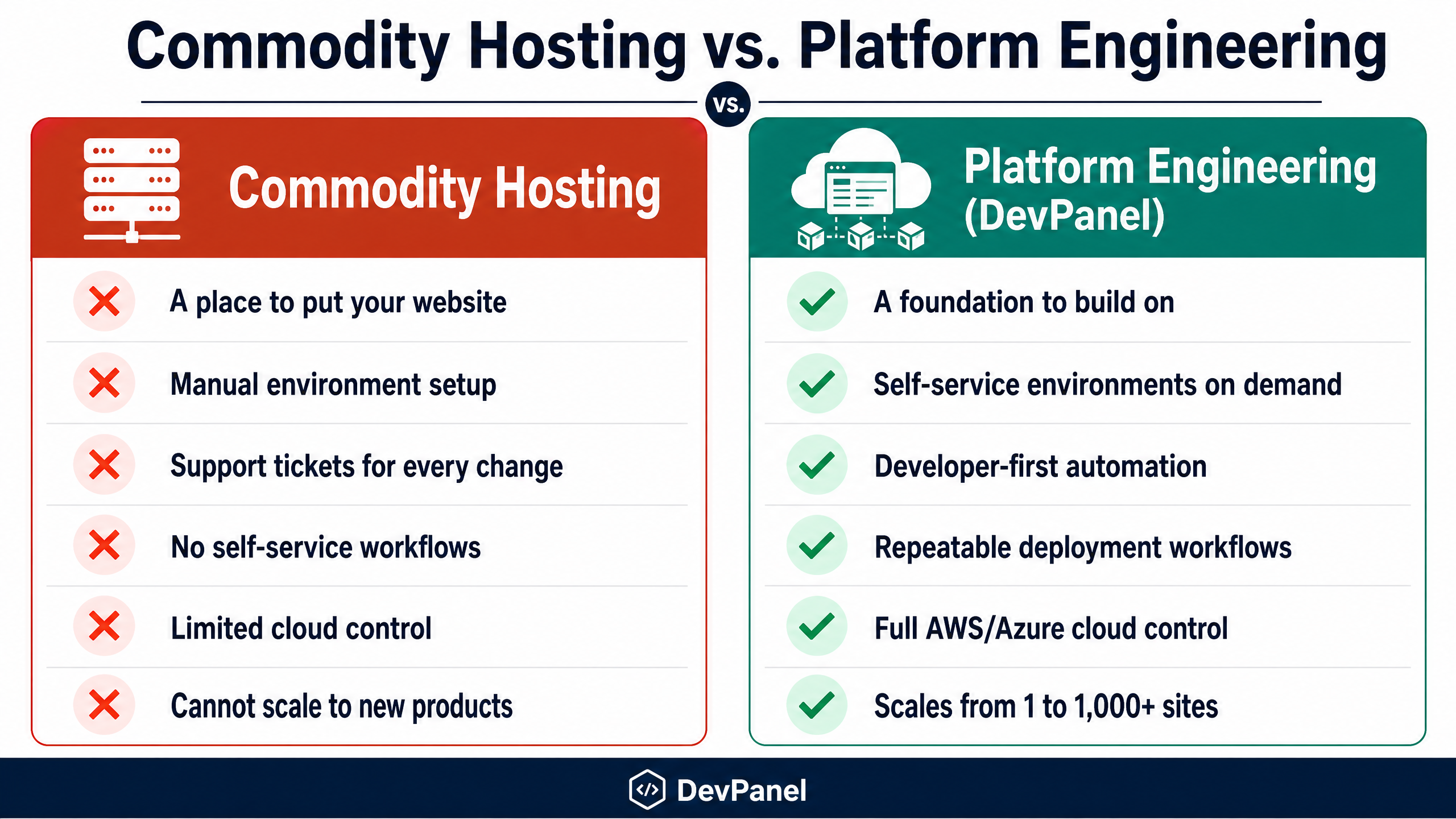
A standard managed hosting provider may gladly give you production hosting, a staging environment, daily backups, and customer support. But what happens when your growing team suddenly needs multiple isolated development environments? What happens when every single feature branch requires its own dedicated test site? What happens when your organization decides to build a multi-tenant marketplace, a massive training platform, an internal developer portal, or a highly repeatable client delivery model?
That is the exact moment when ordinary commodity hosting begins to show its severe limits.
The best hosting platform should let your team build dynamic workflows, not just run static workloads. This represents the critical strategic difference between commodity hosting and a real cloud engineering platform.
Commodity hosting gives you a place to put your site. A real platform gives your team a way to create, manage, and scale complex digital operations.
Reducing Developer Friction
One of the most expensive, hidden problems in modern web operations is developer friction.
Friction appears when a highly paid developer needs to wait three days for IT to provision a staging environment. Friction appears when every new client project requires hours of manual setup. Friction appears when a critical deployment depends entirely on one specific person who understands the legacy deployment scripts. Friction appears when vital infrastructure knowledge lives only in someone’s head instead of inside a repeatable, automated platform.
Modern internal developer platforms are specifically designed to eradicate this friction.
As platform engineering principles dictate, an internal developer platform should drastically reduce cognitive load by giving developers secure, efficient, well-supported templates and automation. Furthermore, these platforms should be treated exactly like products, with the internal developers treated as the primary users.
That is exactly how organizations should evaluate the best hosting platform. Do not only ask whether the platform can host the site. Ask whether it actively makes the developer’s job easier.
Creating Self-Service Workflows
Self-service is one of the clearest, most undeniable signs that a hosting platform has matured into something significantly more valuable.
In the old, legacy model, a developer requests a new environment. Someone from operations provisions it manually. A support ticket gets opened and sits in a queue. Credentials get passed around insecurely via chat. Configuration has to be double-checked. Only then does the developer finally start their actual work.
In the modern, better model, the developer simply chooses an approved template, clicks a button, and starts building immediately.
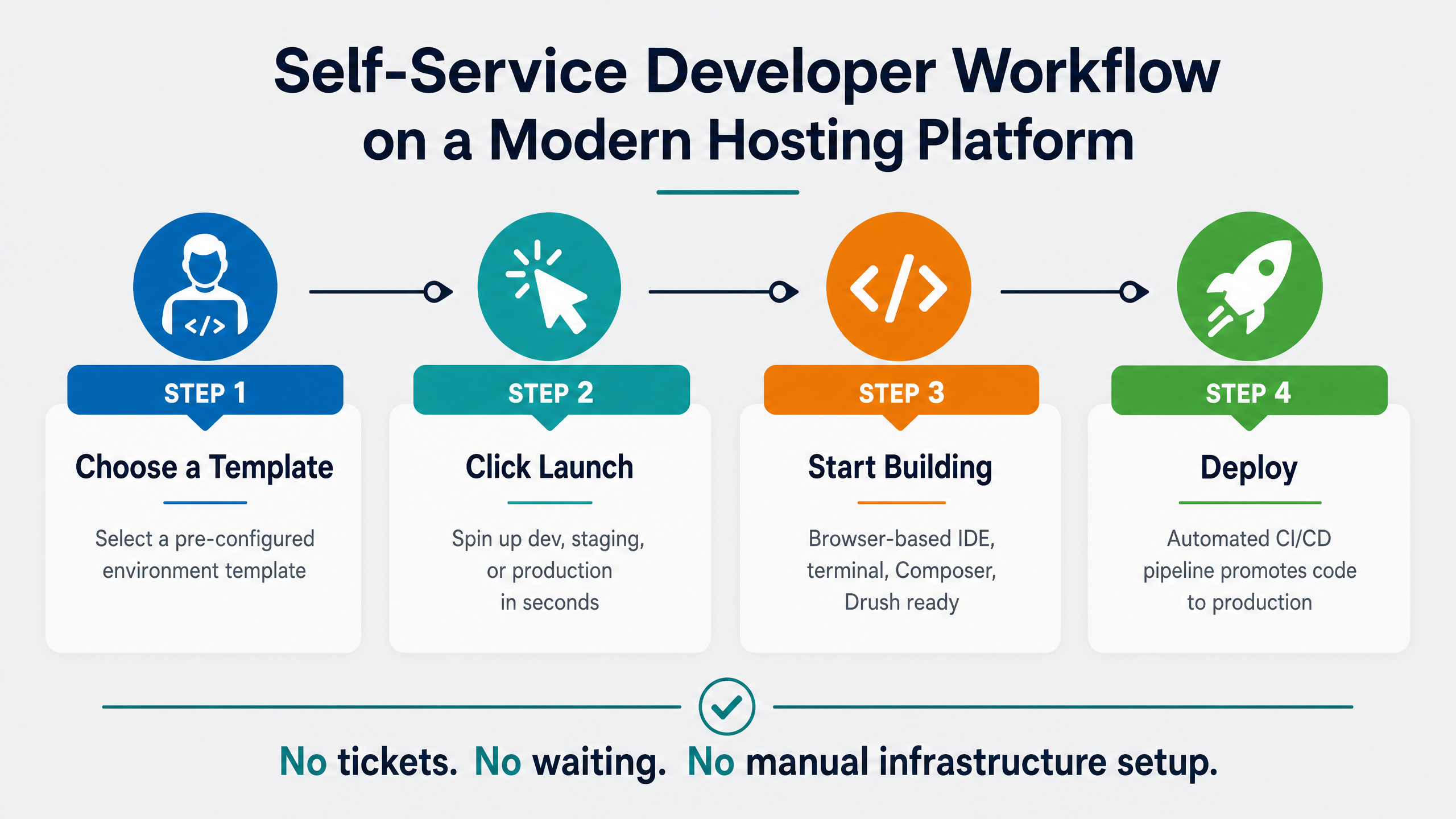
Gartner defines internal developer portals as tools that enable self-service discovery, automation, and access to reusable components, platform services, and knowledge assets. These portals drastically improve the developer experience and service reliability while simultaneously giving organizations centralized governance and visibility.
That is the exact direction serious hosting platforms must move. The best hosting platform should make the right workflow the easy workflow. It should provide strong guardrails without creating frustrating bottlenecks. It should let developers move quickly while giving leadership total confidence that deployments, access, security, and infrastructure are strictly controlled.
Why Teams Need a Platform They Can Extend
Every serious organization eventually develops complex needs that go far beyond a standard, off-the-shelf hosting package.
•An agency may want to create a highly repeatable client delivery platform to increase margins.
•A university may want standardized, compliant environments for dozens of different departments.
•A nonprofit may want to efficiently manage a massive web portfolio with a very small internal team.
•A government contractor may need highly secure dev, stage, and production workflows strictly isolated inside their own AWS account.
•A software vendor may want to offer instant product demos or automated trial environments to prospects.
•An enterprise may want pre-approved, hardened templates for internal teams building new applications.
The best hosting platform must be capable of supporting these future needs. That does not mean every organization needs to build its own massive internal platform on day one. It simply means the platform should not block that path when the organization is finally ready to scale.
This is exactly where cheap, commodity hosting fails. Cheap hosting can be useful for simple, static websites, but it rarely becomes a strategic foundation. It is designed to keep costs low, not to create operational leverage.
Premium hosting platforms are fundamentally different. They are designed for teams that require reliability, high performance, absolute availability, seamless scalability, workflow automation, and deep control.
Cloud Power Without Cloud Complexity
Many organizations desperately want the immense benefits of AWS, Azure, or other major cloud platforms, but they absolutely do not want every single developer to be forced to become a certified cloud engineer.
Cloud infrastructure is undeniably powerful, but it can also be incredibly difficult to manage safely. Teams must constantly think about complex networking, container orchestration, database tuning, storage, granular access control, secrets management, monitoring, backups, CI/CD deployment pipelines, auto-scaling rules, and strict compliance expectations.
The best hosting platform should make that immense power easily usable.
Consider the case of the Academy of Model Aeronautics (AMA). AMA had more than 30 websites across various CMS platforms. Before adopting a platform engineering approach, the organization struggled with severe vendor dependence, delayed development workflows, high operational overhead, and limited internal cloud expertise. By adopting DevPanel, AMA successfully migrated 30+ sites to AWS, managed everything efficiently with just one person, and created seamless self-service dev, test, and staging environments.
That is the true value of a platform your team can build on. It does not merely host the websites; it fundamentally changes how the entire organization operates.
Control Over Your Infrastructure
Many managed hosting platforms are highly convenient because they completely hide the underlying infrastructure from the customer. That can be helpful early on. But as organizations mature, that lack of control becomes a severe liability.
You may need root access. You may need a highly custom architecture. You may need secure VPN access. You may need a highly specific AWS or Azure configuration. You may need strict compliance controls that are simply easier to manage inside your own dedicated cloud account. You may need to scale a specific workload in ways your host simply does not support.
The best hosting platform should never trap your organization inside someone else’s rigid infrastructure model.
A U.S. government news agency delivering 1 to 2 billion monthly pageviews evaluated DevPanel on AWS after facing high costs, limited infrastructure control, slow support, and massive development friction. Because DevPanel could be deployed directly inside the agency’s own AWS account, it gave them total sovereignty over their infrastructure and data, while still providing a simple point-and-click dashboard, powerful development tools, and 24/7 support.
That is the right model for serious teams: total ownership without unnecessary complexity.
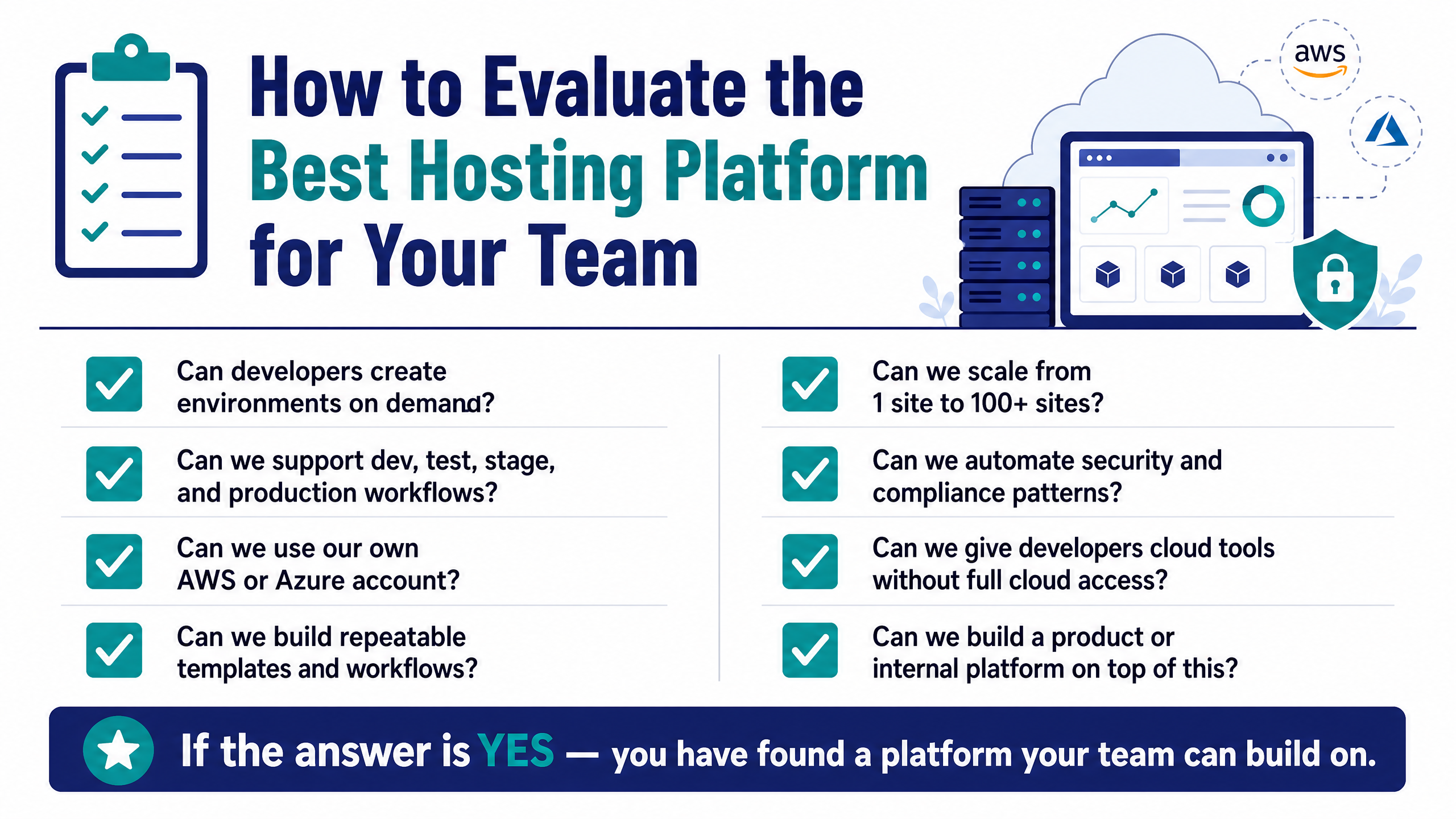
Conclusion: A Strategic Asset
Hosting is entirely too often treated as a simple line item on a budget. That is a massive strategic mistake.
For organizations that rely heavily on digital systems, the hosting platform becomes a core part of the organization’s delivery capability. It directly affects how fast teams can ship, how safely they can deploy, how well they can scale, how much control they retain, and how confidently they can build new products.
The best hosting platform is therefore not just an IT purchase. It is a strategic asset.
It gives developers self-service environments. It gives leadership total control over infrastructure. It gives operations teams repeatable workflows. It gives agencies a foundation for premium services. It gives enterprises a clear path to standardization. It gives organizations the immense power of AWS, Azure, and modern cloud infrastructure without forcing every team to build the platform layer from scratch.
That is why the best hosting platform is the one your team can build on.