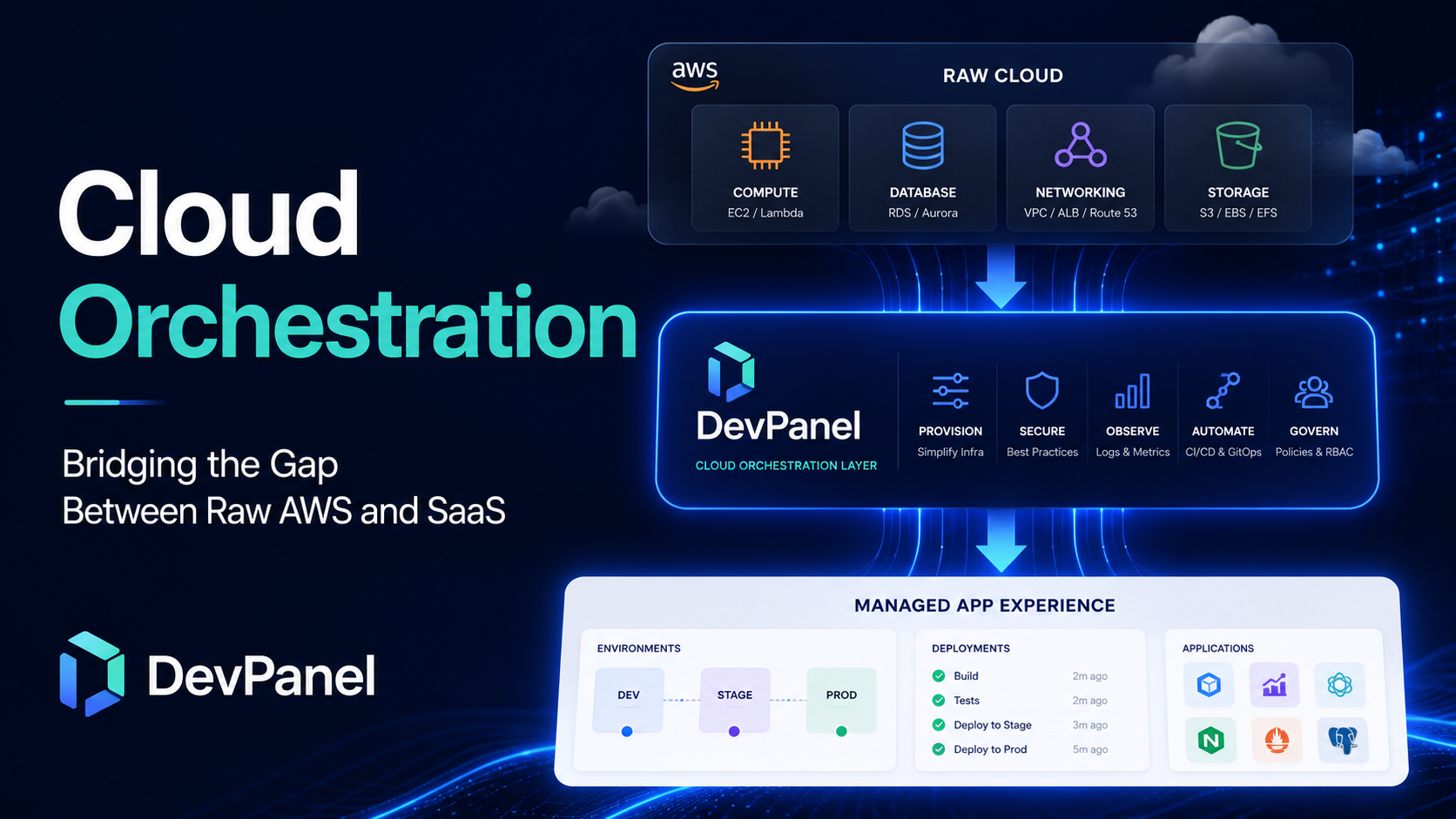
Cloud Orchestration: Bridging the Gap Between Raw AWS and SaaS
Cloud teams often feel trapped between two imperfect choices.
On one side, there is raw cloud infrastructure: AWS, Azure, DigitalOcean, Kubernetes, databases, storage, networking, security rules, deployment pipelines, monitoring, backups, and scaling. This gives you power and control, but it also creates operational complexity.
On the other side, there are managed SaaS hosting platforms. They simplify deployment and operations, but they also limit flexibility, increase dependency on the vendor, and often place a markup between you and the infrastructure your applications actually run on.
Cloud orchestration bridges that gap.
It gives teams the automation and ease of a managed platform while keeping infrastructure ownership closer to the customer. For organizations that want the benefits of AWS, Azure, or DigitalOcean without hiring a full DevOps team, cloud orchestration is becoming the practical middle path.
DevPanel was built for that middle path.
It helps teams run websites and applications inside their own cloud accounts while automating the hard parts of infrastructure management, development workflows, CI/CD, scaling, backups, and day-to-day operations.
Key Takeaways
| Question | Answer |
| What is cloud orchestration? | Cloud orchestration is the coordination of infrastructure, deployment, scaling, security, and application workflows across cloud resources. |
| How is it different from automation? | Automation handles individual tasks. Orchestration connects multiple tasks into repeatable workflows. |
| Is cloud orchestration the same as container orchestration? | No. Container orchestration manages containers. Cloud orchestration also includes networking, storage, access control, deployments, backups, and governance. |
| Why not use raw AWS directly? | Raw AWS provides control, but it requires cloud expertise that many teams do not have internally. |
| Why not use a managed SaaS platform? | Managed platforms are convenient, but they often reduce control over infrastructure, pricing, data location, and architecture. |
| How does DevPanel help? | DevPanel provides an orchestration layer that helps teams manage applications inside their own AWS, Azure, or DigitalOcean accounts. |
What Is Cloud Orchestration?
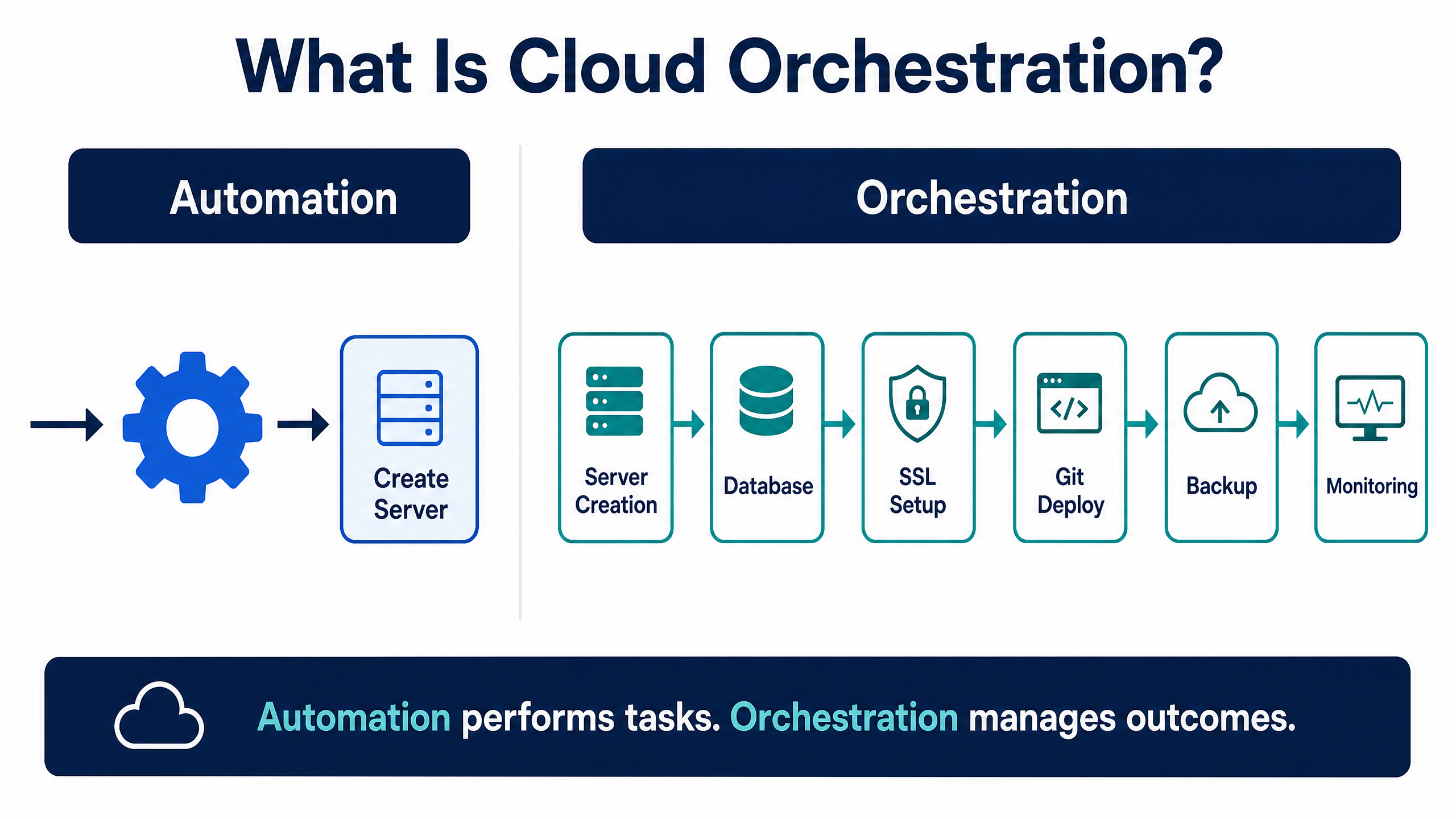
Cloud orchestration is the process of coordinating cloud infrastructure and application workflows so they operate as one managed system.
A simple automation might create a server.
Cloud orchestration goes further. It can create the server, connect it to a database, configure storage, apply security rules, set up a domain, issue SSL, connect the application to Git, deploy the code, create backups, and prepare the environment for developers.
That is the difference.
Automation performs tasks.
Orchestration manages outcomes.
For a modern web application, those outcomes include:
•Development environments
•Staging environments
•Production deployments
•Git-based workflows
•CI/CD pipelines
•Databases
•File storage
•SSL certificates
•Backups
•Scaling
•Monitoring
•Access controls
•Security policies
When all of this is done manually, cloud infrastructure becomes slow, fragile, and expensive to operate. When it is orchestrated, teams can move faster without giving up control.
The Problem With Raw Cloud Infrastructure
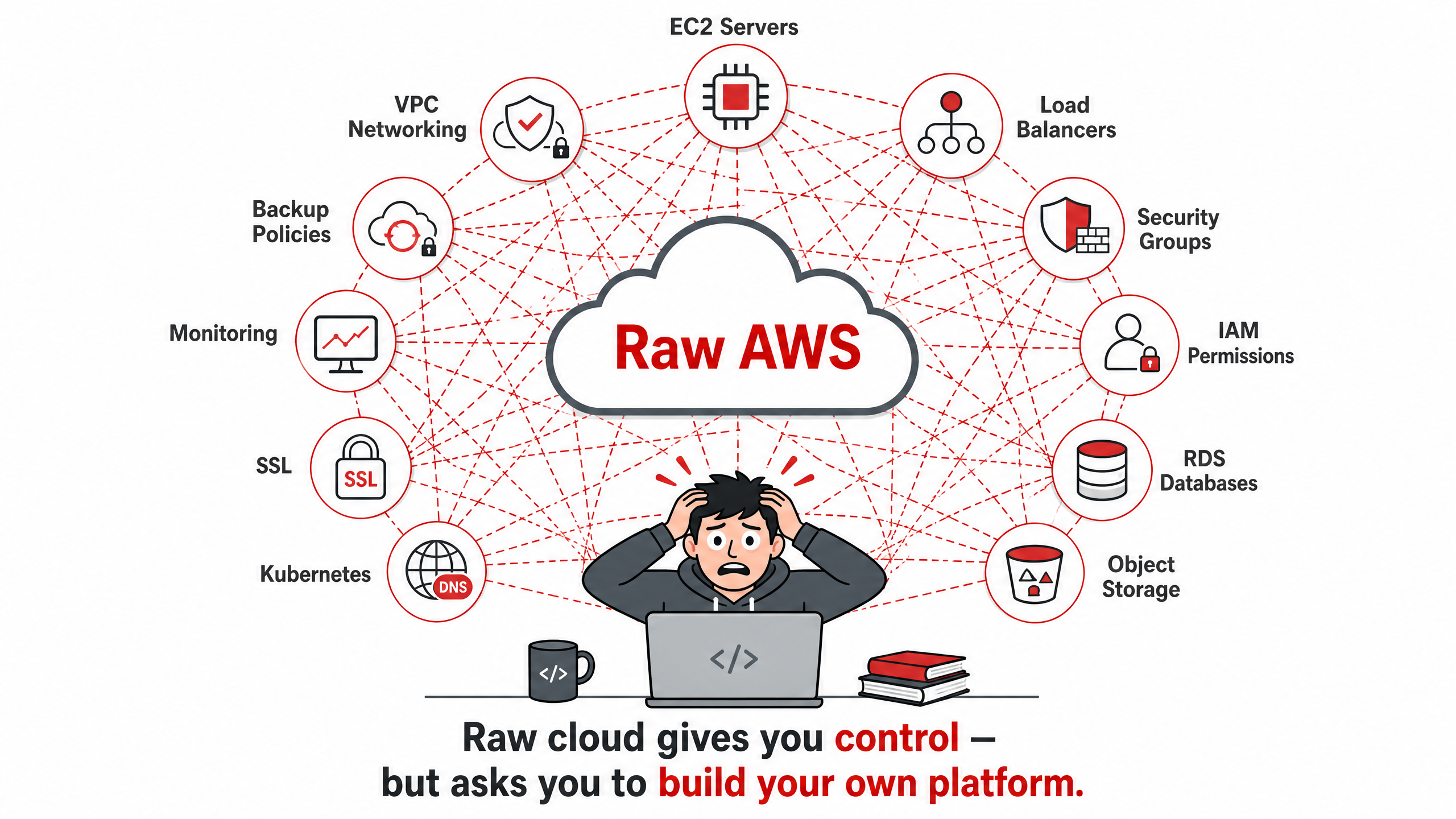
Raw cloud platforms are powerful.
AWS, Azure, and DigitalOcean give organizations access to infrastructure that can support everything from small websites to global enterprise applications. The challenge is not capability. The challenge is usability.
A team using AWS directly may need to understand:
•EC2 or container infrastructure
•VPC networking
•Load balancers
•Security groups
•IAM permissions
•RDS or database services
•Object storage
•Kubernetes
•DNS
•SSL
•Monitoring
•Backup policies
•Deployment pipelines
Each service is useful on its own. But connecting them safely and consistently is where many teams struggle.
Without orchestration, every environment becomes a custom project. Developers wait for infrastructure. Project managers wait for updates. Security teams worry about gaps. Executives see cloud costs rise without always understanding why.
Raw cloud gives you control, but it also asks you to build your own platform.
That is a heavy burden for agencies, nonprofits, SaaS teams, and businesses that simply want reliable application delivery.
The Problem With Managed SaaS Platforms
Managed SaaS platforms solve part of the problem.
They hide the cloud complexity behind a dashboard. They provide workflows for launching sites, deploying code, and managing environments. For many teams, this is a welcome improvement over raw infrastructure.
But convenience comes with tradeoffs.
Managed platforms often mean:
•The platform controls the infrastructure account
•You have limited access to the underlying architecture
•Your workflows depend on the vendor’s rules
•Your pricing depends on the vendor’s packaging
•Migration can become difficult later
•Custom infrastructure needs may be hard to support
•Compliance and data-location requirements may require extra negotiation
This creates a strategic problem.
You get simplicity, but you give up control.
That may be acceptable for smaller projects. But as websites, applications, compliance requirements, traffic, and budgets grow, the lack of control becomes more painful.
This is why many organizations are looking for a new model: the automation of SaaS with the ownership of cloud.
The Middle Path: BYOC Cloud Orchestration
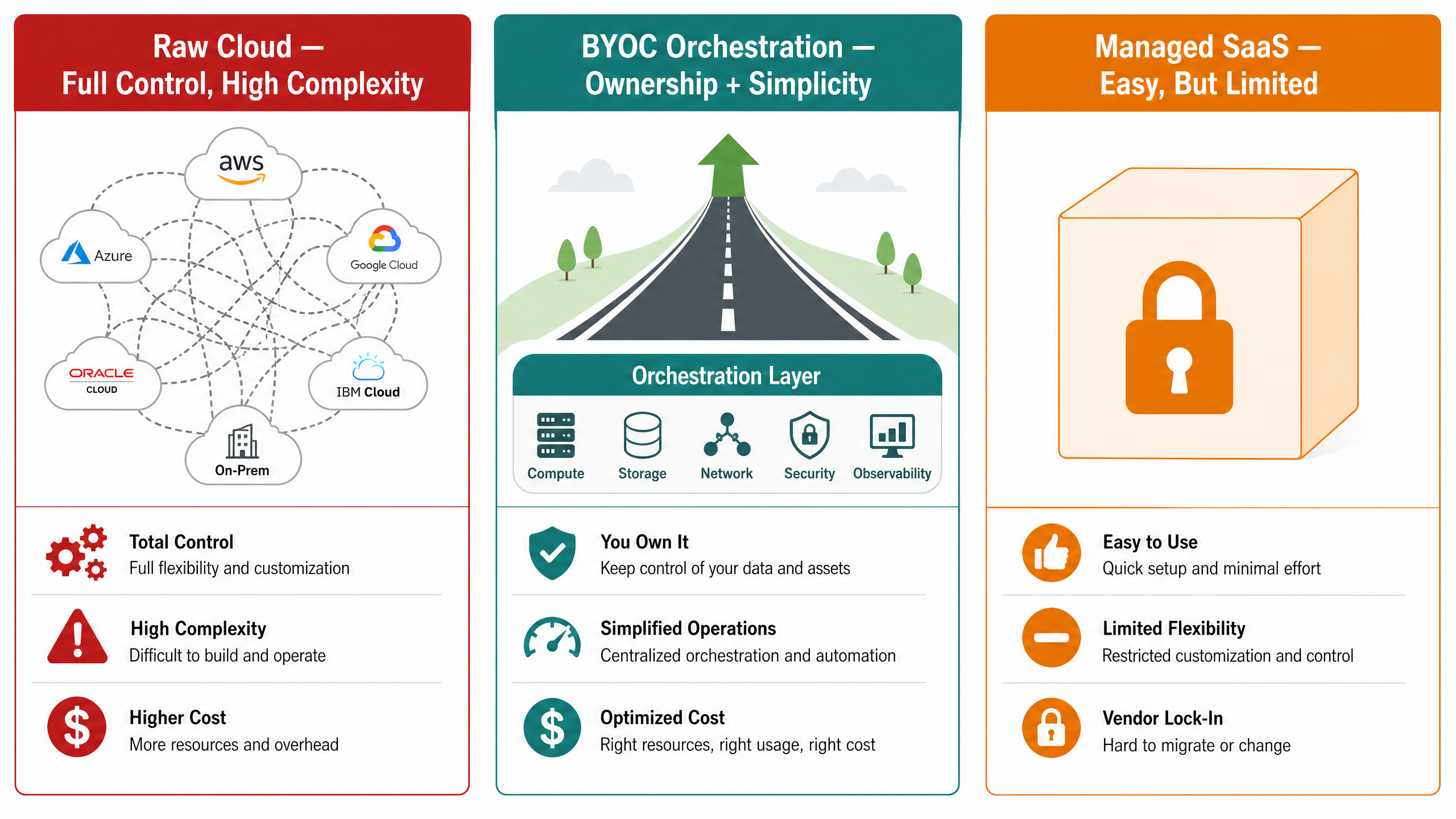
Bring Your Own Cloud, or BYOC, is the model that makes this middle path possible.
Instead of running inside a hosting vendor’s cloud account, your applications run inside your own AWS, Azure, or DigitalOcean account. The orchestration platform sits on top and automates the work required to manage applications in that account.
This changes the relationship between the customer and the platform.
With BYOC:
•You own the cloud account
•You control billing
•You control infrastructure access
•You decide where data lives
•You can connect native cloud services
•You reduce dependency on a single hosting vendor
•You keep more flexibility for future migration or architecture changes
The platform still matters. But it becomes an enablement layer, not a cage.
DevPanel follows this model by giving teams a centralized orchestration layer for managing applications in their own cloud infrastructure.
How DevPanel Bridges Raw AWS and SaaS
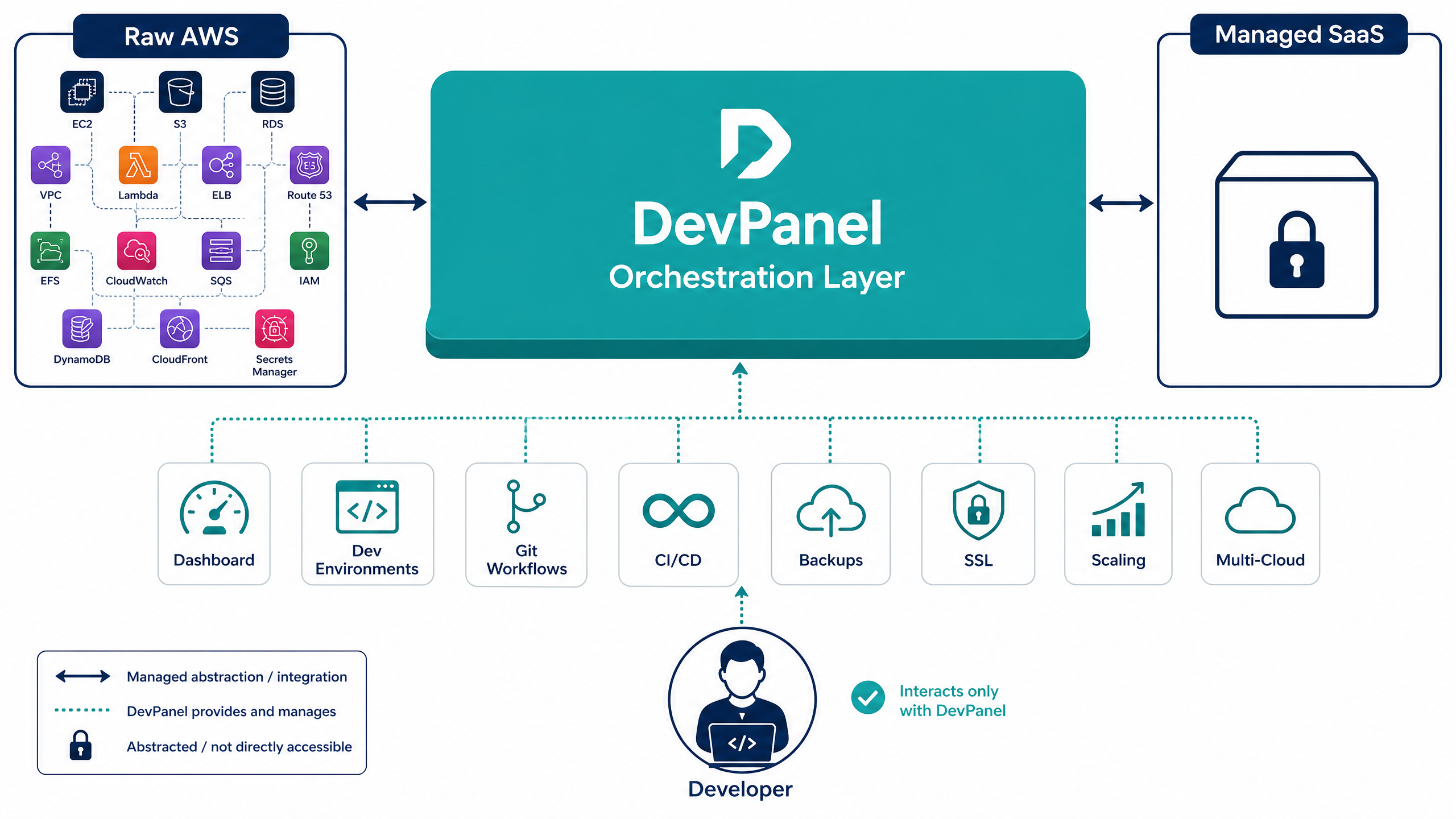
DevPanel is an application orchestration platform for teams that want cloud control without cloud complexity.
It helps teams deploy and manage applications across cloud infrastructure while giving developers, project managers, and administrators a simpler operational dashboard.
Instead of forcing teams to choose between raw AWS and a closed managed platform, DevPanel provides the missing layer between them.
With DevPanel, teams can:
•Create and manage applications from a dashboard
•Use cloud-based development environments
•Open VS Code in the browser
•Clone applications and environments
•Connect Git repositories
•Create dev, stage, and production workflows
•Deploy code through automated pipelines
•Use blue/green deployment patterns
•Manage domains and SSL
•Configure backups
•Support multiple applications and teams
•Run workloads in customer-owned cloud accounts
This gives organizations the operational feel of a managed platform while preserving more ownership over the infrastructure underneath.
Cloud Orchestration vs. Container Orchestration
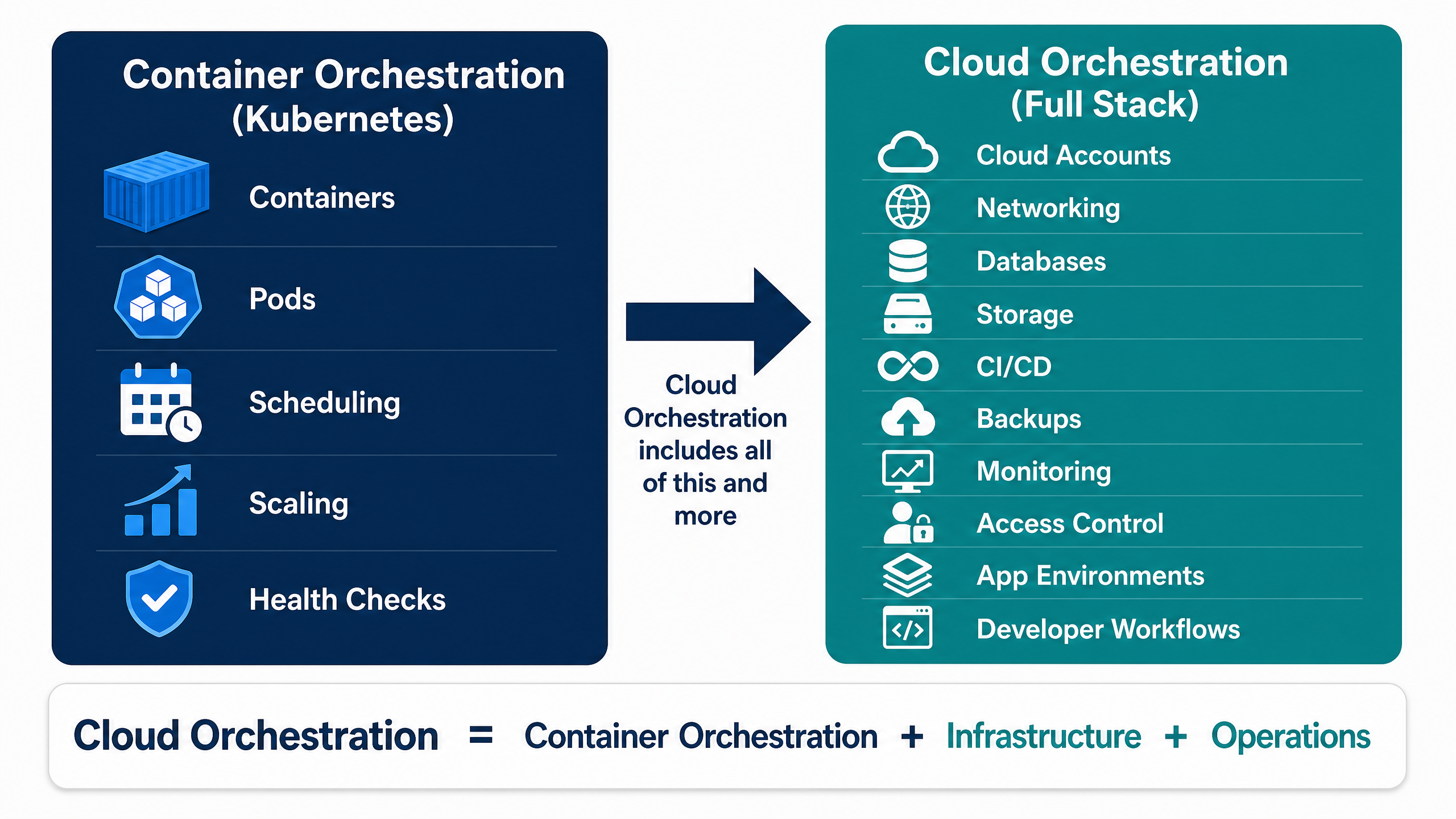
Cloud orchestration and container orchestration are related, but they are not the same thing.
Container orchestration focuses on running containers. Kubernetes is the most common example. It helps manage container scheduling, scaling, health checks, and service availability.
Cloud orchestration is broader.
It includes containers, but it also coordinates the surrounding infrastructure and workflows required to run real applications.
That includes:
•Cloud accounts
•Networking
•Databases
•Storage
•Secrets
•Access control
•Backups
•CI/CD
•Monitoring
•Application cloning
•Environment management
•Developer workflows
A container platform may help your application run. A cloud orchestration platform helps your team operate the full application lifecycle.
For most web teams, this distinction matters. They do not just need containers. They need repeatable, secure, developer-friendly workflows from development to production.
Why Cloud Orchestration Matters for Developers
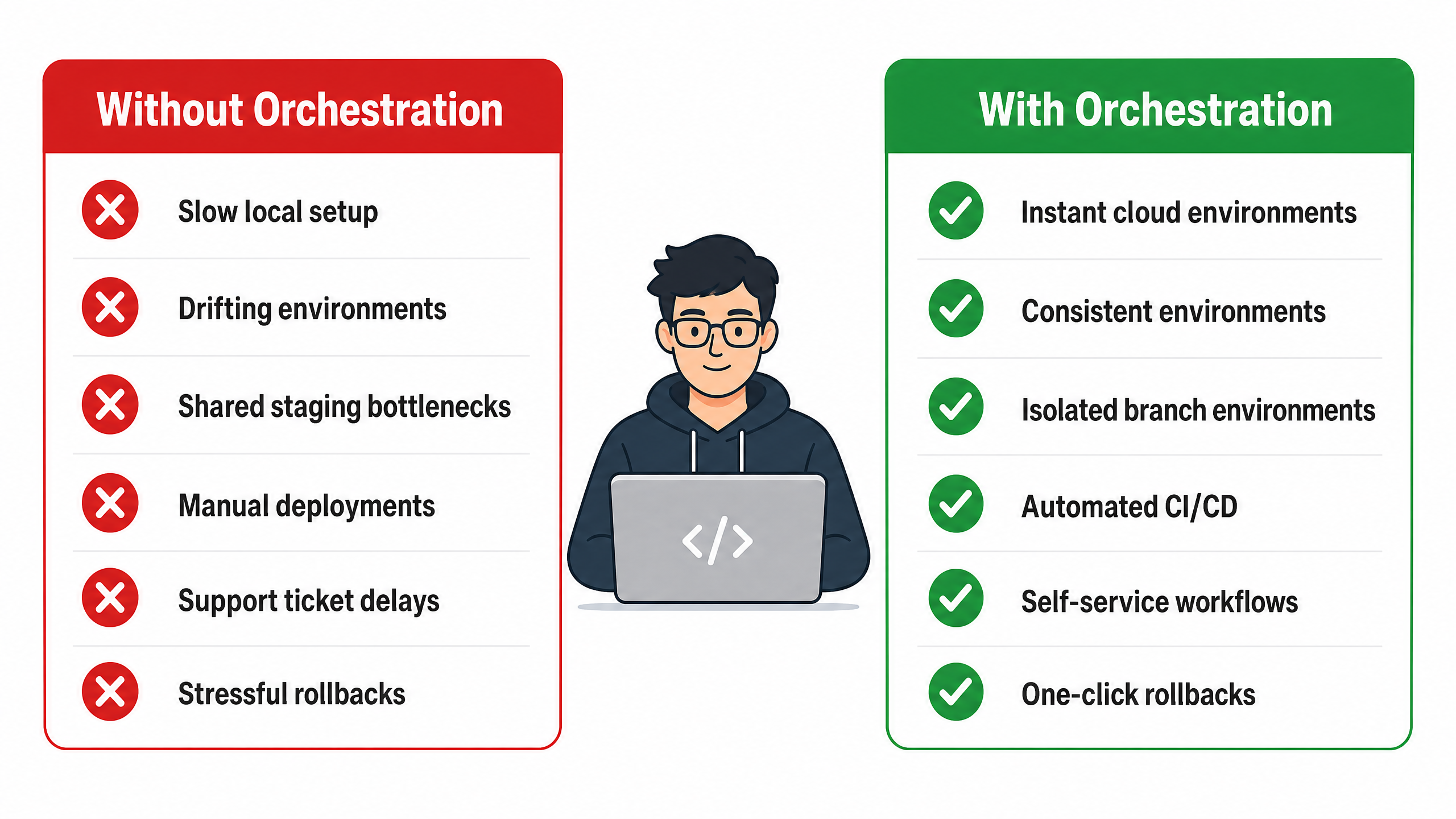
Developers lose time when infrastructure is hard to access or inconsistent.
Common problems include:
•Local setup taking too long
•Development environments drifting away from production
•Shared staging sites blocking parallel work
•Deployment processes depending on one person
•Support tickets slowing down basic environment tasks
•Rollbacks being stressful or manual
Cloud orchestration helps remove that friction.
With DevPanel, developers can use cloud-based development environments and browser-based VS Code instead of spending days setting up local infrastructure. Teams can create isolated environments for testing, updates, and new features. Git-based workflows make it easier to connect code changes to deployment processes.
This improves developer velocity without sacrificing operational control.
The benefit is not just faster deployment. It is fewer bottlenecks.
When developers can work in consistent cloud environments, teams reduce the “works on my machine” problem and make testing more reliable.
Why Cloud Orchestration Matters for Agencies
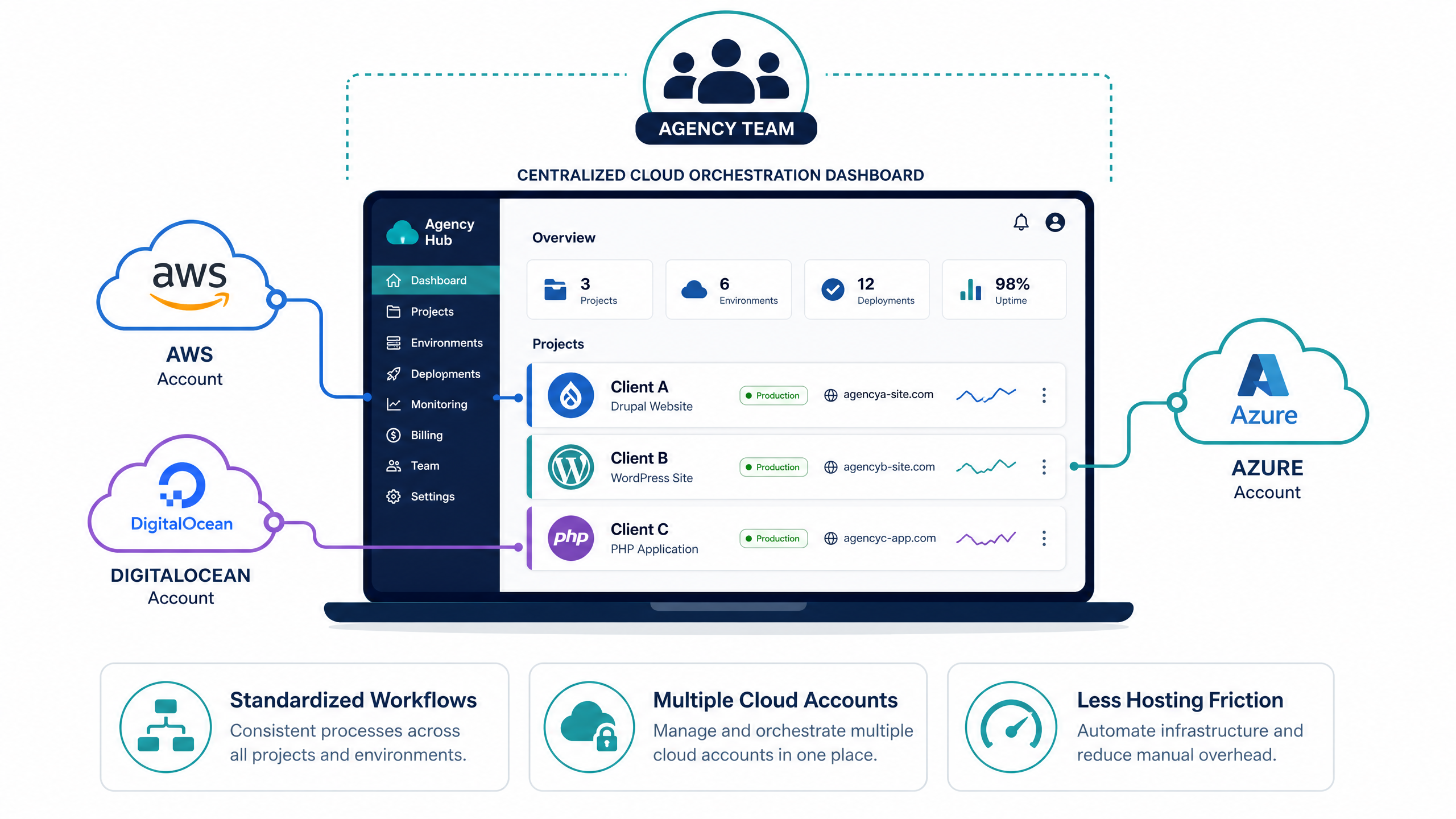
Agencies often manage many clients, many websites, and many technology stacks.
A single agency may need to support:
•Drupal sites
•WordPress sites
•Backdrop sites
•Custom PHP applications
•Separate client environments
•Different compliance requirements
•Different cloud preferences
•Multiple development teams
Without orchestration, this becomes operational chaos.
Every client may have a different hosting login, deployment process, backup process, staging setup, and support workflow. The agency becomes dependent on external platforms for tasks that should be standardized internally.
DevPanel helps agencies create a more repeatable operating model.
They can organize projects, users, and environments through a centralized dashboard while still allowing infrastructure to live in the appropriate cloud account. This allows agencies to serve clients with more flexibility and less manual cloud work.
For agencies, the business value is clear: less time spent on hosting friction, more time spent delivering client outcomes.
Why Cloud Orchestration Matters for Nonprofits and Small Teams
Small teams often want the benefits of cloud infrastructure but do not have the staff to manage it manually.
That is exactly where orchestration becomes valuable.
A nonprofit may want AWS for flexibility and cost control. A small business may want better staging workflows. A SaaS founder may want production-grade infrastructure without hiring a full DevOps team. An education organization may need secure environments for student or portal applications.
In each case, raw cloud is powerful but too complex. Traditional SaaS hosting is simple but limiting.
Cloud orchestration gives these teams a practical way forward.
The Academy of Model Aeronautics is a strong example. AMA manages more than 30 websites across Drupal, Backdrop, and WordPress. With DevPanel, what previously required more coordination and external dependency became manageable through a unified dashboard and AWS-backed infrastructure.
That is the point of orchestration: helping smaller teams operate infrastructure that would otherwise require a much larger technical staff.
Infrastructure Ownership Without Infrastructure Chaos
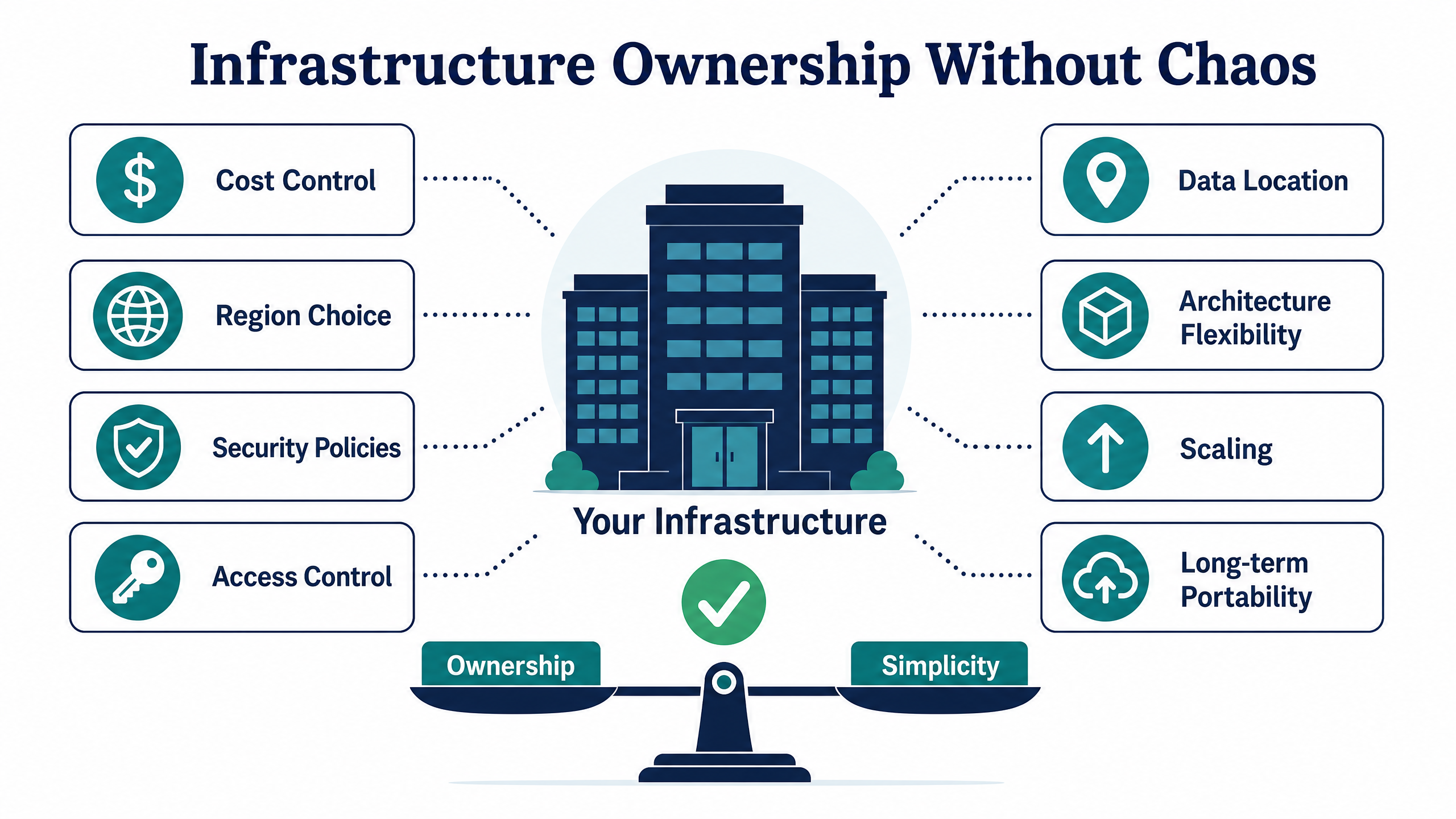
The biggest advantage of cloud orchestration is not just automation. It is ownership.
When your infrastructure runs in your own cloud account, you are not fully dependent on a managed hosting provider’s infrastructure decisions. You have more control over:
•Cost
•Regions
•Security policies
•Access control
•Data location
•Architecture
•Scaling
•Backups
•Integrations
•Long-term migration options
But ownership only works if operations are manageable.
DevPanel helps make ownership practical by automating the infrastructure and application workflows that normally create operational burden.
That is the real bridge between raw AWS and SaaS.
Raw AWS gives you ownership but too much complexity.
SaaS gives you simplicity but less ownership.
DevPanel gives you a way to keep more ownership while reducing the complexity.
Real-World Proof of the Orchestration Model
DevPanel’s value is clearest in real customer scenarios.
The Academy of Model Aeronautics used DevPanel to manage more than 30 sites on AWS across Drupal, Backdrop, and WordPress. DevPanel helped simplify AWS for a small web team and reduce dependency on traditional hosting workflows.
A large U.S. government news agency evaluated DevPanel as a way to move Drupal workloads from Acquia to AWS. The project showed how cloud ownership and orchestration could dramatically improve cost control while maintaining performance, scalability, and support.
DrupalForge was built on top of DevPanel and demonstrated how DevPanel can power a larger platform, not just individual sites. DrupalForge used DevPanel as the engine for launching large numbers of Drupal environments quickly and consistently.
Parents Helping Parents migrated from WP Engine to AWS with DevPanel, gaining greater development flexibility, cloud-based development environments, Cloudflare integration, and more control over infrastructure.
These examples all point to the same strategic lesson: orchestration makes cloud infrastructure usable for teams that do not want to operate raw cloud manually.
Cloud Orchestration and Multi-Cloud Readiness
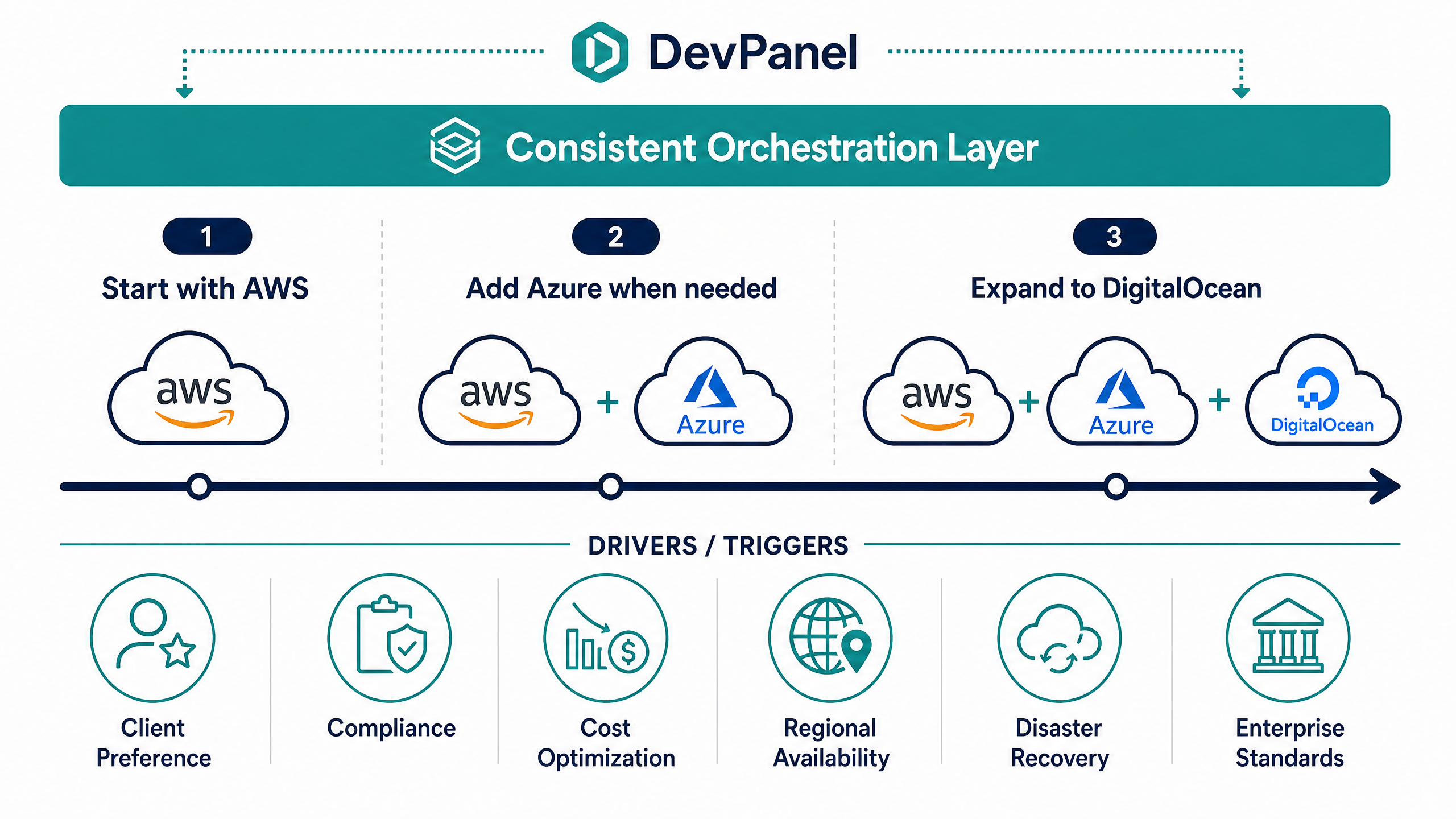
Cloud orchestration also prepares organizations for a multi-cloud future.
Not every team needs to run production across multiple clouds immediately. In fact, many teams should start with one cloud provider and keep the architecture simple.
But teams should avoid building themselves into a corner.
A good orchestration strategy allows an organization to start with AWS, then add Azure or DigitalOcean later when there is a real business reason.
Those reasons might include:
•Client preference
•Regional availability
•Compliance requirements
•Cost optimization
•Disaster recovery strategy
•Existing cloud credits
•Internal enterprise standards
DevPanel supports AWS, Azure, and DigitalOcean, giving teams more flexibility as their infrastructure needs evolve.
The goal is not to create unnecessary cloud complexity. The goal is to avoid strategic dependency.
When Should a Team Consider Cloud Orchestration?
Cloud orchestration is worth considering when your team is facing any of these problems:
•Your managed hosting bill keeps increasing
•Your developers wait too long for environments
•You need more control over cloud infrastructure
•You want to use your own AWS, Azure, or DigitalOcean account
•You manage multiple client sites
•You need better dev, stage, and production workflows
•You want browser-based development environments
•You need repeatable CI/CD workflows
•You want to reduce dependency on hosting support tickets
•You want more flexibility than traditional managed hosting allows
The more applications, environments, developers, and clients you manage, the more valuable orchestration becomes.
Conclusion: The Future Is Not Raw Cloud or Closed SaaS
The old infrastructure choice was too narrow.
Raw cloud gave teams control, but demanded expertise.
Managed SaaS gave teams convenience, but limited ownership.
Cloud orchestration gives teams a better option.
It allows organizations to run applications inside their own cloud accounts while using automation to manage the difficult parts of infrastructure, development, deployment, scaling, and operations.
That is the gap DevPanel fills.
For agencies, it creates a repeatable way to manage client infrastructure.
For nonprofits and small teams, it makes cloud ownership practical.
For enterprises, it creates more flexibility across cloud providers and compliance requirements.
For developers, it removes environment friction and improves delivery speed.
The future of cloud infrastructure is not about choosing between raw AWS and managed SaaS.
It is about owning your cloud while orchestrating it intelligently.
DevPanel gives teams that bridge.
Frequently Asked Questions
What is cloud orchestration?
Cloud orchestration is the coordination of cloud infrastructure, deployment workflows, scaling, security, storage, networking, and application management into repeatable automated processes.
Is cloud orchestration the same as automation?
No. Automation handles individual tasks. Orchestration connects multiple automated tasks together so the full system works as one workflow.
Is cloud orchestration the same as Kubernetes?
No. Kubernetes is a container orchestration tool. Cloud orchestration is broader and includes application environments, databases, networking, storage, CI/CD, backups, access control, and governance.
Does cloud orchestration replace AWS?
No. Cloud orchestration does not replace AWS, Azure, or DigitalOcean. It sits on top of cloud infrastructure and makes it easier to manage.
What is BYOC?
BYOC means Bring Your Own Cloud. It means your applications run inside your own cloud account while an orchestration platform helps manage provisioning, deployment, scaling, and operations.
Why use DevPanel instead of raw AWS?
Raw AWS gives you control, but it requires deep cloud expertise. DevPanel helps automate cloud and application workflows so teams can use AWS, Azure, or DigitalOcean without manually managing every infrastructure detail.
Why use DevPanel instead of a managed SaaS hosting platform?
Managed SaaS platforms simplify hosting but often reduce infrastructure control. DevPanel helps teams keep more ownership of their cloud account while still gaining platform-level automation.
Who benefits most from cloud orchestration?
Agencies, nonprofits, SaaS teams, government contractors, education organizations, and businesses managing multiple websites or applications can benefit from cloud orchestration.