
The ‘Managed Hosting Exit’ of 2026: Agency Margin Recovery on Pantheon vs AWS vs AWS + DevPanel
The managed hosting exit of 2026 is not a trend. It is a financial reckoning, and agencies hosting WordPress sites on platforms like Pantheon are doing the math right now. DevPanel’s own data shows that running sites on AWS with DevPanel costs 75% to 80% less than legacy managed platforms, and that delta is exactly what is driving the agency margin recovery conversation this year.
Key Takeaways
| Question | Answer |
|---|---|
| What is the managed hosting exit of 2026? | It is the deliberate move agencies are making away from expensive all-in-one platforms like Pantheon toward cloud-native infrastructure (primarily AWS) combined with orchestration layers like DevPanel. |
| How much can agencies recover in margin? | DevPanel documents 75% to 80% hosting cost reductions vs platforms like Pantheon when running WordPress on AWS with DevPanel’s orchestration layer. |
| Is AWS alone a better option than Pantheon? | Raw AWS is cheaper but operationally expensive without tooling. The real margin recovery story is AWS paired with DevPanel’s platform, not AWS alone. |
| What does DevPanel actually do for agencies? | DevPanel integrates all development tools and processes under one umbrella, introduces automation, embeds security checks, and eliminates bottlenecks so dev teams deliver projects faster, all inside the agency’s own cloud account. |
| Does this work for small agencies or only enterprise? | DevPanel is designed for small and medium businesses through to enterprise. The BYOC model scales with your client portfolio without proportional cost growth. |
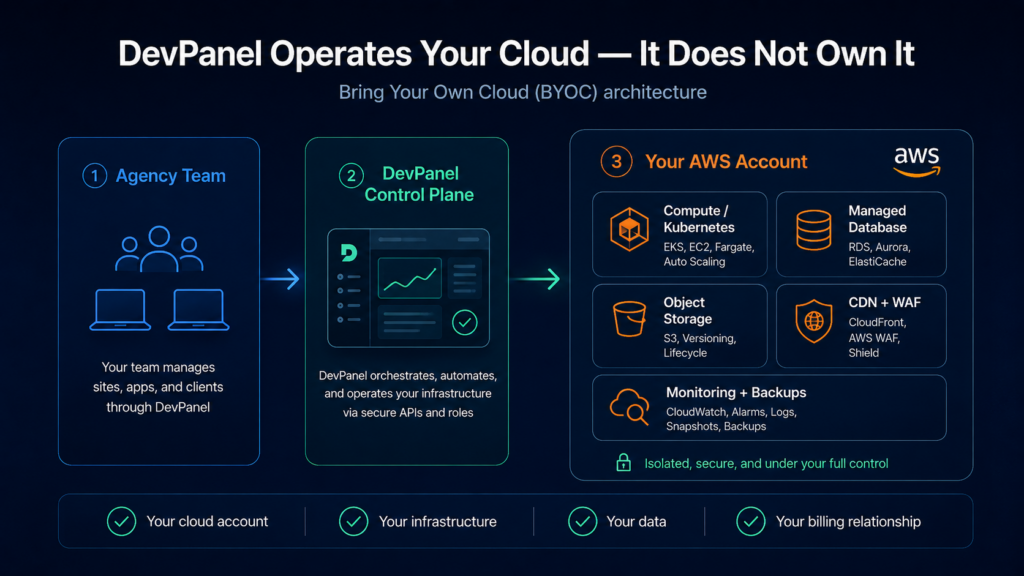
| What is BYOC and why does it matter for margin recovery? | BYOC (Bring Your Own Cloud) means DevPanel runs inside your AWS, Azure, or DigitalOcean account. There is zero platform markup, no vendor lock-in, and your margin belongs to you, not the hosting platform. |
| Is there a risk of operational failure when exiting managed hosting? | Yes, but round-the-clock support for AWS, infrastructure, and operations is part of the DevPanel offering, which closes the operational gap most self-managed exits leave open. |
What Is the Managed Hosting Exit of 2026, and Why Is It Happening Now?
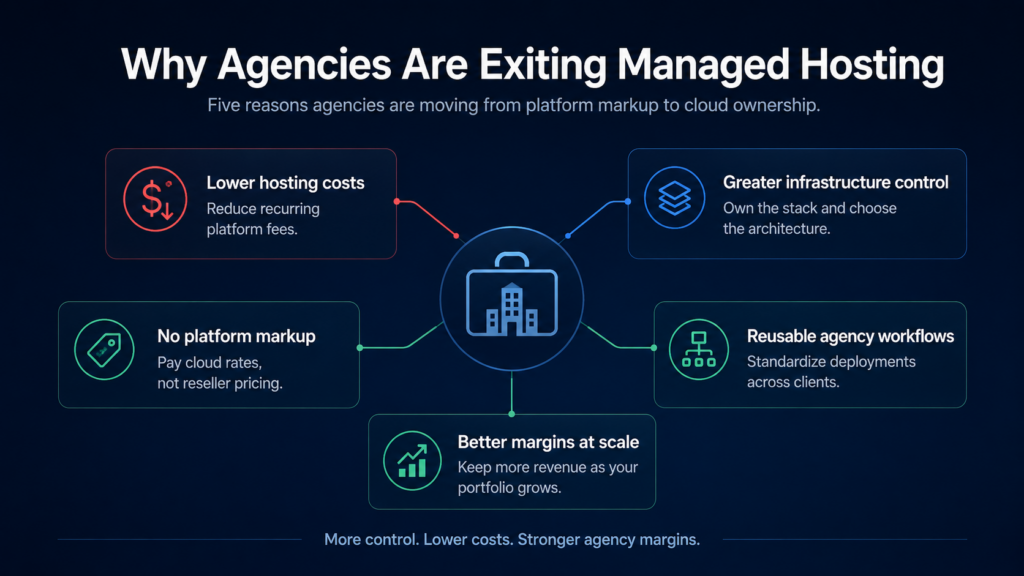
Let’s be direct about the numbers. Managed hosting platforms built their pricing on the assumption that agencies would always pay a premium for simplicity. In 2026, that assumption is cracking.
The managed hosting exit is the decision point where an agency stops paying platform markups for WordPress hosting, stops accepting the performance ceilings of shared infrastructure, and starts owning its delivery stack. It is not a new idea. What is new is the scale at which agencies are executing it, and the tooling that now makes it viable.
Platforms like Pantheon were solving a real problem in 2015. Agencies needed WordPress hosting that was stable, fast to provision, and required minimal infrastructure expertise. Pantheon delivered that. It also built a pricing model that extracts significant margin from agencies at every tier.
In 2026, that equation has changed. AWS has matured. Automation tooling has matured. And platforms like DevPanel have made it operationally realistic for agencies, not just enterprise infrastructure teams, to run WordPress on their own cloud without the complexity overhead.
Pantheon vs AWS: The Core Margin Math Behind the 2026 Managed Hosting Exit
Pantheon’s pricing for WordPress agency hosting ranges from under $10 per month for basic entry-level plans to over $1,000 per month for enterprise-grade tiers. The mid-range most agencies occupy sits between $50 and $150 per month, per site. Multiply that across a 20, 30, or 50-site client portfolio and the number stops looking like a cost of doing business. It starts looking like margin compression by design.
AWS at raw list pricing is dramatically cheaper for compute and storage. But here is the hard truth: raw AWS without orchestration is not an apples-to-apples comparison. You are trading Pantheon’s platform cost for DevOps labor cost, and for most agencies, that trade is not profitable on its own.
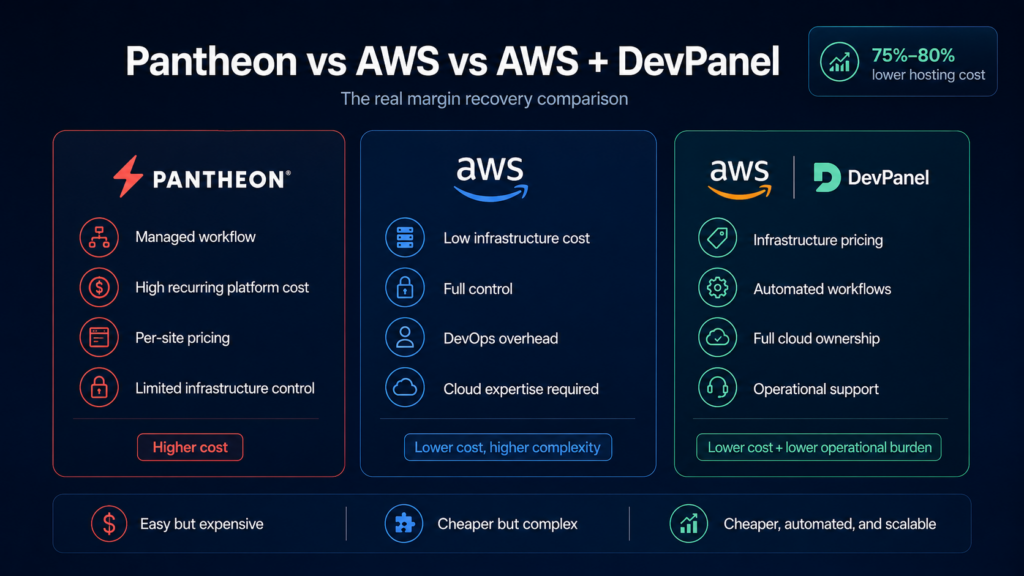
The comparison that actually matters in 2026 is Pantheon vs AWS with DevPanel. That is the three-way framework we want to walk through.
Pantheon: What You Get and What You Pay For
- Managed WordPress environments with pre-configured performance layers
- Built-in CDN, caching, and developer workflows (Git-based deploys)
- Workspace billing separation (client billing isolated from agency management)
- Per-site pricing that scales linearly, meaning your costs grow with your client count without a corresponding drop in unit cost
- Platform markup baked into every tier, whether you use 100% of the capacity or not
Raw AWS: What You Get and What You Trade Away
- Near-unlimited compute and storage at infrastructure rates (no platform markup)
- Full control over your stack, region, and architecture
- No managed WordPress layer, no pre-configured caching, no developer workflows out of the box
- Significant DevOps overhead to maintain environments, handle updates, and manage security
- Infrastructure security expertise becomes a team requirement, not an assumption
AWS + DevPanel: The Hybrid Model
- AWS infrastructure rates with a control plane layered on top
- One-click deployments, environment cloning, automated provisioning, and branch-based dev environments
- Security checks embedded throughout the development lifecycle, not bolted on at the end
- BYOC architecture: DevPanel runs inside your cloud account, not inside DevPanel’s infrastructure
- Round-the-clock support for AWS, infrastructure, and operations without requiring in-house infrastructure expertise
This is the hybrid model. And it is the one driving the managed hosting exit of 2026 for agencies that want their margin back without burning their operational continuity.
Did You Know?
52% of MSPs are investing in efficiency and automation specifically to counter slow revenue growth and economic pressure in 2026.
Source: Kaseya 2026 MSP Efficiency Report
Why Pantheon’s Model Compresses Agency Margins in 2026
Pantheon was not built to grow your margin. It was built to remove infrastructure complexity from your team. That is a legitimate value exchange, but only at certain volume thresholds and only if you are not losing more in platform fees than you are saving in labor.
The noisy neighbor problem is one part of this. At its core, the noisy neighbor problem emerges from resource contention in multi-tenant CMS hosting environments. When you are on shared infrastructure and a neighboring site spikes, your site absorbs that instability. Pantheon has addressed this at higher tiers, but addressing it costs money, and that cost flows to your invoice.
The bigger margin problem is structural. Pantheon’s pricing does not reward scale in the way cloud-native infrastructure does. Adding your 40th client site does not cost meaningfully less than your 10th. AWS compute costs, by contrast, benefit from reserved instances, savings plans, and consolidated billing optimizations that grow more favorable the larger your portfolio becomes.
Agencies that have exited managed hosting platforms in 2026 are not doing so because Pantheon broke. They are doing so because the numbers stopped making sense at scale.
The Agency Margin Recovery Case: Hosting 20+ WordPress Sites
Let’s be direct about the numbers for a mid-size agency portfolio.
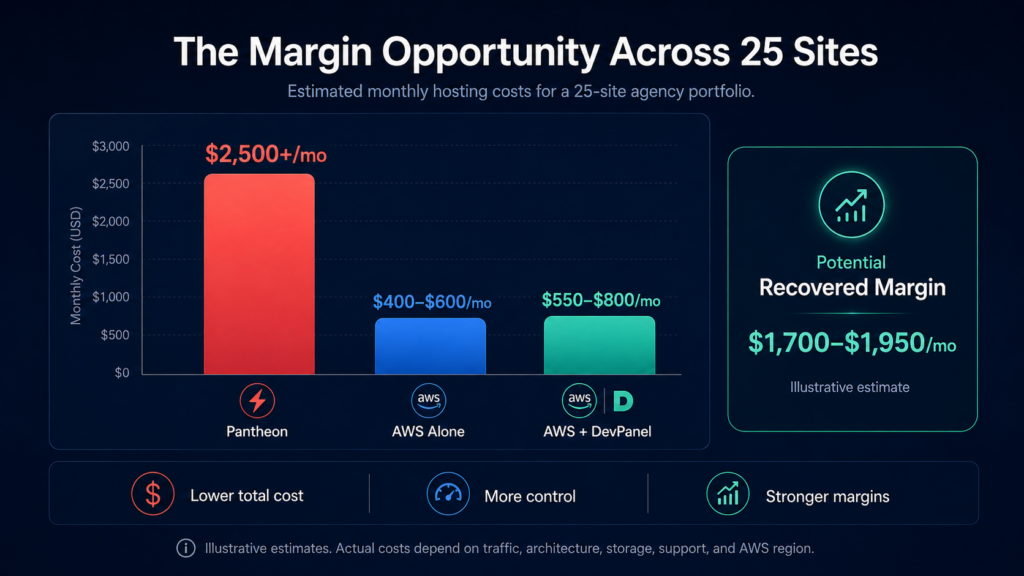
A 25-site portfolio on Pantheon’s mid-range plan at $100 per site per month is $2,500 per month in hosting costs. That same portfolio on AWS EC2 with RDS and CloudFront, provisioned and managed through DevPanel’s infrastructure automation platform, comes in at a fraction of that, depending on traffic profiles and instance sizing.
DevPanel’s data on this is specific: 75% to 80% lower hosting costs vs legacy platforms. Applied to a $2,500/month Pantheon bill, that recovery is worth $1,875 to $2,000 per month in recaptured margin. Per year, that is over $22,000 flowing back to the agency, not to a platform.
Serious websites need operational continuity. The concern most agencies raise at this point is not the cost comparison. It is the operational risk. What happens when something breaks at 2am? What if your team does not have the infrastructure depth to manage AWS properly?
This is where the managed hosting exit of 2026 is different from earlier migration attempts. “When something goes wrong, just contact the DevPanel team.” That is not a marketing line. It is the actual operational safety net that makes the exit viable for agencies without dedicated SRE staff.
Agency Margin Recovery: Platform Comparisons Across Site Types and Sizes
| Site Profile | Pantheon Cost (Est.) | AWS Alone (Est.) | AWS + DevPanel (Est.) | Margin Recovery |
|---|---|---|---|---|
| Small brochure site (low traffic) | $50-$100/mo | $10-$20/mo | $15-$30/mo (incl. DevPanel) | 65-75% |
| Mid-traffic business site | $100-$300/mo | $25-$60/mo | $35-$80/mo | 70-80% |
| High-traffic e-commerce / WooCommerce | $300-$700/mo | $70-$150/mo | $90-$200/mo | 70-75% |
| Agency portfolio (25+ sites) | $2,500+/mo | $400-$600/mo | $550-$800/mo | 75-80% |
| Enterprise / high-availability WordPress | $1,000+/mo per site | $200-$500/mo | $250-$600/mo | 70-80% |
Note: Estimates are directional based on publicly available pricing and DevPanel’s documented cost comparisons. Your actual numbers will vary based on traffic, storage, and regional AWS pricing.
What DevPanel Actually Delivers That Pantheon Does Not
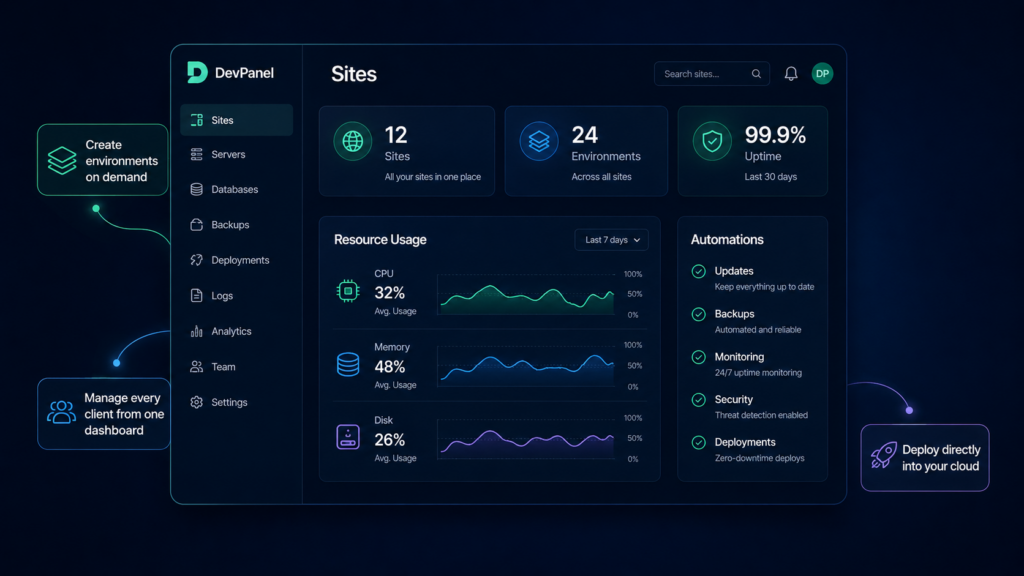
Our platform isn’t just another tool in your tech stack. That distinction matters when you are evaluating managed hosting exit strategies, because the failure mode most agencies hit when they try to self-host on AWS is not cost. It is the operational gap.
DevPanel was designed as a platform to integrate all the development tools and processes and bring them under one umbrella, introduce automation, embed security checks, and eliminate bottlenecks so dev teams can deliver projects faster. Pantheon offers a managed environment. DevPanel offers a control plane over your own environment, and that distinction changes the entire margin structure.
Here is what the DevPanel layer gives you that raw AWS does not, and that Pantheon charges a premium to provide in their own infrastructure:
- One-click deployments for WordPress applications, without custom scripting or DevOps hours
- Automated branch cloning and instant preview URLs for development and staging workflows
- Cloud development environments built on browser-based VS Code, so developers onboard in minutes without local environment setup
- App templates and reusable configurations that compress project launch time across the agency’s client portfolio
- Security checks embedded in the workflow, not added as a post-launch audit
- BYOC architecture that means your infrastructure is in your cloud account, not DevPanel’s, so there is no platform markup on compute
DevPanel was never designed to replace the tools that developers depend on. It is the orchestration layer that makes those tools work together at agency scale, inside your own cloud, at infrastructure cost rather than platform cost.
How much do your developers know about security? Especially infrastructure security? Right. That is the gap DevPanel closes without requiring you to hire a dedicated cloud security engineer.
The Managed Hosting Exit of 2026 for Specific Agency Verticals
The agency margin recovery calculus is not the same for every vertical. Here is how it breaks down across the client types agencies typically serve.
Healthcare and Higher Education
Compliance is the primary concern. Healthcare clients and higher education institutions need HIPAA-aligned or FERPA-aware infrastructure. Managed platforms like Pantheon offer compliance positioning, but at enterprise price points that compound the margin problem. AWS with proper controls, and DevPanel’s compliance-aware deployment framework, gives agencies the governance layer without paying for a managed platform’s compliance overhead at every tier.
Government and Non-Profit
Government and non-profit clients often have budget sensitivity that makes managed hosting pricing politically difficult to justify. A 75% reduction in hosting cost on a government contract is not just better margin for the agency. It can be the difference between winning or losing the renewal bid.
Business and Enterprise
For enterprise clients, the conversation shifts from cost to control. Enterprise clients want data residency, custom SLAs, and the ability to audit infrastructure. Pantheon is a managed black box. AWS + DevPanel is fully auditable, region-selectable, and client-presentable. That is a positioning advantage, not just a cost advantage.
Did You Know?
71% of MSPs cite acquiring new customers as a top issue in 2026, while 48% also report profitability among their top challenges. Margin recovery is not optional at that pressure level.
Source: Kaseya 2026 State of the MSP Report
The Operational Risk of a Managed Hosting Exit: What Agencies Get Wrong
The managed hosting exit of 2026 fails for agencies that confuse infrastructure access with operational readiness. Cheap hosting works until it does not. That is the pattern we see repeatedly: an agency migrates to AWS, realizes the first month’s bill is dramatically lower, and then encounters a site outage at midnight with no clear escalation path.
This is not an argument against exiting managed hosting. It is an argument for exiting with the right safety net in place.
DevPanel was created to address real issues. The real issue is not that AWS is too hard. The real issue is that agencies do not have the operational depth to run AWS at production quality for client sites without support infrastructure behind them. Round the clock support for AWS, infrastructure, and operations is one of the core components of the DevPanel offering, and it is the component that makes the managed hosting exit viable for agencies that are not running 10-person infrastructure teams.
The blast radius of a poorly executed exit is significant: client churn, SLA penalties, emergency retainer costs, and reputational damage. The blast radius of a well-executed exit with proper orchestration and support is near zero. That is the difference between a platform trap and an actual operational upgrade.
How to Execute a Managed Hosting Exit in 2026 Without Losing Operational Continuity
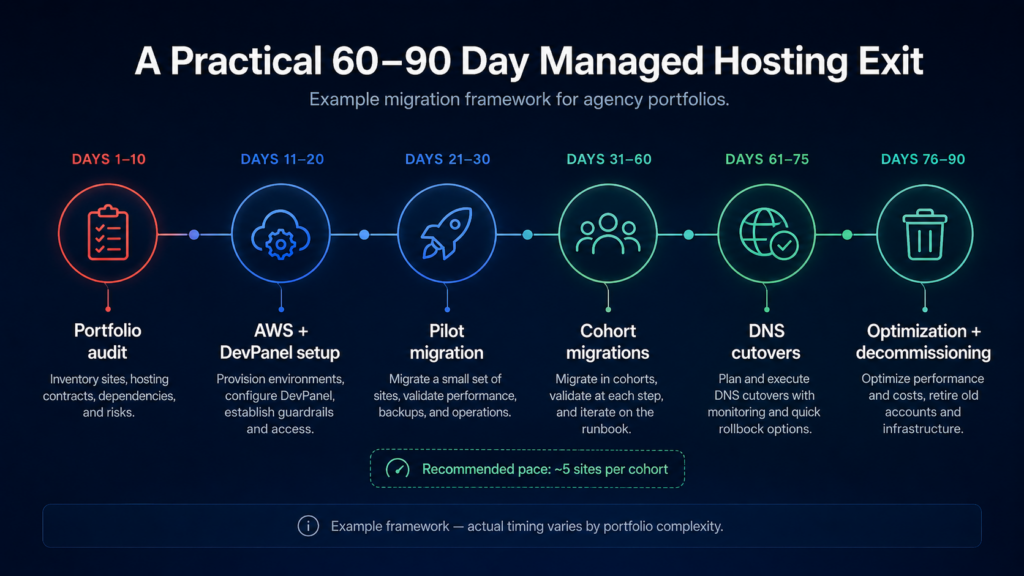
The path from Pantheon to AWS + DevPanel is not a weekend migration. It is a structured transition. Here is how agencies are actually doing it this year.
- Audit your portfolio. Which sites are on Pantheon plans that cost more than their traffic justifies? Start the migration with those sites. Low-traffic, low-complexity WordPress sites are the easiest wins and the fastest margin recovery.
- Set up DevPanel in your AWS account. BYOC means DevPanel provisions inside your cloud. This is not a new hosting account. It is your existing cloud infrastructure with DevPanel’s workspace management layer sitting on top of it.
- Use DevPanel’s template library for WordPress deployments. Pre-built app templates compress initial setup time and ensure consistent environment configurations across your portfolio.
- Clone existing environments before cutting over. The deploy-and-clone workflow lets you build a parallel AWS environment alongside the existing Pantheon setup, test it fully, and then cut DNS over with minimal downtime risk.
- Migrate in cohorts, not all at once. 5 sites per sprint is a reasonable pace for a mid-size agency. Full portfolio migration in 60 to 90 days is achievable and keeps the operational risk contained.
- Use DevPanel’s cloud development environments for ongoing work. Once migrated, cloud-based development environments replace local setup overhead and keep your dev workflow consistent regardless of which client site is being worked on.
Conclusion: The Managed Hosting Exit of 2026 Is an Agency Margin Recovery Decision
The managed hosting exit of 2026 is not about abandoning managed platforms because they are bad products. Pantheon built a real solution to a real problem. The conversation changes when you are running 20, 30, or 50 WordPress sites and the platform fee is consuming margin that your agency cannot recover through any other lever.
AWS alone is not the answer. It trades platform cost for operational cost and, for most agencies, that trade is not a net win.
AWS with DevPanel is the answer that the agency margin recovery conversation has been building toward. BYOC architecture. Zero platform markup. One-click deployments. Security checks embedded throughout. Round-the-clock operational support. And a 75% to 80% reduction in hosting cost that flows directly back to your agency’s bottom line.
Operational continuity does not require a managed platform. It requires the right control plane, the right support layer, and the right orchestration. That is what DevPanel delivers, inside your own cloud, at your own pricing.
If you are doing the math on your Pantheon bill right now, the question is not whether to exit managed hosting. The question is how to exit without losing the operational continuity your clients depend on. Start with DevPanel’s pricing model and run your own portfolio numbers. The margin recovery case is waiting in that spreadsheet.
Frequently Asked Questions
Is the managed hosting exit of 2026 worth it for small agencies with fewer than 10 sites?
At fewer than 10 sites, the margin recovery from exiting managed hosting is real but smaller in absolute dollars. The operational overhead of managing your own AWS setup may not justify the switch unless you are using an orchestration layer like DevPanel that keeps that overhead low. Agencies with 15 or more sites see the most dramatic margin recovery results.
How much can an agency realistically save by moving WordPress sites from Pantheon to AWS?
DevPanel documents 75% to 80% lower hosting costs when running WordPress on AWS with DevPanel versus legacy platforms like Pantheon. On a 25-site portfolio at $100 per site on Pantheon, that is $1,875 to $2,000 per month in recovered margin, or over $22,000 per year flowing back to the agency.
What is the biggest risk of exiting Pantheon for self-hosted AWS?
The biggest risk is the operational gap: moving from a fully managed environment to raw AWS without adequate support, automation, or incident response coverage. Agencies that mitigate this risk with an orchestration and support layer like DevPanel see exit success rates far higher than those attempting raw AWS self-hosting without tooling.
Does DevPanel replace Pantheon completely, or is it a different kind of platform?
DevPanel is not a managed hosting platform. It is an orchestration and automation layer that runs inside your own cloud account (AWS, Azure, or DigitalOcean). It provides the developer workflow, deployment automation, and security checks that managed platforms bundle into their pricing, but at infrastructure cost rather than platform cost. DevPanel was never designed to replace the tools that developers depend on; it integrates and automates them.
Can WordPress multisite or WooCommerce sites handle the migration to AWS + DevPanel?
Yes. WordPress multisite and WooCommerce are both fully supported on AWS infrastructure, and DevPanel’s template library and environment cloning capabilities make setting up complex WordPress configurations repeatable and consistent. High-traffic WooCommerce sites in particular benefit from the ability to right-size AWS instances rather than paying for fixed managed platform tiers.
How long does it take to migrate a WordPress agency portfolio from Pantheon to AWS with DevPanel?
Most agencies complete a full portfolio migration in 60 to 90 days when working in structured cohorts of 5 to 10 sites per sprint. DevPanel’s deploy-and-clone workflow allows parallel environment setup alongside existing Pantheon sites, which minimizes downtime risk and makes the cutover process controllable rather than chaotic.
What happens to compliance requirements like HIPAA or government standards after a managed hosting exit?
Compliance requirements do not go away after exiting managed hosting, but they are fully addressable on AWS with proper configuration. AWS itself holds a wide range of compliance certifications (HIPAA, FedRAMP, SOC 2), and DevPanel embeds security and governance controls into the deployment workflow so compliance posture is maintained from development through production. Agencies serving healthcare or government clients should review DevPanel’s compliance documentation before migrating.