DevPanel vs Pantheon vs Acquia: Cloud Ownership, Cost, and Control Compared
The evolution from WebOps to application orchestration platforms
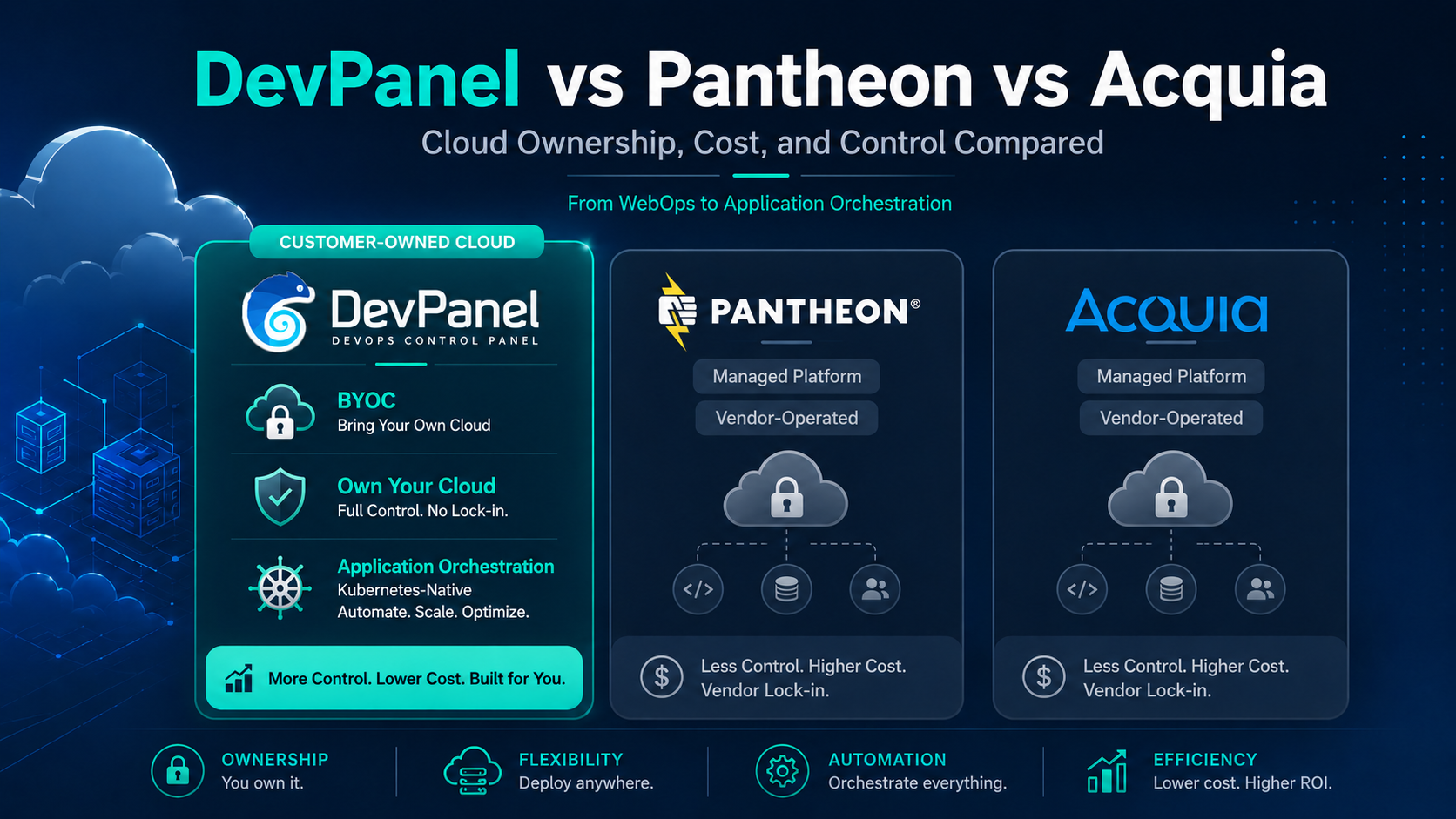
Pantheon, Acquia, and DevPanel all help organizations standardize development, deployment, and application operations. The fundamental difference is not whether they provide modern workflows. It is where those workflows run, who controls the infrastructure, and how much freedom the organization retains.
Pantheon provides a managed WebOps platform for WordPress, Drupal, and Next.js. Acquia provides a managed, enterprise-focused Drupal platform with extensive governance, support, and compliance capabilities.
DevPanel takes a different approach.
Instead of requiring organizations to place their applications inside infrastructure operated by the platform vendor, DevPanel brings development, deployment, and operational automation into the customer’s own AWS, Azure, DigitalOcean, or Kubernetes environment.
That distinction changes the economics, architecture, security model, and long-term flexibility of the platform.
For organizations that want the vendor to control the infrastructure, Pantheon or Acquia may be the appropriate choice. For organizations that want platform-level automation without surrendering control of their cloud account, architecture, data, or infrastructure spending, DevPanel offers a fundamentally different operating model.
Legacy WebOps was the upgrade. Application orchestration is the next step.
Pantheon and Acquia helped move website operations beyond traditional servers and manual hosting. They introduced standardized environments, repeatable deployment workflows, centralized governance, and managed scaling.
Those capabilities remain valuable.
However, modern organizations are no longer managing only individual websites. They are managing application portfolios, APIs, decoupled frontends, multiple CMS platforms, custom services, cloud resources, development environments, security policies, and automated deployment pipelines.
The question has evolved from:
Where should we host our websites?
To:
How should we orchestrate our applications across teams, environments, and cloud infrastructure?
DevPanel is designed around that second question.
It provides the convenience of a platform while allowing the underlying infrastructure to remain inside the customer’s cloud account, under the customer’s policies, and billed directly by the cloud provider.
DevPanel vs Pantheon vs Acquia at a glance
| Capability | DevPanel | Pantheon | Acquia |
|---|---|---|---|
| Best fit | Organizations that want platform automation in their own cloud | Teams that want a fully managed platform for WordPress, Drupal, and Next.js | Enterprises that want a Drupal-focused managed platform and product ecosystem |
| Infrastructure ownership | Runs in the customer’s cloud account | Runs on infrastructure operated by Pantheon | Runs on infrastructure operated by Acquia |
| Cloud options | AWS, Azure, DigitalOcean, Kubernetes, and supported private-cloud configurations | Pantheon-operated cloud platform | Acquia-managed cloud platform built primarily on AWS |
| Primary application scope | Drupal, WordPress, other CMS platforms, Node.js applications, and custom containerized applications | WordPress, Drupal, and Next.js web experiences | Primarily Drupal, with supporting digital experience and Node.js capabilities |
| Development workflow | Cloud development environments, Git workflows, CI/CD, cloning, preview environments, and blue/green deployments | Dev-Test-Live workflow, Git, Multidev, and platform tooling | Dev/Test/Prod workflows, Git, Cloud IDE, Code Studio, and CI/CD |
| Infrastructure customization | High — architecture can be adapted within the customer’s cloud | Limited to supported Pantheon platform patterns | Limited to supported Acquia platform patterns |
| Scaling model | Cloud-native scaling within customer-controlled infrastructure | Scaling managed by Pantheon | Kubernetes-native scaling managed by Acquia |
| Cloud billing | Customer pays the cloud provider directly | Included within the Pantheon service | Included within the Acquia service |
| Compliance model | Architecture can be designed around the customer’s internal controls and cloud compliance requirements | Vendor-managed security and governance controls | Vendor-managed platform with extensive enterprise certifications |
| Portability | Infrastructure, applications, and data remain under the customer’s cloud account | Applications and data must be migrated away from Pantheon | Applications and data must be migrated away from Acquia |
| Operational responsibility | Customer, agency partner, internal team, or DevPanel Managed Services | Pantheon | Acquia |
The fundamental difference: Who owns the cloud?
This is the most important distinction in the DevPanel vs Pantheon vs Acquia comparison.
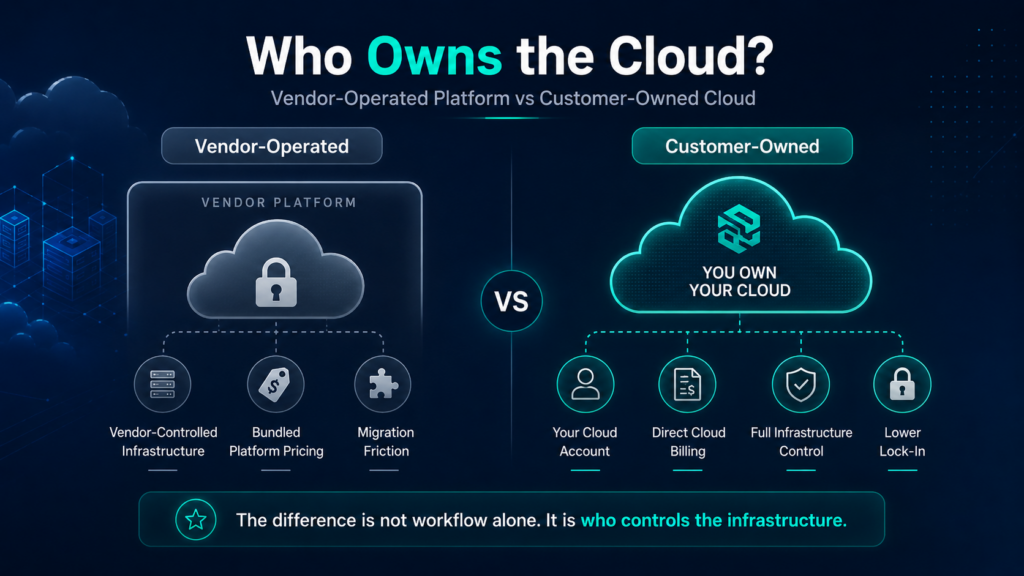
With Pantheon and Acquia, customers receive access to a managed platform. The vendor operates the infrastructure, defines the supported architecture, manages the underlying platform, and bundles infrastructure into the commercial relationship.
This can be convenient. Teams do not need to design or operate their own cloud environment, and the vendor takes responsibility for many infrastructure-level concerns.
The trade-off is control.
Customers generally cannot make unrestricted infrastructure changes, select every underlying cloud service, negotiate infrastructure costs directly, or redesign the architecture beyond the options provided by the platform.
DevPanel uses a Bring Your Own Cloud model.
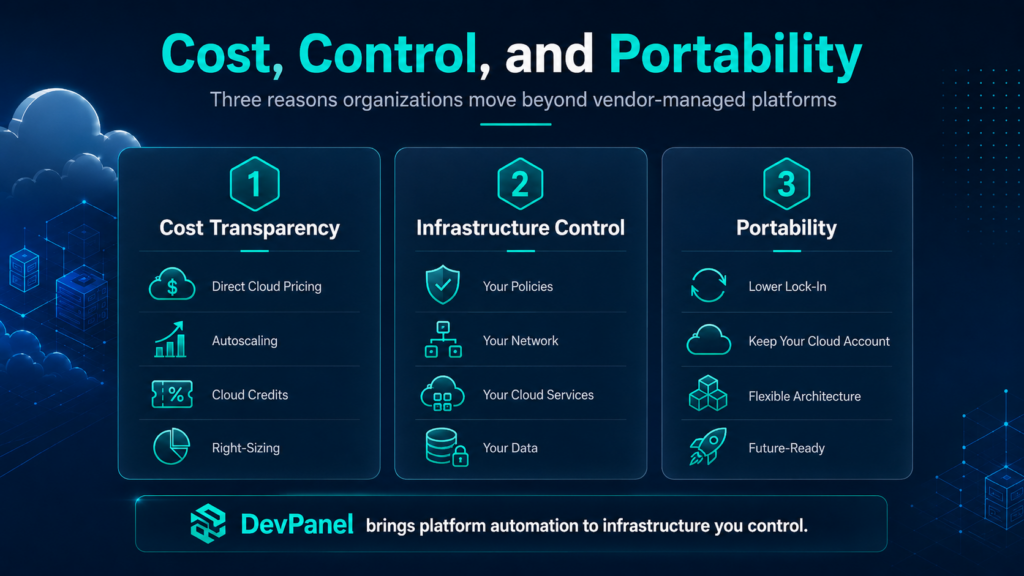
Your applications can run inside your organization’s own cloud account. Your team retains control of:
- The cloud provider relationship
- Infrastructure billing
- Data location
- Network architecture
- Access policies
- Resource sizing
- Security services
- Backup policies
- Monitoring systems
- Scaling rules
- Cloud credits and negotiated discounts
DevPanel provides the orchestration and automation layer on top of that infrastructure.
This gives organizations a third option between traditional managed hosting and building an internal platform from scratch.
You do not have to surrender control to receive automation, and you do not have to assemble a large DevOps team simply to operate your own cloud environment.
Pantheon: Strong WebOps inside a managed platform

Pantheon is a strong choice for organizations that want standardized website operations without managing the underlying infrastructure.
Its platform is centered on WordPress, Drupal, and Next.js, with established workflows for development, testing, deployment, and governance.
Pantheon’s Dev-Test-Live model gives teams a predictable release path. Its Multidev capability allows developers to create independent environments containing their own code, database, and files. This is especially useful for agencies, marketing teams, universities, and organizations managing multiple website initiatives.
Pantheon may be the stronger fit when:
- Your portfolio is centered on WordPress, Drupal, or Next.js
- You prefer a vendor-operated infrastructure model
- Your teams want opinionated, standardized website workflows
- You do not require administrative control of the underlying cloud environment
- Infrastructure customization is less important than platform simplicity
The principal limitation is not that Pantheon lacks modern tooling. It is that the tooling operates within Pantheon’s platform boundaries.
When an organization needs direct cloud ownership, extensive infrastructure customization, broader application support, or direct control over cloud spending, those boundaries may become restrictive.
Acquia: Enterprise Drupal with governance and compliance
Acquia remains one of the strongest options for large organizations that want an enterprise Drupal platform.

Acquia Cloud Platform provides Drupal-optimized hosting, development workflows, Kubernetes-native scaling, Cloud IDE capabilities, GitLab-based Code Studio tooling, and a broad ecosystem of digital experience products.
Acquia also has a substantial compliance story. Its platform supports organizations operating under demanding governance and regulatory requirements, and its formal certifications are important for buyers that require a vendor-managed, audited platform.
Acquia may be the stronger fit when:
- Drupal is the organization’s strategic CMS
- You want a vendor-managed Drupal platform
- Formal platform certifications are central to procurement
- You require Acquia Site Factory or related Acquia products
- Your organization values an integrated digital experience suite
- You are comfortable operating within Acquia’s platform model
The trade-off is similar to Pantheon’s.
Acquia manages the infrastructure and defines the platform boundaries. Organizations gain enterprise support and a mature Drupal ecosystem, but they do not receive the same level of cloud ownership or architectural freedom available in a customer-controlled cloud model.
DevPanel: Platform automation in your own cloud
DevPanel is designed for organizations that want the operational advantages of a managed platform without placing their infrastructure inside a vendor-controlled hosting estate.
It provides a centralized control layer for building, deploying, cloning, scaling, and managing applications across development, testing, staging, and production environments.
Teams can use DevPanel to automate:
- Cloud infrastructure provisioning
- Development, testing, staging, and production environments
- Browser-based development with VS Code
- Git-based deployment workflows
- CI/CD pipelines
- Application and database cloning
- Blue/green deployments
- Backups
- SSL certificate management
- Security configuration
- Monitoring and logging integrations
- Resource scaling and optimization
The infrastructure can remain inside the customer’s own cloud environment.
This makes DevPanel particularly valuable for organizations that want to modernize their operations but do not want to choose between two extremes:
- Accepting the restrictions and bundled costs of a vendor-operated platform
- Hiring a large internal cloud and DevOps team to build everything independently
DevPanel provides the automation layer between those two models.
Reduce infrastructure dependency and vendor lock-in
Vendor lock-in is not simply about whether code and databases can be exported.
Most reputable platforms allow customers to retrieve their application data. The deeper form of lock-in is operational dependency.
Over time, teams adapt their processes, architecture, deployment workflows, environments, and support model to the provider’s platform. Moving away can require more than transferring files. It may require reconstructing the entire operating model elsewhere.
With a Bring Your Own Cloud architecture, the underlying cloud account remains under the customer’s control.
The organization retains its:
- Cloud resources
- Network configuration
- Databases
- Storage
- Security policies
- Monitoring systems
- Cloud-provider agreements
- Reserved capacity
- Credits and discounts
- Infrastructure history
DevPanel can provide the interface and automation without becoming the permanent owner of the infrastructure.
This reduces the cost of future change and gives the customer more negotiating power.
The goal is not merely to make migration possible. It is to prevent the platform from becoming the only party capable of operating the environment.
Move beyond a CMS-specific operating model
Pantheon has expanded beyond traditional Drupal and WordPress hosting by adding support for Next.js. Acquia also supports modern Drupal architectures and Node.js development through parts of its platform.
However, both platforms remain strongly connected to their core CMS ecosystems.
DevPanel is designed around application orchestration rather than a single CMS.
Organizations can use the same operational model to manage Drupal, WordPress, Backdrop, Node.js applications, APIs, and other supported containerized workloads.
This matters for organizations whose portfolios are becoming more diverse.
A university may operate Drupal for its primary website, WordPress for departmental sites, Node.js for internal applications, and a decoupled frontend for a new digital service.
An agency may support different technologies for different clients.
An enterprise may need to manage CMS applications alongside portals, APIs, internal tools, and custom services.
Instead of adopting a different hosting platform for every technology, DevPanel provides a common layer for environments, deployment, access, automation, and infrastructure management.
Modern development without rebuilding DevOps from scratch
All three platforms provide valuable development workflows.
Pantheon offers its established Dev-Test-Live pipeline and Multidev environments. Acquia offers Drupal-focused environments, Cloud IDE, Code Studio, and automated CI/CD capabilities.
DevPanel’s distinction is that its development and deployment workflows can operate within infrastructure the customer controls.
Developers can work in browser-based VS Code environments without spending days configuring local development systems. Teams can create environments from branches, clone applications and databases, test changes independently, and promote approved releases through automated pipelines.
Organizations can also integrate their preferred CI/CD systems and deployment practices rather than being limited to one proprietary workflow.
This is particularly useful for teams that need:
- Custom deployment scripts
- Security scanning
- Automated testing
- Visual regression testing
- Approval gates
- Infrastructure-specific deployment rules
- Blue/green releases
- Rollback procedures
- Integration with existing Git and CI/CD tools
The platform accelerates delivery without forcing every organization into the same operational pattern.
Scale the operating model, not just the websites
Pantheon and Acquia both provide strong capabilities for managing large website portfolios.
Pantheon offers portfolio governance and repeatable WebOps workflows. Acquia supports enterprise Drupal portfolios, multisite deployments, and Site Factory use cases.
DevPanel approaches scale more broadly.
It can standardize how applications, environments, templates, deployments, and cloud resources are operated across a portfolio.
That allows teams to create repeatable application blueprints containing:
- Approved infrastructure configurations
- Security controls
- Development tools
- Deployment workflows
- Monitoring integrations
- Backup policies
- Scaling rules
- CMS or application code
- Required services and dependencies
Instead of configuring every new project independently, teams can launch new applications from standardized templates.
DrupalForge demonstrates the scale of this model. Built on DevPanel, it can create cloud development environments in seconds and scale from a small number of sites to a large temporary fleet for training, testing, demonstrations, and community events.
The result is not simply faster site creation. It is a repeatable operating system for launching and managing applications.
Compliance: Two different models
Compliance should not be reduced to a simple checklist.
Acquia provides a vendor-managed platform with formal certifications and authorizations. This can be a major advantage for organizations that need to procure a pre-certified Drupal platform.
Pantheon also provides centralized security, governance, and platform controls designed for enterprise website operations.
DevPanel offers a different compliance model.
Because the infrastructure can run inside the customer’s own cloud account, organizations can design the environment around their own:
- Identity and access systems
- Network requirements
- Data residency policies
- Encryption standards
- Monitoring tools
- Security services
- Audit requirements
- Cloud-provider controls
- Incident response procedures
This can be valuable for organizations that must maintain direct authority over their infrastructure and data.
However, using DevPanel in AWS, Azure, or another compliant cloud does not automatically transfer every cloud-provider certification to the application or organization. Compliance still depends on the architecture, implementation, controls, procedures, and managed-service scope.
The advantage is control and adaptability, not automatic certification.
Compare total cost, not only subscription prices
Pantheon and Acquia bundle infrastructure, platform software, operations, and support into their commercial services.
That can simplify procurement, but it can also make it difficult to separate the cost of infrastructure from the cost of the platform and service layer.
DevPanel allows the cloud provider to bill the customer directly.
This gives organizations visibility into the actual cost of:
- Compute
- Databases
- Storage
- Bandwidth
- Backups
- Load balancing
- Monitoring
- Security services
- Development environments
It also allows organizations to use cloud-provider credits, negotiated agreements, reserved capacity, autoscaling, resource right-sizing, scheduled environments, and other cost controls.
The savings will vary by application and organization. Traffic, support requirements, architecture, availability targets, compliance obligations, and migration complexity all affect total cost.
However, the potential difference can be substantial.
In one evaluation for a large government news organization, four sites on Acquia were costing approximately $1 million annually. The estimated cost of operating a much larger portfolio on AWS with DevPanel was less than $200,000 annually, including additional operating buffers.
That represented projected savings of more than 75%.
The strategic point is not that every organization will save the same percentage. It is that direct cloud ownership gives customers access to cost levers that are often unavailable inside a bundled managed platform.
Real-world DevPanel results
More than 75% projected hosting savings
A U.S. government news organization evaluated DevPanel and AWS as an alternative to Acquia for a portfolio serving between one and two billion monthly pageviews.
The AWS environment also successfully handled load tests exceeding one million requests per minute.
More than 30 websites managed by one person
The Academy of Model Aeronautics used DevPanel to move more than 30 Drupal, WordPress, and Backdrop websites to AWS.
DevPanel automated the underlying infrastructure and gave the organization a centralized interface for managing environments, deployments, security, and operations.
Work that previously required multiple people and outside hosting support could be handled by one member of the web team.
Infrastructure deployed in minutes instead of months
During an initial demonstration, DevPanel created development, staging, and production environments with deployment automation in approximately 17 minutes.
HIPAA-aligned Azure architecture
The project included multiple environments, Azure-managed services, security integrations, backups, monitoring, and architecture designed around HIPAA requirements.
Infrastructure that could have required weeks of specialized Azure work was provisioned through automation in less than 30 minutes.
Which platform should you choose?
Choose Pantheon when:
- You want a fully managed platform for WordPress, Drupal, or Next.js
- You value standardized WebOps workflows
- You want the provider to operate the underlying infrastructure
- You do not require extensive infrastructure customization
- Pantheon’s workflow and governance model fits your organization
Choose Acquia when:
- Drupal is central to your digital strategy
- You want an enterprise Drupal platform and product ecosystem
- Formal platform certifications are important to procurement
- You need Acquia Site Factory or related Acquia products
- You prefer Acquia to manage the infrastructure
Choose DevPanel when:
- You want applications to run inside your own cloud account
- Infrastructure ownership and direct cloud billing are strategic requirements
- You need to support multiple CMS platforms or custom applications
- You want flexible CI/CD and deployment workflows
- You need greater control over architecture, security, and cloud services
- You want to reduce dependence on vendor-owned infrastructure
- You want platform automation without building an internal platform from scratch
Frequently asked questions
Is DevPanel a hosting company?
DevPanel is an application orchestration platform. It provisions and manages applications and environments on supported cloud infrastructure. Customers can operate DevPanel themselves or combine it with managed cloud and DevOps services.
Does DevPanel replace AWS or Azure?
No. DevPanel runs on top of cloud infrastructure and automates much of the work required to provision, configure, deploy, and manage applications. The cloud provider continues to supply the underlying infrastructure and managed services.
Does DevPanel require an internal DevOps team?
Not necessarily. DevPanel is designed to make cloud infrastructure accessible to development and web teams that do not have extensive Kubernetes, AWS, or Azure expertise. Organizations can also use DevPanel Managed Services for architecture, migration, operations, and support.
Can DevPanel support Drupal and WordPress?
Yes. DevPanel supports Drupal, WordPress, and additional supported CMS platforms, frameworks, and containerized web applications from a centralized dashboard.
Can DevPanel migrate applications from Pantheon or Acquia?
Yes. Migrations can be completed in phases, with cloned environments, testing, performance validation, security review, and planned production cutover.
Will every organization save 60% to 80%?
No fixed savings percentage applies to every organization. Savings depend on infrastructure, traffic, support, compliance, architecture, and current platform pricing. Large organizations with expensive managed-platform contracts may have the greatest opportunity to reduce costs.
The strategic shift
Pantheon and Acquia remain capable platforms.
The decision is not between modern and outdated technology. Both vendors provide sophisticated development workflows, managed infrastructure, governance, and scaling.
The real decision is about the operating model.
Do you want the platform vendor to own and operate the infrastructure?
Or do you want the platform to automate infrastructure that remains under your control?
Pantheon and Acquia optimize the vendor-managed platform model.
DevPanel offers a path toward customer-owned application orchestration — combining cloud ownership, development automation, deployment flexibility, centralized management, and optional expert support.
For organizations seeking greater control over infrastructure, architecture, costs, and long-term direction, that is not a minor feature difference.
It is a different category of platform.
Take control of your application infrastructure
See how DevPanel can help your organization migrate from Pantheon or Acquia, operate applications in your own cloud account, and build a more flexible development and deployment platform.