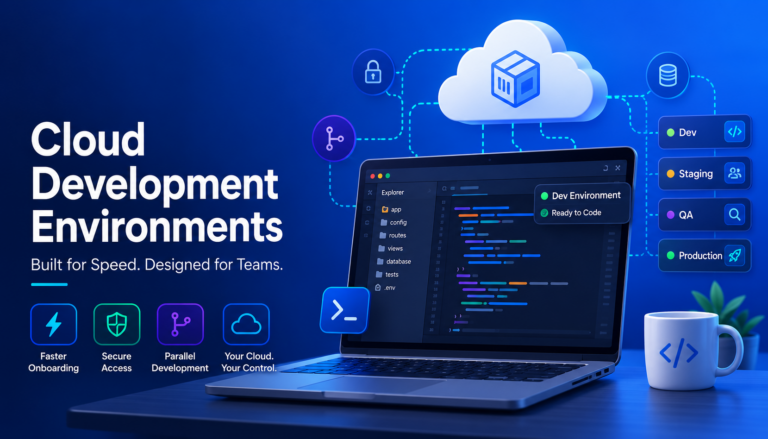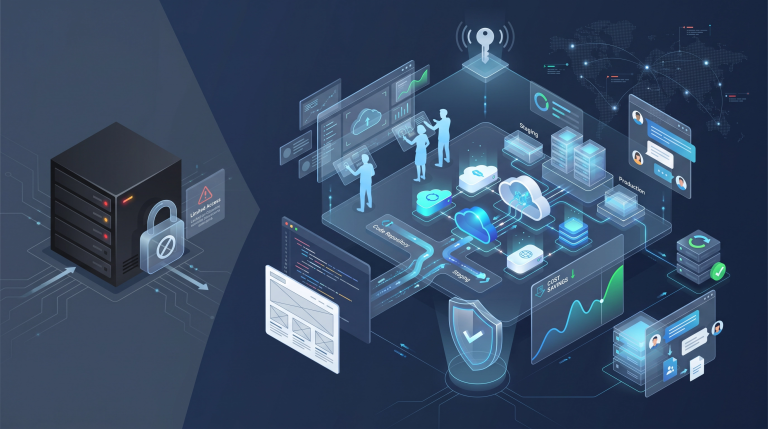
Illustration of a laptop with a cloud-based code editor, connected to development, staging, QA, and production environments.

Cloud Development Environments: The New Standard for Developer Velocity

Why the future of software engineering is moving from fragile local setups to standardized, browser-based cloud workspaces. Cloud development environments are rapidly moving from early adoption to mainstream engineering practice. The reason is simple: they solve the everyday problems that slow software teams down — broken local setups, slow onboarding, inconsistent environments, scattered access, and…

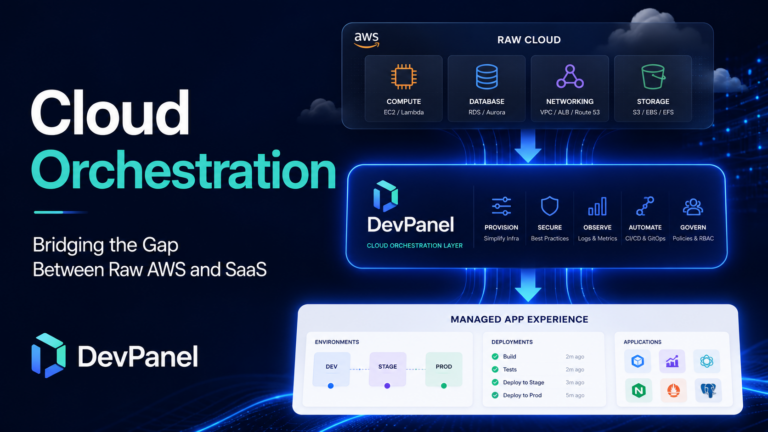
Cloud orchestration graphic showing DevPanel bridging raw AWS infrastructure and managed SaaS-style application workflows.

Cloud Orchestration: Bridging the Gap Between Raw AWS and SaaS

Cloud teams often feel trapped between two imperfect choices. On one side, there is raw cloud infrastructure: AWS, Azure, DigitalOcean, Kubernetes, databases, storage, networking, security rules, deployment pipelines, monitoring, backups, and scaling. This gives you power and control, but it also creates operational complexity. On the other side, there are managed SaaS hosting platforms. They…

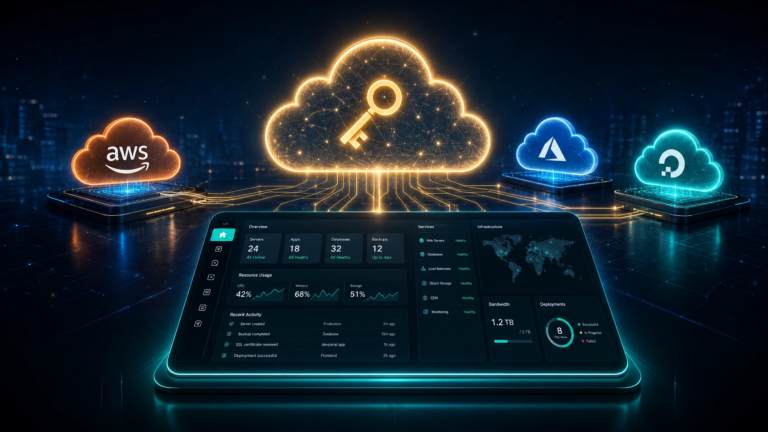
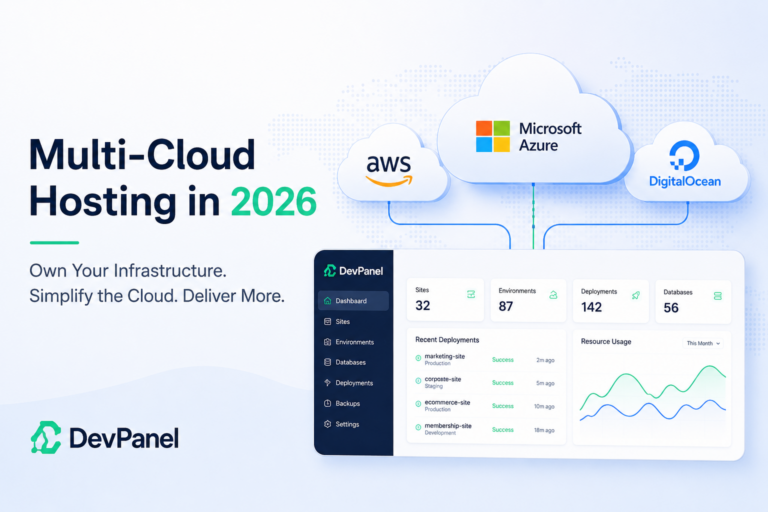
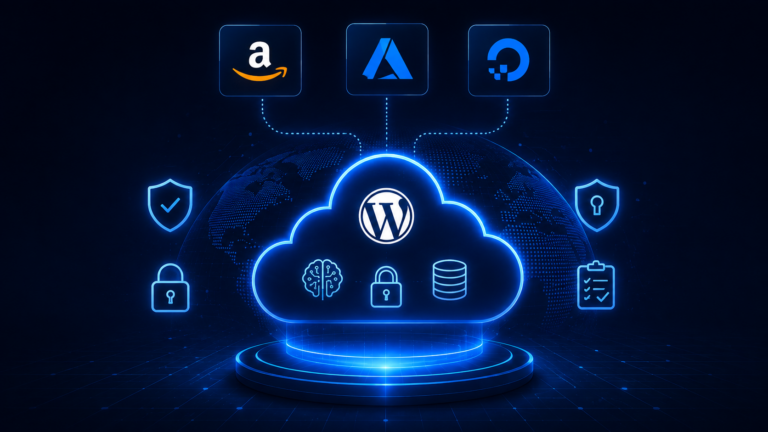
Featured image for “Multi-Cloud Hosting in 2026” showing DevPanel connecting AWS, Microsoft Azure, and DigitalOcean clouds through a unified infrastructure dashboard.

Multi-Cloud Hosting in 2026: Own Your Infrastructure Without Managing Cloud Complexity

Multi-cloud hosting is becoming a serious strategy for organizations that want more control over cost, performance, compliance, and vendor risk. For years, many website teams had only two realistic options. They could use a traditional managed hosting platform and accept its limits, or they could move directly to AWS, Azure, or DigitalOcean and take on…

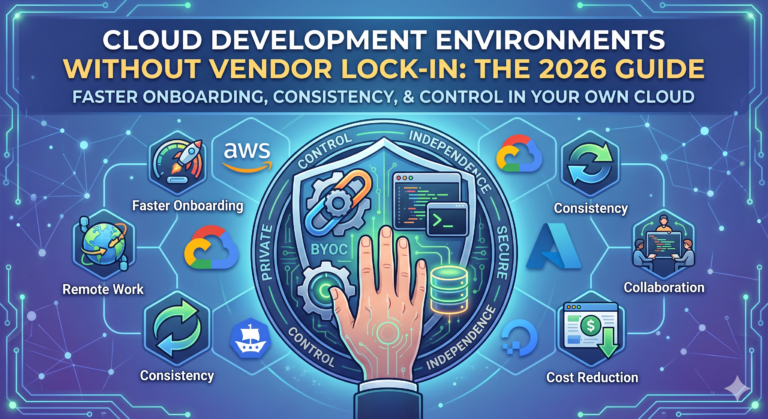
Infographic diagram demonstrating Bring Your Own Cloud (BYOC) Cloud Development Environments (CDE) with icons for faster onboarding, remote work, consistency, cost reduction, and collaboration alongside AWS, Azure, Google Cloud, and DigitalOcean logos surrounding a central shield representing control and independence.

Cloud Development Environments Without Vendor Lock-In: The 2026 Guide

For years, software engineering organizations were forced to choose between two fundamentally flawed development models: building directly on physical laptops (with fragmented environments and slow onboarding), or embracing the first generation of managed Cloud Development Environments (CDEs) which meant surrendering infrastructure control and locking into aggressive vendor markups. In 2026, this binary tradeoff is obsolete….

An isometric illustration shows a WordPress development and deployment pipeline on a Platform-as-a-Service, demonstrating why owning your cloud infrastructure beats managed platforms in 2026 for reliability, cost control, and security

Why Owning Your Cloud Infrastructure Beats Managed Platforms (WordPress Hosting in 2026)

Did you know that a single hour of IT downtime can cost a mid-size or large enterprise more than $300,000? In 2026, that number is exactly why we believe Why Owning Your Cloud Infrastructure Beats Managed Platforms is not just a budget conversation, it is a reliability and control conversation for every WordPress team building…

A comparison infographic between legacy proprietary platforms and modern wordpress cloud hosting on AWS with DevPanel, highlighting 75% cost savings and auto-scaling Kubernetes features

Best WordPress Cloud Hosting Infrastructure: How to Pick Your Perfect Stack in 2026

Did you know that DevPanel users on AWS report approximately 75% hosting cost savings compared to legacy enterprise platforms? Choosing the right wordpress cloud hosting for your business determines whether you scale effortlessly or get stuck with high bills and slow speeds in 2026. Key Takeaways Feature Description Best for Savings AWS with DevPanel offers…

A conceptual 3D visualization of data sovereignty in a server room, comparing "Shared" hosting infrastructure with complex wiring and "Dedicated" hosting infrastructure protected by a glowing digital shield and lock icons, featuring a holographic global map and GDPR compliance checklist in the background.

Data Borders and CMS Architecture: Navigating Sovereignty in the Age of Cloud Compliance

In the modern digital landscape, the question “Where is my data?” has evolved from a simple IT inquiry into a multi-million dollar boardroom concern. For organizations deploying Content Management Systems (CMS) like Drupal and WordPress, the physical location of data is no longer the only factor—the legal jurisdiction governing that data is what defines its…